In 2026, as Donald Trump’s second term unfolds, the global geopolitical landscape is undergoing profound changes. From Venezuela to Iran, and from trade tariffs to technological competition, how to interpret Trump’s foreign policy has become a central concern among scholars of international relations.
In this in-depth interview, Diao Daming—Professor at the School of International Studies at Renmin University of China and Deputy Director of its Center for American Studies—characterizes the current state of U.S.-China relations as “layered stability.” He offers a detailed analysis of how the Trump administration, operating under a logic of “transactional realism,” is managing developments in the Middle East and the Western Hemisphere through a strategy of “selective hegemony.” He further argues that this strategic shift—marked by a return to a “new-era Monroe Doctrine”—is the key to understanding the present condition of “layered stability” in U.S.-China relations.
This interview was conducted before the U.S. and China mutually agreed to postpone President Trump’s visit to China due to the ongoing conflict with Iran. As of now, the visit has not been cancelled, and the overall stability of U.S.-China relations has not been severely impacted by China’s relative neutrality on the war. We assume the new dates of the visit will not be announced until there is certainty on the outcome of the war.
Juan Zhang (JZ): President Trump is about to visit China, marking one of the most watched diplomatic moves of his second term. Some observers believe that compared to his first term and the Biden administration, the overall tension in Sino-US relations seems to have eased. You previously characterized Trump 2.0’s foreign policy as “transactional realism.” How is this logic specifically reflected in Sino-US relations? What is the biggest difference compared to the competitive model of the Biden era?
Diao Daming (DD): Since the start of Trump’s second term, Sino-US relations have maintained a rare “overall stability,” avoiding a continued free-fall. This represents a degree of stability seldom seen since 2017.
This stability is due, on one hand, to China’s consistent stance in Sino-US relations and its accurate assessment of Trump’s second-term domestic and international agendas. Furthermore, China has utilized policy tools in economic and trade interactions to ensure a state of “mutual deterrence” (ensuring reciprocal leverage) within global industrial and supply chains. On the other hand, it stems from new shifts in Trump’s second-term China policy. For instance, Trump believes that “Making America Great Again” requires solving internal issues and necessitates a favorable external environment; he views MAGA and China’s own development as potentially non-interfering. Additionally, since returning to the White House, Trump’s investment in geopolitical hotspots has outweighed his investment in a specific China or regional strategy. Moreover, Trump holds absolute dominance over China policy, focusing primarily on economic and trade issues, which has effectively stabilized bilateral relations.
Of course, this “overall stability” is more accurately described as “layered stability.” In fields involving core international competitiveness, such as technology, the U.S. continues to push for decoupling. In areas of vital mutual interest, like trade and economy, both sides are negotiating while maintaining mutual leverage, gradually achieving compromise and cooperation. On sensitive issues capable of triggering uncontrollable conflict or irreconcilable differences (such as the Taiwan question, human rights, Hong Kong, Xinjiang, and Tibet), there has been no “spillover” or unnecessary provocation. These layered, multi-faceted dynamics are sufficient to maintain the general stability of the relationship.
JZ: From a realistic perspective, what specific outcomes or understandings must be reached during this summit to maintain this relative stability? Is a “new equilibrium” possible in trade, tech restrictions, the Taiwan question, or military communication?
DD: The overall stability of 2025 has laid a solid foundation for 2026. Both sides should continue working to reinforce this steady trajectory. Specifically, following the aforementioned “layered” approach: in sectors involving core national competitiveness, both sides must find common ground to offset the trend of decoupling. In the economic and trade sectors, they should further engage in dialogue, consultation and cooperation to identify broader areas and directions for mutually beneficial collaboration. In areas where no spillover has occurred, both sides—particularly the U.S.—should strictly abide by existing major commitments and not cross established red lines. Only then can Sino-US relations in 2026 move from “general stability” toward a “resilient and sustainable stability,” providing a more positive and predictable outlook for bilateral interactions.
JZ: Before the U.S. took military action against Iran, many scholars believed Trump’s second-term strategy showed a “retrenchment” trend: reduced global intervention paired with high pressure in trade and tech. However, the military action against Iran suggests the U.S. is still willing to use force in key regions. How do you interpret this seemingly contradictory foreign policy behavior?
DD: Judging by the National Security Strategy or the external actions of the second Trump administration, U.S. strategy is not one of simple “retrenchment.”
Overall, the Trump administration’s foreign strategy is more of a “recalibration” or “adjustment”—a posture of selective hegemony. The administration lacks interest in regions or issues deemed irrelevant to core U.S. interests and thus allocates no resources there. Conversely, it continues to invest heavily in regional issues considered vital to U.S. core interests. This is selective hegemony. The key, then, is how these “core interests” are defined—that is the starting point of the selection. Furthermore, the definition of core interests may shift at any time. This is why the Trump administration emphasizes maintaining a lead in core competitive areas like the economy, military, and technology—to ensure the “America First” capability to maximize U.S. interests in any vital region or agenda.
Precisely because of this selective hegemony, the Trump administration reprised its previous work by refocusing on Venezuela. After four months of preparation, it opted for a “decapitation-style” military strike. This action was clearly driven by an “inward-looking” orientation, fitting the political aesthetic of the MAGA movement: it must serve perceived core interests without sinking back into a “forever war quagmire.” It is an expression of restrained interventionism.
Evidently, the initial success in Venezuela provided Trump with a stimulus that may have been misinterpreted. Having repeatedly emphasized his role as a “mediator” and “peace president” in 2025 without receiving a positive response from the international society, Trump seems to have turned to other methods to forge his second-term geopolitical legacy: namely, uprooting long-standing geopolitical “holdouts.” From this perspective, following the action in Venezuela and facing the current situation in Iran—alongside repeated lobbying from Israel—Trump ultimately chose military action against Iran. From what is known, this decision was based on the assumption of a quick victory similar to the Venezuelan operation. There was insufficient estimate of the risks of a protracted conflict or the impact of a potential blockade of the Strait of Hormuz on the global economy. This led directly to the current predicament.
A flaw in decision-making on a single issue reflects deficiencies with the decision-maker and their team, but it does not necessarily indicate a change in strategic direction. However, the consequences of such decisions and what they mean for the implementation of the broader strategy require long-term observation.
JZ: Is Trump’s second-term policy strategic retrenchment or a more selective global intervention? How will this model affect the future international order?
DD: Clearly, it is not strategic retrenchment, but a form of selective hegemonic presence. This behavior is guided by the “America First” principle and reflects restrained interventionism in both goals and means.
Regarding the international order, Trump and his cabinet members have frequently mentioned a “multipolar world.” Of course, the subtext of this rhetoric is the abandonment of international responsibilities while ensuring “America First.”
Selective hegemony, by nature, still seeks to maintain unilateral dominance and maximize self-interest at all times. However, compared to the past, the discourse on a multipolar world and the increased focus on domestic American concerns provide more potential space for the world order to move in a truly multipolar direction.
In one of your articles, you mentioned that under “America First,” the U.S. has withdrawn from or weakened various international organizations. This could lead to an “America Alone” scenario or a new form of unilateralism. What exactly do you mean by “selective hegemony,” and how does it differ from the U.S.-led rule-based international order after the Cold War?
DD: One could argue that all hegemony is selective — choosing to do this while choosing not to do that. However, the reason I emphasize “selective hegemony” is that the Trump administration’s choices are measured against the standard of “America First” and originate from the domestic interests as understood by Trump or the MAGA movement. This differs significantly from the traditional long-term hegemony that used to focus on promoting specific values, providing global public goods, and constructing international systems.
JZ: The U.S. has a two-party system, and many Democrats disagree with Trump’s policies. If the White House changes hands, could these policies be reversed? In the long run, which parts of U.S. foreign policy are prone to change, and which have strong continuity?
DD: The Trump administration shows a clear “inward-looking” (introverted) tendency. This is driven partly by the “America First” ideology, but it also reflects long-standing American traditions of nativism and isolationism—legacies shared by both parties. Even under Biden, we saw the “Foreign Policy for the Middle Class,” which emphasized that diplomacy must serve domestic interests. To some extent, this is also a form of “America First” or “inward-looking” tendency. This continuity suggests that the U.S. is entering an “inward-looking cycle,” prioritizing its own tangible interests. If this trend holds, even a Democratic president in 2029 would likely maintain this posture. It might not be called “America First,” but it certainly won’t return to the pre-2017 posture. Of course, even if a bipartisan consensus on this inward shift emerges, there is likely disagreement on who at home benefits from the resources brought back from abroad.
JZ: You have long studied the U.S. Congress. Amidst “America First” and “New Era Monroe Doctrine” rhetoric, has Congress’s stance on the Taiwan question changed? Are there new policy ideas or debates emerging within Congress?
DD: Compared to the relatively pragmatic attitude of the Trump administration under the overall stability of 2025, Congress—especially Republicans—has continued to propose many negative China-related bills, including those involving Taiwan. This reflects the fragmented nature of congressional politics.
The result is that American political figures exhibit a certain “double-dealing” in China-related affairs. This is clearly not conducive to maintaining stability. It means we must remain clear-headed: while the relationship is currently stable, the posture of strategic competition remains. We must balance active engagement with “bottom-line thinking” (preparing for the worst).
JZ: You have studied Trump’s cabinet members in depth. How do you evaluate the roles of Vice President Vance and Secretary of State Rubio? Specifically regarding China, where is their influence reflected?
DD: Public records show that Rubio has a more extensive and negative track record regarding China in Congress. However, it is certain that, so far, the overall direction of China strategy and policy is dictated by Trump himself. This dynamic is actually a positive factor for the stability of the relationship.
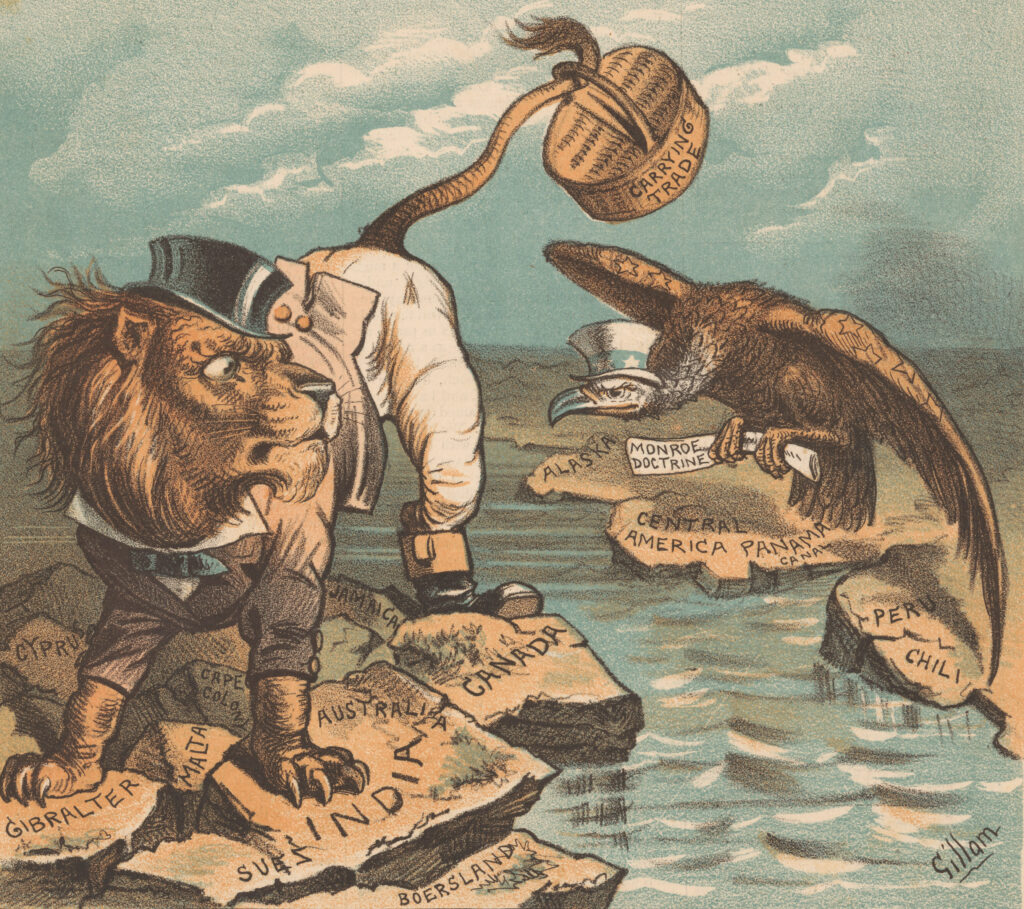
JZ: When the Monroe Doctrine was first proposed, the U.S. was an emerging power; today, it is a superpower with global interests. Is it truly possible for the U.S. to return to a “New Era Monroe Doctrine”—focusing primarily on the Western Hemisphere? Or is this more of a political slogan than a viable long-term strategy?
DD: In the 250 years since the signing of the Declaration of Independence, the period during which the U.S. has expanded its presence on the international stage has clearly not been the majority; on the contrary, it actually spent more time looking inward, even practicing isolationism and the Monroe Doctrine. Given this reality, it is difficult to judge which state is the “norm.” Even if both are norms, periodic shifts between them are entirely possible.
In fact, the process of U.S. expansion was the process of its ideology overflowing from the national framework to the world; the inward-looking process is the return of that ideology to the national framework. This framework might be the U.S. itself, or it might include the Western Hemisphere (especially the Caribbean)—the region upon which the U.S. originally built its rise and would seek to base its resurgence. This return might be the process of the U.S. becoming a “normal” state, or perhaps, it is simply the country returning to its natural state.