
The “Made in China” label is ubiquitous in American consumer products. From textiles to technologies, the U.S. has increasingly identified “Made in China” as a threat to domestic industrial strength—but how did the world’s largest communist state become a manufacturing superpower in global capitalism?
None of this was inevitable, writes Dr. Elizabeth Ingleson. US businesspeople spent centuries eyeing China’s massive consumer market, and as economic interests converged—cheap labor for US manufacturing operations and money to accelerate China’s industrial development—a transformation occurred at the expense of working-class people. Dr. Ingleson agreed to an email interview with the U.S.-China Perception Monitor to explore how, exactly, modern global capitalism came to be.
Elizabeth O’Brien Ingleson is an assistant professor of international history at the London School of Economics, specializing in the histories of U.S. foreign relations, U.S.-China relations, capitalism, and labor. Ingleson earned her doctorate at the University of Sydney and held fellowships at Yale University, the University of Virginia, and Southern Methodist University. She is the author of Made in China: When US-China Interests Converged to Transform Global Trade (Harvard University Press).
To start, please give a brief overview of your findings in your book “Made in China: When US-China Interests Converged to Transform Global Trade.” What were your foremost findings regarding the joint transformation of the Chinese and American economies amidst and following détente in the ‘70s and ‘80s?
Elizabeth Ingleson: The book starts with a puzzle: how and why did China, the world’s largest communist nation, become such an integral part of the global capitalist system? This is something that is worth problematizing rather than accepting as a natural or inevitable process, particularly given our vantage point in 2026, when we could easily take for granted that China is such an important economic player. Most scholars who examine China’s engagement with the capitalist order will point to the reform and opening Deng Xiaoping announced in late 1978, and for good reason: the post-1978 changes within China were indeed crucial to this process. But scholars whose main focus is China have tended to pay less attention to the capitalist system with which China began to engage. In order for China to converge with global capitalism, the United States—the largest and most powerful player in the capitalist system—needed to accommodate China’s needs.
So, my interest was in bringing these two dynamics together: the changes happening within China as well as those happening within US capitalism. And I found that even before Deng’s reforms, Chinese reformers began to experiment with ways of integrating China’s own development goals with processes that were underway within the United States and accelerating in the 1970s: the internationalization of manufacturing through cheap offshore labor and emerging supply chains. American businesspeople had already begun slowly internationalizing their manufacturing before trade with China reopened. In the 1950s and 1960s, they turned to non-communist sources like Japan and, later, Taiwan. In the 1970s, China’s leaders began to adapt to these emerging dynamics, and in the process, they slowly transcended the Cold War divisions that had so long divided China and the United States.
This transcendence of the Cold War divisions is the second key puzzle I grapple with. In most parts of the world, the Cold War ended in the late 1980s when the Soviet Union collapsed, and the U.S.-led vision of neoliberal capitalism became the key organizing principle for social development. But in the case of U.S.-China relations, the Cold War ended without systemic collapse in either nation. Instead, Cold War divisions between these two nations fizzled out during the 1970s through a gradual convergence of interests between US capitalism and Chinese communism.
The history I tell can’t be told without exploring the decisions and actions happening in both countries. I wasn’t able to make sense of the changes happening within the U.S. business community trading with China without looking deeply into what was happening in China. And the reverse is also true. The ways that Chinese pragmatists started to experiment with ways of integrating with the capitalist system necessitated an understanding of changes happening in the post-Bretton Woods United States. In that sense, it’s very much a transnational story—one that had a wide-reaching impact on global capitalism and trade.
How does the U.S.-China relationship today differ from the time period you analyzed? What can we learn about the current state of U.S.-China relations and the related business interests from the history you have outlined in your book?
EI: There are quite fundamental differences between the U.S.-China relationship of the 1970s that I examined and the relationship today. These differences are so stark precisely because of the changes that occurred throughout the 1970s. The internationalization of manufacturing fundamentally altered the way that goods are made, distributed, and sold. From our standpoint in 2026, the history that my book tells of converging interests between the United States and China reads more and more like a story of a very different era. But when I first started this research, in the early 2010s, there were still hopes that the interdependent trade relationship might help bring about positive geopolitical relations. In the space of a decade, a lot has changed. Living through ten years as I researched and wrote about a different ten-year period really brought home to me how much can change in a relatively short period of time due to decisions—and shared visions—of those with more political and economic power than others.
The transformation of both nations’ economies, as you outline in your book, arose out of close coordination and mutual effort between the United States and China, both in the political and business worlds. Today, though, tensions between the two nations make such coordination nearly unthinkable. How did this cross-Pacific coordination come about, and what should be the key takeaway?
EI: For centuries, US and European businesspeople had seen in China the promise of a huge consumer market, what one US businessman famously described in the 1930s as “400 million customers.” To them, China trade meant expanding exports. In the 1970s, US and Chinese traders together reframed the meaning of the Chinese market. They began to nurture a new promise of outsourced manufacturing—a proverbial 800 million workers.
As Chinese pragmatists debated ways of accelerating China’s industrialization, they increasingly experimented with using the cash generated from sales of exports to fund their development efforts. By selling textiles and raw materials, they hoped to buy factories, airplanes, and so on. China’s huge workforce offered the potential to create cheap manufactured goods that could be sold to the United States and elsewhere, in turn generating the money needed to buy the infrastructure to accelerate China’s industrialization.
The convergence of interests happened, most particularly, in manufacturing. As American corporations internationalized their manufacturing operations to other parts of the world, they began to see China as offering the potential to join—and assist—in this process. For most of the 1970s, China did not permit foreign direct investment, but it did offer cheap labor. So the interests of Chinese pragmatists and US capitalists began to align. The consequence of this alignment was a fundamental reconfiguration of what it meant to speak of “U.S.-China trade”—no longer a Chinese market of 400 million customers, but one of workers instead.
It’s important to underscore, however, that these efforts were met with fierce opposition. The 1970s were a period of immense social and political upheaval in China, overshadowed by Mao’s illness and eventual death in 1976. There was no certainty that these halting efforts in the 1970s would continue. It’s easy, I think, from today’s perspective to consider China’s convergence with global capitalism to be a natural or inevitable process of economic growth and development. But the opposition to the trade relationship and problems underpinning it are precisely why it was not inevitable: trade was difficult, and profit was far from certain.
In the closing of your book, you draw attention to the lesson of this slice of history not being one of seeking to return to some now-lost economic state of being, but instead focusing on the real-time issues facing working-class people to create real and lasting change. Is this happening today? How can we better attain such a goal?
EI: There was no way of knowing in the 1970s that China would indeed become such a significant source of labor. China was extremely poor with a weak industrial base—a key reason its convergence with global capitalism was not inevitable. But signs were certainly emerging that things might be changing in China. And this came at precisely the moment US manufacturing was turning towards overseas sources of cheap labor.
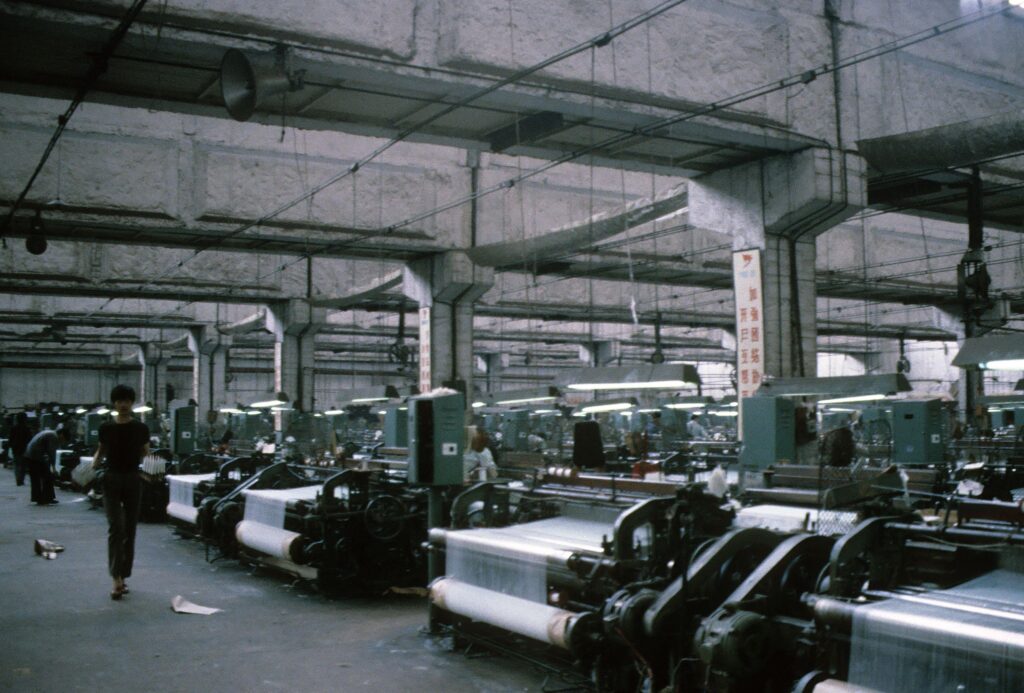
It was the US textile industry that voiced fears about China the loudest. This was an industry whose workforce was almost entirely women of color, an important reason why they were not given the attention they were pushing for. They weren’t the hard-hat-wearing men of the auto and steel industries that played a prominent role in US politics of the 1970s. But even more importantly, many of the white male leaders of the textile industry who were pursuing—on behalf of these women of color—restrictions on trade with China were calling for market order rather than fundamental reforms that would protect working Americans. The idea of moving to cheap labor overseas was not a problem, per se, for many within the textile industry. Instead, they were looking for a transition towards outsourced manufacturing that would unfold steadily, giving managers time to adjust their production lines to overseas cheap labor. Their concern was with China specifically because its communist state structures made it easier for China to undercut labor costs and dump cheap goods. Dumping was disruptive: it made it harder for US textile managers to slowly and steadily move to overseas labor.
Ultimately, Chinese leaders’ ability to lift their population out of poverty came at the expense of ununionized minimum-wage textile workers in the United States and later other industries as well. But that impact on US workers was fundamentally enabled by the decisions of industry leaders and executives at US corporations, aided by legislation in Washington. US corporations and businesspeople were therefore crucial linchpins in both China’s industrialization and the United States’ deindustrialization. In the United States, this was a deindustrialization of labor. Between the late 1940s and early 2020s, manufacturing in the United States remained relatively stable as a proportion of real GDP. The United States continues to make goods. In fact, until 2010, it was the world’s largest manufacturing country, after which it remained second only to China. It was not manufacturing that went into decline in the United States in the 1970s, but its employment: a result, largely, of new technologies used in the manufacturing process, new kinds of high-tech goods being made, and the movement of labor-intensive industries to factories overseas.
The continued focus in Washington today on the threat of “Made in China” peddles the myth that the United States is no longer a manufacturing nation, and, in the process, it removes accountability from corporate decisions that pursue low wages over all else. The problem at the heart of US industrial policy today, then, isn’t China. It’s a politics that enables these actions by prioritizing capital over labor.