
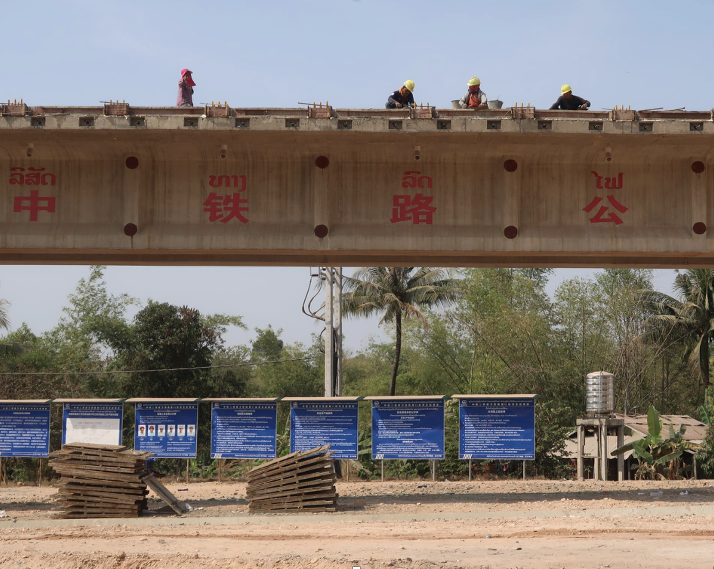
Across the Global South, China has become a significant source of funding for infrastructure and development. From perspectives in Washington, D.C., Chinese-built hydropower dams in Laos or nickel mining operations in Indonesia may be interpreted as a bid for global hegemony. But in the countries and communities where projects are constructed, there is a great deal of continuity with earlier initiatives funded by Western donors and multilaterals. Additionally, in many cases, these projects are shaped by the priorities and ambitions of host countries themselves rather than by China alone. Thus, the meanings and significance of Global China vary widely across places and scales. The Monitor spoke with Jessica DiCarlo about China’s role in global development, environmental leadership, globalization, and the rush for critical minerals.
Jessica DiCarlo is an Assistant Professor in the School of Environment, Society & Sustainability and Faculty in Environmental Humanities and Asian Studies at the University of Utah. She co-founded the Second Cold War Observatory, and is a 2023-25 Public Intellectual Program Fellow with the National Committee on US-China Relations and 2023-24 Wilson China Fellow. She researches Global China, development, and infrastructure as well as the geopolitical economy of U.S.-China competition. Her work can be found in Dialogues in Human Geography, Nature Energy, Antipode, Progress in Human Geography, Transactions of the Institute of British Geographers, Geoforum, Ecology and Society, Geopolitics, Globalizations, and more. She uses multi-sited, multi-scalar, and multi-lingual research methods, and relies on ethnography to connect meticulous, ground-level cases with global processes.
Isobel Li: Much of your work has focused on Global China and its composition in terms of relations and processes rather than strict geopolitical borders. Could you elaborate on this concept and Global China’s ‘paths’? Where do conventional approaches to understanding Global China and Chinese-led development fall short?
Jessica DiCarlo: I think one of the most important starting points is to move beyond thinking about Global China as simply China extending outward from Beijing as a coherent top-down project. Across my work—and the work of many brilliant scholars in this field—we approach Global China less as a bounded national project or entity and more as a set of relations, processes, and pathways that connect China to the world in highly uneven, contested, and often unexpected ways.
The paper that you’re referring to, “Six paths of Global China,” which I co-authored with Meredith DeBoom, argues that Global China is best understood as a contested geographical imaginary rather than a fixed object. We were really interested not just in what Global China is, but in how Global China has come to be understood, how it’s used and invoked, by whom, and to what ends. Global China is produced through everything from infrastructure projects and migration to trade, educational exchanges, logistics networks, digital platforms, finance, environmental governance, and much more. It isn’t reducible to the Chinese state or the Belt and Road Initiative (BRI), even though those are important parts of this story. Global China could take the form of multiple land-based projects in Laos and all the workers that come with them, a Chinese-owned mine and its environmental effects in Zambia, logistics corridors spanning continents, or even digital platforms that shape how people perceive or imagine China and its role in the world.
In the article, Meredith and I identify six paths or overlapping ways that Global China is used and understood: as Other, Integration, Bridge, Status, Threat, and Alternative. We don’t think of these as neat categories so much as different frames through which people come to understand China’s relationship to the global. Some view China as an existential threat. Others see it as a bridge for South-South cooperation or infrastructure connectivity. Still others understand global China through capitalist integration, supply chains, development finance, or even as an alternative world order. Global China looks very different depending on where you’re standing.
You also asked about the limitations of more conventional approaches. Too often, I think they flatten the tensions that we try to bring out in the paper. Discussions of Chinese-led development often fall into two camps: either celebrated as a benevolent alternative to Western development or portrayed primarily as a geopolitical threat. Both miss the messy middle ground where Global China is negotiated, improvised, and experienced in ways that rarely fit neatly into either narrative.
I also think conventional frameworks tend to overstate state coherence and understate fragmentation within China itself. Again, Global China is neither coherent nor solely state-directed. There’s a tendency, especially in policy discourse, to assume there’s some master plan emanating from Beijing for everything—from ports to dams to whatever the project is. But there is a wide range of actors to take into account, such as ministries, state-owned enterprises, provincial actors, and financiers. These all lead to really improvised, fragmented projects.
More broadly, I try to think about Global China as both transnational and relational. Its emergence is closely tied to domestic developments within China and to histories of global capitalism, imperialism, and politics that all extend beyond the nation-state. This is why it’s important not to exceptionalize Global China when many of these practices—whether resource extraction, infrastructure-led development, or debt—are embedded in longer histories and local politics. So they’re not uniquely “Chinese.” Meredith and I suggest that the task is not to treat Global China as an anomaly, but to examine how it both reflects and reshapes broader structures like racial capitalism, geopolitical rivalry, or uneven development. Our hope was to raise questions and move beyond simply threat-opportunity binaries to make room for relational, politically attentive understandings of China’s evolving role in the world
IL: China is often discussed as a globalization story—first opening up to globalization, then becoming an initiating force. But where does Global China challenge assumptions about globalization?
JD: I think Global China challenges some of the most basic assumptions embedded in conventional understandings of globalization. It is obviously deeply tied to globalization, but not in the simple linear ways we hear. The dominant story is that China was largely closed off from the world, then opened up through reform and opening after 1978, its 2001 WTO accession, and its integration into a Western-led global order before eventually becoming a globalizing force itself. There’s some truth to this narrative, but it is also a particular Western-centric way of understanding globalization.
So, there are many other ways to think about China’s relationship with globalization. Returning to “Six Paths of Global China,” for example, we try to unsettle this story. For one, China was never simply isolated from the world. China had longstanding global engagements through socialist interventions, Cold War solidarities, migration networks, and South-South cooperation, all well before WTO accession and the BRI. The notion that China suddenly “became global” in the 1970s or 2000s reflects a particular geopolitical assumption about when and how actors are recognized as global according to (typically Western) institutions, priorities, or standards.
Global China also challenges assumptions that globalization is inherently liberalizing, border-erasing, or convergent. Much of the globalization theory in the 1990s imagined a world becoming more integrated, democratic, and cosmopolitan through shared liberal norms. But even as China has become deeply embedded in global capitalism, it’s also maintained a strong party-state, pursuing expansive industrial policy and preserving distinct political and economic institutions. Integration did not necessarily produce convergence in ways expected.
A third provocation is what counts as globalization in the first place. A Global China perspective challenges the dominant economic focus of globalization. One of the paths we write about—Global China as Bridge—includes educational exchanges, migration, artistic collaborations, diaspora networks, even ties to religion and tourism, all forms of everyday encounter. These connections can sometimes be overlooked by dominant accounts of globalization that focus on states, trade flows, or geopolitics. Global China is also produced in courtrooms, jade markets, on construction sites, in universities, and communities around the world. Using Global China as a lens directs our attention to these lived and relational dimensions of globalization.
I think the present moment makes these questions even more interesting because globalization itself is being reworked. We’re living in an era of rivalry, sanctions, reshoring, expanding industrial policy, and supply chain securitization. Global China isn’t only a product of hyper-globalization. It’s also part of a world in which globalization is fragmenting and being reorganized amid focus on competition and security. So, I see China as both embedded in global capitalism and positioned as a strategic rival across those same globalized networks.
To wrap up, I think “Global China” pushes us to rethink who gets to define “the global” and who is recognized as a global actor. The global is often equated with the West or Western institutions and recognition; even to say “Global China” implies a view from the West. Why say “Global China” and not “Global America” or “Global Japan”? The very term “Global China’ reveals something about the assumptions built into how globalization has been imagined and narrated.
But at the same time, China’s growing global role in areas such as green technologies, development finance, and infrastructure is undeniably shaping the world. So, I think the question is no longer whether China is integrating into a globalized order, but how it is remaking globalization itself or producing alternative forms of globality altogether. For me, Global China offers a window into the contradictions, unevenness, and contested nature of globalization, both how it came to be and how it is transformed today.
IL: On this note of recognizing the different terms we use and the assumptions behind those terms, China continues to maintain its claim to being a “developing nation” while the U.S. rejects this label. How do China’s massive global development efforts impact perceptions of China’s positionality—if you could speak on the perspectives of the U.S., the recipient governments, and the smaller-scale communities impacted by “south-south cooperation?”
JD: I’m really interested in this tension. China is the second-largest economy in the world, and a major source of investment and industrial production. At the same time, the Chinese government continues to position itself as part of the Global South and a developing country, drawing on shared historical experiences of imperialism and underdevelopment. These claims are more than rhetorical moves on China’s part; they are rooted in China’s own development trajectory and continue to shape how China presents itself internationally.
To start, China’s contemporary global role cannot be separated from its own developmental history. In the “Six Paths of Global China” framework, one tension we identify is precisely the coexistence of China as an actor in South-South solidarity and as a great power. The claim to developing-country status is part of a broader political and historical narrative that should not be brushed aside. From the Century of Humiliation to regional inequalities, and even to the country’s remarkably rapid economic growth, these remain central to how Chinese leaders understand their place in the world.
However, from the perspective of many Western policymakers, China’s continued identification as “developing” is viewed as illegitimate or opportunistic. They argue that China cannot simultaneously claim the advantages associated with developing-country status in institutions like the WTO, while also operating as a global superpower with enormous industrial capacity or lending influence. In U.S. policy discourse, this often feeds into broader narratives about unfair competition, state capitalism, or revisionist political power. As a result, China’s development finance is frequently interpreted through the lens of geopolitical expansion or hegemonic ambition rather than through histories of south-south cooperation, which, of course, has the effect of intensifying competition.
But if we shift focus to recipient countries, the picture becomes even more complex. Many governments across Asia, Latin America, Africa, and the Pacific engage China quite pragmatically. Chinese finance and projects are often appealing because they have historically been delivered relatively quickly and with fewer overt conditionalities associated with Western donors or international financial institutions. At the same time, official discourse from China frames these relationships in terms of mutual development, non-interference, south-south cooperation, and ecological civilization. These framings are powerful and impact how states or companies decide to interact with “China.” Of course, recipient locations are not passively accepting Chinese initiatives or projects on Chinese terms.
One thing I try to emphasize across my work is that these relationships are negotiated, contested, and shaped by local politics—it’s not strictly top-down. Governments engage strategically with China to advance their own developmental or political goals, often balancing China against other powers such as India, Japan, the EU, and the U.S. In my work with Lee Jones, Shahar Hameiri, Seth Schindler, and Ilias Alami, we’ve described this as polyalignment: rather than choosing between sides, many states maintain flexibility by cultivating multiple external partners at once.
You also asked about perspectives from communities living with the material effects of projects. It’s hard to say ‘community’ writ large, but I can say that people rarely experience “Global China” as an abstract geopolitical project. They experience it through encounter: via a particular dam, mine, industrial park, or a new marketplace. Infrastructure can obviously bring roads, electricity, jobs, and various forms of connection, but it also leads to labor tensions, displacement, or debt concerns. Local perspectives are often more ambivalent than state-led narratives of cooperation or alarmist narratives of threat would suggest.
So I’d say that China’s global development efforts tend to destabilize traditional categories. China has been both a recipient of development assistance and a major financier. It is deeply integrated into global capitalism while critical of aspects of it. And it is, in many ways, both an actor in the Global South and a global power. Rather than forcing one category or another, we really need to attend to the tensions between categories, as they can tell us something important about China’s contemporary role in the world and about how development, power, and global inequality are being reconfigured in the twenty-first century.
IL: In Behind the Spectacle of the Belt and Road Initiative, you describe the complex relations and politics underlying the BRI’s grand progress narrative. Could you share more about the fieldwork experiences that guided your analysis, and if you had any moments that really surprised or challenged you?
JD: Absolutely, my views are challenged all the time. One of the biggest lessons I’ve learned from doing long-term, ethnographic, grounded fieldwork is how often your assumptions turn out to be incomplete or simply inaccurate. That’s part of why I’m so committed to these methods. When you spend years returning to the same places, you start to see layers of complexity that can be glossed over in policy or media conversations.
One thing that challenged my assumptions was how people talked about Chinese infrastructure projects in Laos. Before my fieldwork, I expected conversations to revolve around China itself—questions of sovereignty, influence, dependence, or geopolitics. And those concerns certainly existed, especially among some elites or policymakers in the capital. But in many of the places where I conducted fieldwork along the railway corridor, people were more often concerned with issues such as land acquisition, compensation, employment opportunities, or actions of local officials. In other words, their frustrations were frequently directed at local governance dynamics they had dealt with for years rather than “China.” These experiences pushed me to rethink the idea of China versus the host country and pay closer attention to internal politics and everyday forms of negotiation, which can say more than the label “Chinese project.”
Another aspect that surprised me was the experience of Chinese workers. Perhaps this shouldn’t have been surprising, given the Global China literature, but seeing how Chinese workers were treated and experienced development, was something I couldn’t have anticipated. These projects are made up of thousands of individuals whose experiences are rarely part of the story. At a Special Economic Zone at the Laos-China border, I spent significant time with workers and became fascinated by the ways they weren’t just building infrastructure but also “performing development.” During visits by investors or officials, workers would stage displays of luxury and prosperity to create the appearance of a thriving city yet-to-come. I was struck by the precarity of their days, how the timing varied, and how it wore on them. Workers would go from working one hour per day to as much as 17 hours per day. Paying attention to how Chinese people are embedded in and making these projects on everyday levels made me think differently about how development is produced, represented, and lived from the ground up.
A moment that perhaps stayed with me the most, though, was when I was sitting with a Lao woman near a section of the railway under construction, when she turned to our research team and asked, “What is the BRI?” That question stuck with me because it disrupted assumptions that the BRI is a universal category we used to explain all sorts of projects. But for her, the railway was another development project to her, and whether it belonged to something called the BRI was beside the point. This moment crystallized the argument of this chapter, that the BRI often functions as (geo)political spectacle to make sense of China’s global presence, but people living alongside projects encounter it through more immediate concerns, sometimes without China in mind at all.
Years of work in Asia have convinced me that we need to constantly break apart and reassemble categories, whether it’s the BRI or Global China, and that these interactions are constantly shifting, so we have to pay attention to how they are materially and relationally produced on the ground. That’s not to dismiss important geopolitical or larger structural questions, but to recognize how these projects are always mediated through local politics, histories, and social relations.
IL: Expanding on these impacts and perspectives surrounding the BRI, how did you observe communities in Laos and Indonesia navigating the social and economic impacts of development?
JD: One thing I always try to emphasize is that there is no single community perspective. Even within the same village or area, people experienced projects very differently depending on class, livelihood, ethnicity, age, or, for instance, whether they have a cousin in local politics. Constantly breaking apart “the community” is critical. So I’ll offer a few different perspectives on this question from people I describe as “living in the shadow of infrastructure”—those whose everyday lives are either directly disrupted by construction or development—and then those who are more indirectly connected to projects.
For many near major development projects, uncertainty can be a regular experience, as projects get paused and restarted, or compensation is delayed. In Laos, many families near projects lost access to farmland, homes, and burial grounds long before compensation arrived, if it arrived at all. People described waiting for years without clear information about compensation, construction timelines, or locations. Other villages were physically divided by projects, making everyday mobility more challenging. Infrastructure is imagined as accelerating mobility but for many, the immediate experience was one of suspension and waiting.
I saw similar dynamics in research with David Fernando Bachrach, where we compared processes of “corridorizaiton” between the Laos-China Railway and Jakarta-Bandung railway. Communities displaced by land acquisition spoke not only about losing homes or productive land, but also about losing social worlds, which we believed was important to add to the literature. Neighborhood relationships, gathering places, informal economies, and senses of belonging were disrupted. What stood out to me was that displacement was at once material as well as social and emotional—grieving loss of place and community. That said, I have to emphasize, perhaps obviously, that there is value in infrastructure and connectivity. It would be inaccurate to portray communities as simply losing out on or rejecting projects. When I returned to Laos after the railway was operational, I met people who were thrilled at the ability to travel safely across the country in a fraction of the time it once took.
What I find fascinating is the unevenness of benefits and experiences of connectivity. Some residents still struggled to access train stations. One person told me that the train is very fast once you’re on it, but getting to it is the difficult part. So there is this idea that corridors develop frictionless connections, but they are marked by chokepoints, detours, and waiting at different scales.
IL: Turning to your research on the environment, international actors may generally approve of China’s efforts at greening the BRI or pursuing other climate-related development, but your work underscores the uneven effects that are obscured in macro readings. On an individual or community level, what might be the consequences of China’s continued green development push?
JD: I think one starting point is to avoid broadly treating green development as inherently good or bad, depending on who’s doing it. Whether we’re talking about China, the U.S., the World Bank, or anyone else, it’s always critical to ask who benefits and who bears the costs and why?
At the same time, I want to emphasize that climate and environmental action are absolutely essential. We’re in the midst of climate, biodiversity, and pollution crises. Progress, especially at the global scale we need, is frankly not possible without China. Earlier this year, I co-authored an article with a group of China-environment scholars titled “China Aspires to be an Environmental Leader: How Should the Rest of the World Engage?” We argue that China has become indispensable to global environmental governance through its contributions to renewable energy, green tech, climate finance, and biodiversity initiatives. China’s green development push is producing very real contributions, if you think about the scale of solar, battery technologies, finance for renewables, or even the reduction in clean tech costs.
But green development or clean energy initiatives are not purely environmental or technical projects. They are also uneven political, social, and spatial processes. A hydropower dam may be framed as a source of renewable energy, while nearby communities experience displacement or altered river ecologies. A critical mineral project may be justified for decarbonization, even as it creates new sacrifice zones or degradation under green imperatives. So, it’s also important to avoid simply celebrating or dismissing China’s environmental role.
Another point we discuss is that China’s approach to environmental governance often emphasizes large-scale, state-led, and technocratic approaches. This capacity can be extremely effective in mobilizing resources and deploying technologies. But it can also raise questions about participation. In my fieldwork, I rarely encounter people who oppose development or environmental improvement in the abstract. People generally want reliable electricity, roads, and cleaner environments. What they often contest is how projects are implemented or how resources are extracted around them.
One issue I have become interested in is the material intensity of energy transitions. Decarbonization requires enormous quantities of minerals and metals. In recent work on what we call “just-shoring,” my co-authors and I argue that simply reshuffling supply chains through reshoring, onshoring, and friendshoring doesn’t automatically create a just transition. What’s more, extractive consequences tend to fall on marginalized people: nearly 70% of global projected energy transition minerals operations are located on or near Indigenous and agrarian lands. Holding ideas about China’s environmental role and the ill effects of extraction in tension is something I’m really working on; we have to engage China while attending to very clear, localized effects.
Finally, an important piece of this puzzle is that many “green” projects are increasingly justified through security imperatives as much as environmental ones. Critical minerals, energy technologies, and supply chains are framed in terms of national security and geopolitical strategy. So thinking about China’s green development push also means thinking about how environmental efforts are entwined with questions of power, security, and competition.
IL: You’ve been working on critical minerals and energy transitions. On this note of securitization, how have political narratives surrounding rare earth elements changed over time? Has the “green rebrand” of the critical mineral industry influenced perceptions of, or justifications for, extraction among impacted communities and international actors?
JD: We might start with a short history of the rare earths industry. Extraction and processing are predominantly concentrated in China today, in part because Western countries have effectively offshored the environmental costs. REE-producing regions in China were historically treated as sacrifice zones, where pollution and environmental degradation were tolerated to enable industrialization and export-led growth. And you’re right—we now see the language of clean energy transition affecting the rare earth sector. These materials, once associated with pollution, are now framed as indispensable for climate and cleaner energy. Earlier narratives around rare earths often centered on national security and industrial necessity, and today they’re about climate urgency as well as competition. Chinese policymakers increasingly justify extraction not simply in terms of growth but in the languages of ecological civilization and technological sovereignty. In the U.S. and EU, too, we see a national security push around rare earths.
I find it fascinating that many countries that had offshored these intensive mining processes to China are now pursuing onshoring strategies in the name of strategic advantage. Onshoring, of course, doesn’t eliminate the environmental and social consequences of mining. “Green” must be placed in quotation marks because much mining still involves significant water and soil contamination, land degradation, and labor issues. There is a real risk that climate narratives legitimize the expansion of extractive frontiers without confronting these consequences. New technologies in China are supposedly improving, but people are still experiencing serious consequences—a paper by Thaw Htoo on the local effects of Chinese rare earth mining in Myanmar in the Journal of Political Ecology underscores this.
This green rebrand has changed the moral language surrounding extraction. My recent work with Raphael Deberdt and Philippe Le Billon on the coloniality of green finance argues that decarbonization has become a new frontier of accumulation, as green capital “lands” in mineral-rich regions, transforming them into sites of sacrifice for the benefit of distant consumers and energy transitions elsewhere. In this way, the critical mineral rush risks reproducing extractive harms under the banner of energy and climate, while increasingly justified through national security and tech competition. As critical minerals are increasingly securitized, states are racing to secure these supply chains, diversify sources, and reduce dependence on China. In the case of rare earths, they have become not just commodities, but strategic assets embedded in struggles over power and technological futures.
IL: In late April, the U.S. and EU launched their partnership on critical mineral supply chains. Do you see this impacting China’s central governance strategy? And seeing that your work has emphasized the fragmentation of actual governance and implementation, how might any changes play out?
JD: I do think securitization will almost certainly shape China’s governance strategy, but I’d be careful about assuming it is primarily a move toward central control. The U.S. and its allies are pushing aggressively to diversify supply chains away from China and to build alternative systems. But these capacities of processing, refining, manufacturing, and tech expertise are so entrenched in China. I would expect Beijing to keep pushing in several directions at once. Maybe there will be more consolidation of the rare earth sector. This has already happened in many ways, including companies consolidated into the northern rare earth group, tighter export controls, and increased investment in downstream processing and high-end manufacturing. There may be stronger efforts to curb unlicensed mining or local practices that might undermine this strategy.
In our article “Fractured Extraction” in The China Quarterly, we argue that rare earth governance in China is negotiated across central authorities, provincial governments, municipalities, and SOEs. Central leaders tend to set these strategic directions, but implementation always depends on subnational actors with their own interests, such as local revenue, employment, and regional development. That means securitization could actually intensify fractures rather than resolve them. For example, if Beijing wants stricter environmental enforcement or production controls to stabilize prices or protect resources, you might simultaneously have a province or municipality that wants to expand production, attract investment, subsidize local firms, and protect jobs. In the places we examine—Inner Mongolia, Jiangxi, and Sichuan—local governments often selectively implement these central directives to align with local economic priorities, leading to slow or uneven enforcement. On top of that, we may see a tension between green governance and security governance, and I’m not sure how that’ll play out, but with the defense and advanced manufacturing imperatives, rare earths might be reframed in that way as well.
This question is also related to your earlier one on globalization. Securitization is changing economic integration as it increasingly operates through strategic networks and the emergence of what we’ve called “state capitalist geopolitics.” Others and I at the Second Cold War Observatory have done a lot of thinking on the shift toward network-oriented competition and on how global networks are being reorganized around geopolitical concerns, which I share as a shameless plug.
Finally, my bigger concern is that the securitization frame can narrow our political imagination. If critical minerals are framed in terms of national security competition, we lose sight of questions about labor, sovereignty, justice, environmental health, or even demand reduction. We’re focusing on the supply side. I think rather than greater coherence, securitization is generating new tensions across scales of governance, making it more difficult to address questions of justice and sustainability.