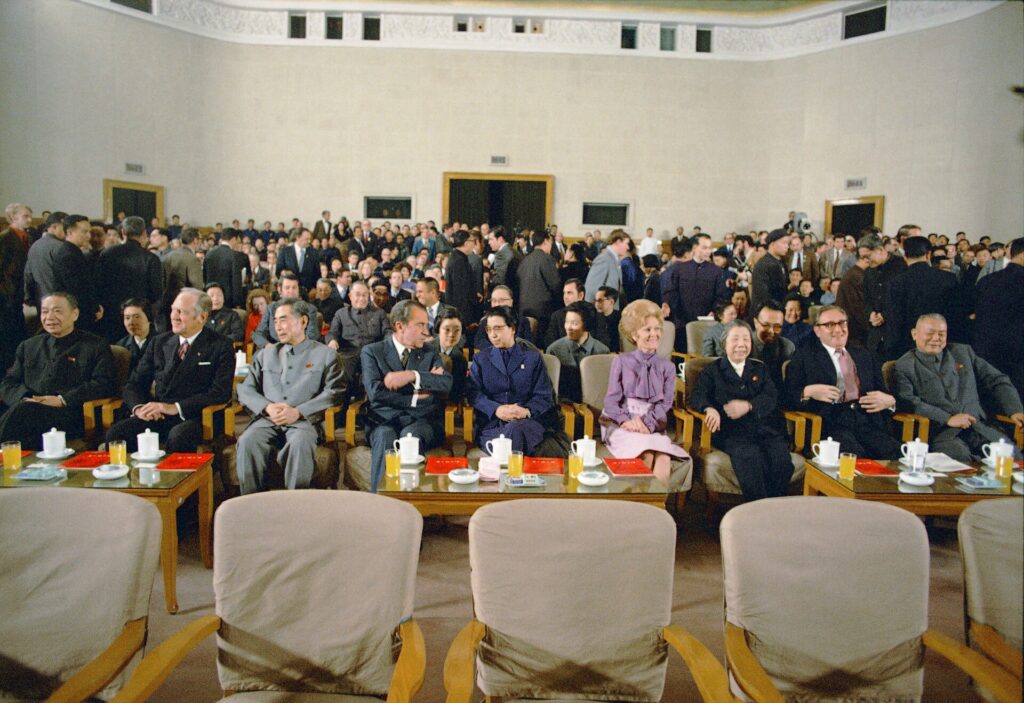
Today, rivalry colors all aspects of U.S.-China relations. Yet this relationship was built on hopes of collaboration and mutual gain for the United States and the China, while agreements were made with the government on Taiwan that still impact dealings today. Our modern understanding of these relationships began with historic meetings between Richard Nixon, Mao Zedong, Henry Kissinger, and Zhou Enlai in 1972. To hear firsthand about that trip and its significance for decades to come, the Monitor spoke with Ambassador Chas Freeman.
Ambassador Chas Freeman is a retired career diplomat who was Assistant Secretary of Defense for International Security Affairs from 1993-94, earning the highest public service awards of the Department of Defense for his roles in designing a NATO-centered post-Cold War European security system and in reestablishing defense and military relations with China. He served as U. S. Ambassador to Saudi Arabia (during operations Desert Shield and Desert Storm). He was Principal Deputy Assistant Secretary of State for African Affairs during the historic U.S. mediation of Namibian independence from South Africa and Cuban troop withdrawal from Angola. Ambassador Freeman worked as Deputy Chief of Mission and Chargé d’Affaires in the American embassies at both Bangkok (1984-1986) and Beijing (1981-1984). He was Director for Chinese Affairs at the U.S. Department of State from 1979-1981. He was the principal American interpreter during the late President Nixon’s path-breaking visit to China in 1972. In addition to his Middle Eastern, African, East Asian and European diplomatic experience, he had a tour of duty in India.
Emma Brignall: How did you become interested in diplomacy? Your career has brought you to so many different countries and regions, but China stands out as one where you concentrated a lot of time. Why China specifically?
Chas Freeman: I come from a family which had a five-generation tradition of speaking a foreign language at the dinner table, Tuesdays and Thursdays. In my case, it was Tuesday with French, and Thursday was Spanish. I knew nothing about China whatsoever, although my family had been involved with China, way back when. One of the earliest New England ships to go to China, after the Revolution, was captained by an ancestor of mine. Three of my great grandfathers worked in China. John R. Freeman was Sun Yat-sen’s advisor, and the engineer who designed the Three Gorges Dam, which he knew he could not get built, so he left after six months. This was written up in Jonathan Spence’s To Change China. My mother’s grandfather, Robert Ezra Park, was a founding sociologist at University of Chicago and also at Yanjing University, which became Beida, and later, at Lingnan, which is now part of Zhongshan University in Guangzhou. Another great grandfather, whose ring I wear—jade, supposedly given to him by the Shandong viceroy in the Qing dynasty—was with Henry Siemens and his own older brother, the inventor of the Open Heart Steel Furnace. He was hired by the Qing government to modernize the Chinese steel industry. One other great grandfather didn’t make it to China.
I discovered this, almost by accident, when I was at Harvard Law School. I determined I did not want to be a lawyer. I liked languages, because of cultural communication. And I liked history, so I went to the Widener Library and started reading history rather than attending classes at the school. I read around the world. I’d had a British education; it was pretty solid on British views of European history, and so forth. I had a degree in Latin American studies, from Yale. There wasn’t very much written about Africa, so it didn’t take long to read about that. I read about the Middle East, I read about India, I read about Southeast Asia, I read about Japan, and Korea, and then I got to China. And I became fascinated. It caused me to think: this was 1964-65. We had no relationship at all with Beijing. We were championing Taipei, the losing party in the Civil War, as the government of all of China.
Later, I would go to the UN and make the case for keeping Beijing out of the China seat: There’s only one China, but the capital of it is in Taipei, not in Beijing. There is not a government in exile, because Taiwan is part of China. That was our line at the time, and we got away with it for much longer than we should have been able to do. Anyway, I became fascinated with the geopolitical situation. And I thought, this is illogical. China has experimented with an alliance with the Soviet Union; it’s now backed away from that. We have no relationship with it, but we’re under pressure in the Cold War from the Soviet Union. We need to reach out to China, and China needs to reach out to us, because it’s under pressure from the Soviets. And I thought, I’d like to be there when that happens. To my great surprise, I actually was.
EB: You served as the translator for Richard Nixon in his historic opening of relations with the People’s Republic of China in 1972. Could you walk me through what that moment was like and what the reactions were in Washington and Beijing?
CF: Well, my major contribution to that path-breaking opening to China was really not the interpreting, although I’ll talk about that. I wrote almost half of the briefing papers for the president about China. And so he was very well prepared on a vast array of subjects; it was a huge array of writing. I was locked up in a controlled space in the Department of State for several months doing that. I had no idea I was going to be on the trip itself. I found out when some baggage tags were shoved through my mail slot at home, and there was an article in Time magazine saying I had been designated as the interpreter, which contained a lot of mistaken biographical background; obviously, someone at the White House had provided that. So, I found out that I was going on that basis, but nobody told me what to do, and I’d never actually served as an interpreter, although I had been trained to be one for the Warsaw Talks, which were the ambassador-level talks between the United States and the People’s Republic of China that began at Geneva and continued for 136 iterations in total at Warsaw, and which were, in their late phase, the origin of the language that finessed the Taiwan problem and enabled the visit of Nixon to go forward.
I arrived in Beijing, hoping to be told what the president wanted me to do. We checked into the Diaoyutai State Guesthouse. I got a call mid-afternoon, the President wants to see you, so I went over to his villa. I thought he’d tell me what he wanted me to do, but he didn’t. I remember, he came into the room. He was slightly taller than I. His nose was right at my eye level, and there were three black hairs sticking out of it, a groove in it, and one of them had a blob of Max Factor on it. I had never seen a man made up except in a television studio, so this was a little shocking. But he didn’t tell me what to do, he just said he’d heard good things about me. Then he retreated, and left me and the other two backup interpreters standing there, and we went back to our villa. He went off unexpectedly to see Mao Zedong, who was on life support, basically, which is why the Chinese couldn’t actually schedule a meeting; they had to get him pumped up to be able to be coherent. He didn’t take anyone with the State Department with him, so there was no Chinese speaker in the room. I facetiously wondered, on occasion, whether Tang Wensheng or the other interpreter, who was their Chinese interpreter, just made up what Mao was saying, because nobody in the American delegation spoke Chinese. But I’m sure they didn’t; they were very serious people.
Because of that meeting, the timing for the banquet was delayed till 9:30, which is very late for Chinese. I was called over about 8 o’clock to the president’s villa, and Dwight Chapin, who was his protocol officer, and the appointment scheduler came out of the suite where the president was staying in, said, “The president wants you to interpret his banquet toast tonight.”
And I said, “Fine, may I see the text?”
He said, “I don’t think there is a text.”
And I said, “Mr. Chapin, I think you’re wrong. Please check with the president.”
He went in, came back out, and said, “The president said he’s going to do this extemporaneously. There is no text.”
I said, “Mr. Chapin, it might interest you to know that I drafted the toast for tonight. I know there is a text, and I’ve heard that some of Chairman Mao’s poetry has been put into it, by the NSC staff, and if you think I’m going to stand up in front of the entire world in the Chinese Central Committee, and ad-lib Chairman Mao’s poetry from an unknown English translation into Chinese, you’re out of your—and I used a foul word—mind.”
And he said, “There is no text.”
I said, “Well, in that case, I won’t do it.”
So he pulled the text out of his pocket and gave it to the Chinese, who then turned to me and said, “What is this poetry?”
So, anyway, I averted a disaster, and two days later, Nixon, with tears in his eyes, apologized to me, saying that “I shouldn’t have done that.” He had a habit of memorizing speeches; he had a near photographic memory, which I also have. I wouldn’t have had to stand up there with a text. He feared I would. He wanted to appear extemporaneous. And so, a disaster was averted. President Nixon, once again, showed that he was a really weird personality. And instead of being deprived of a federal government career, I continued.
I should say that I did all the interpreting for the Secretary of State. The way summit meetings are often arranged, you have two tracks. The Secretary of State is assigned the unwelcome, uneasy, difficult task of rehearsing all of the differences with the other side. We argued about the Indochina War, Vietnam, about Korea, where we had been on opposite sides, about Kashmir, where we had different positions about the role of Japan in the region where we didn’t have a common understanding, and this was all essential, because, as Zhou Enlai was, they had suggested the Shanghai communiqués should begin by reassuring all of our friends and client states that we had not sold out their interests. So the communiqué begins with a detailed statement of the two sides’ totally incompatible positions. Then it transitions to say that, basically, the United States and China have different social economic systems and ideologies and different foreign policies. Nonetheless, we can cooperate on matters of common interest, which were effectively joint opposition to the Soviet expansionist agenda.
EB: From then on, your career spanned decades and world leaders. From Mao Zedong to Xi Jinping and from Richard Nixon to Donald Trump, what are the most significant moments you’ve witnessed in U.S.-China relations?
CF: Well, that’s hard to say. I was one of the managers of Deng Xiaoping’s visit to the United States after the normalization communiqué was agreed, and that was certainly a very high point. I was in many of the meetings with Deng. I later got to know Deng very well. He came to the United Nations in 1974, out of labor reform, released to speak for China at the U.N. General Assembly. I met him then with Kissinger, who was the Secretary of State at the time. He was enormously impressive. He just cut through the murk of issues and right to the heart of them, almost immediately. Very outspoken, not perhaps a terribly nice man, but a very bright and vigorous and decisive one, which he showed, indeed, in his handling of reform in China. That was a memorable moment. I actually introduced Jimmy Carter, to Deng Xiaoping, in Beijing when I was the chargé and temporarily in charge of the embassy in the summer of 1981. The president then, and Rosalynn Carter, came to visit.
But probably the most memorable moment was the negotiation of what is called the 八一七公报 (Bāyīqī gōngbào), the August 17 communiqué, which was done at my dining table in Beijing. Formal sessions would confirm what I and counterparts from the Chinese foreign ministry had worked out, ad referendum, to Ronald Reagan and Deng Xiaoping. If we got back a nod, then there might be a formal meeting with the ambassador and his counterpart to formally agree on that. So this is a very common method of negotiation, that is, you have a semi-official what-if session with counterparts, and if they can reach an apparent agreement, then it is confirmed by higher levels. That communiqué temporarily resolved the issue of American foreign sales to Taiwan, which was threatening the existence of the relationship after normalization. It wasn’t anything that either side was happy with. And neither side gained what we wanted to gain. The Chinese had to agree that U.S. arms sales to Taiwan would continue for some time. We had to agree that we would cut them out eventually and that we would reduce their quality and quantity over time. It was not a happy moment when we actually reached an agreement that was a lot better than breaking relations, which indeed was a possibility. That was pretty significant.
There were many other things. I think dealing with the Chinese as a diplomat is very interesting. They are consummate actors. They are able to compartmentalize things. I would go into a meeting with my counterpart, say the vice foreign minister or assistant foreign minister, on a contentious subject. We’d sit down, slouch in those big overstuffed chairs that they favor. I would say to him, “How’d your kid do on that exam? Have you seen this movie? How’s your wife? Do you have any travel plans?” and other things like that. We talked about that for about five minutes, and then both of us would pull ourselves up in the chair, knees together, hands on knees, feet on the floor. And I would say to him, “I have been instructed to protest in the very strongest terms the absolutely outrageous performance of your government in the Persian Gulf. What you are doing is something that no civilized country would do, and you will bear all the consequences that flow from this.” And then he would say, “I categorically reject every one of your statements. They’re all untrue. You are the ones who are making mistakes in the Persian Gulf.”
And we go on at each other like that for a while, and then we look at each other and say, “Have we finished?” And we’d slouch back down, and I’d say, “What about a picnic this weekend?” So, you can’t do that with a lot of other nationalities, who confuse personal relationships with official stances. We each represented our governments faithfully, but we also had a personal relationship, which, when there was a possibility of moving toward agreement, was very helpful. He knew I would not lie to him, and he would not lie to me. I cared about his opinion and regarded him with respect, and he had the same view of me. That’s diplomacy in Beijing back then. Very little of that goes on now, I’m told, which is a shame.
EB: You watched China’s rise firsthand, a phenomenon that is now a bipartisan troubling issue to members of Congress and much of the country. How do you regard China’s rise to global prominence and how is it influencing the world order?
CF: First, when Nixon opened the relationship with China, our concern was not Chinese strength, but China’s vulnerability. It was not China’s connectedness to the world, but China’s isolation. It was not China’s wealth, but its poverty. These things are all things that we wanted to offset in order to enlist China in the containment of the Soviet Union, and hopefully, persuade them, as we were unable to do, to stop backing in Vietnam Indochina. We’re now concerned about the opposite. China has returned to wealth and power, and it is eclipsing us in many areas of endeavor—scientific, technological, economic—and it is a major force in the world as we retreat from the world. We have withdrawn from multiple United Nations specialized agencies, where we are not kind to our partners or friends, sometimes we’re kinder to our foes than our friends. We are going toward, what I would call, a diplomacy-free foreign policy, which does not enable us to compete effectively with China, which has quite a different approach. So that’s the first thing, the irony.
Second is that, as you said, I did indeed witness the rise of China in what Deng Xiaoping clearly considered the real revolution, to follow Mao Zedong’s revolution. He very definitely thought of Mao as the equivalent of Qin Shi Huang, the first emperor. They had a totalitarian ruler, whose vision of China was never implemented, but gave way to the Han dynasty’s reinterpretation of it and installation of Confucianism, which he abhorred. Deng saw himself in that Han dynasty role as someone creating a new China, on the ruins of the one that Mao left him to direct. I was maybe the first person to spot this seriously. I was in Beijing. I was the country director for China in the State Department, in charge of the overall relationship, at a time when that level had real power. I went to Beijing to talk to the embassy, and go to Hong Kong and talk to them, and that was the main China watching post at the time.
I walked out from the Beijing Hotel, in the direction of the Forbidden City in Tiananmen, and at the corner of the Forbidden City there was a street called 南池子 (Nán chízǐ), the South Pool. At that intersection, there was a guy with a pushcart selling noodle soup. There had been no such thing in China. There were cafeterias; there were no individual vendors of anything, and the whole glory of Chinese xiaochi, of little delicacies, had disappeared, basically. So I was really struck by this guy’s presence. I went up to him, and I asked him in Chinese, “What work unit do you belong to? What commune?” And he said, “I’m my own work unit.” And I thought, Wow, something fundamental is happening.
I went back to the United States, and in February the next year, 1980, there was an All China Watchers conference convened in Smithsonian Castle, which I attended. I was the only one there who thought there was a real revolution going on in China and that China was changing direction and that it could work. Everyone else argued more of the same. I was so annoyed that I got on the motorcycle that I then commuted to work on, and went back to the Department of State after the meeting and spent the night writing a memorandum called “China in the World 2000.” You can find that as part of auxiliary material online on my website, which is ChasFreeman.net. I argued that China was going to break free of socialist sloth and that it was going to be very successful economically.
I was roundly criticized by the CIA, and went out there for a struggle session, and by China Watchers in Hong Kong, for being far too optimistic. I had said that I thought China could grow six or seven percent a year. They grew 15%. I thought it could revitalize its agriculture. The agricultural growth rate was twice what I estimated. I was told, No, no, no, you’re completely wrong. It can never do that. I got all of the things right, and the only thing I got wrong was Chinese geopolitics, because I never imagined the Soviet Union would do what George Kennan had wanted it to do, namely, collapse of its own defects. I imagined that the Soviet Union and China would still be in rivalry in the early 21st century. And, of course, the Soviet Union had disappeared by then. So that was wrong, but then, so was everybody else, wrong about that, so I don’t feel too badly.
EB: What would you say are the biggest misunderstandings in U.S.-China relations today?
CF: I think they’re fundamental. I think, essentially, the United States has fallen into a habit of fantasy foreign policy, in which we have very distorted views of foreign countries. You mentioned Condoleezza Rice [in conversation before recording]. She had such a distorted view of Iraq. She imagined that we would be welcomed with flowers by the Iraqi people, liberating them from Saddam Hussein, that the war would pay for itself because every Iraqi lived in a palace, and there was gold under every date palm in Iraq. We invaded the Iraq of our dreams, not the real one. And I think in many respects, we’re dealing with the China of our nightmares, not the real one.
Does China intend to replace the United States as the global hegemon? There’s no evidence of that. We, however, fear being displaced, and in many respects, China’s rise is displacing us, but that is not to say that China wants to run the world in the manner that we’ve done. We imagine that China is expansionist, but it aspires to no territory beyond the traditional borders of China, including Taiwan. We see disputes in the South China Sea, and we take the side of the non-Chinese claimants against China. And yet, their claims are, if anything, no more solid—perhaps less solid—than those of the Chinese. We think of the Chinese through analogies with the German search for Lebensraum, more territory to settle people on. But the Chinese have no indication of that. They don’t want more Koreans or more Vietnamese or more Turks on their territory. We think of the Chinese, perhaps in terms of the analogies of imperialism, imperial Japan, mercantilism, but the Chinese don’t aspire to control markets by military occupation or annexation. They’re very happy to compete in the capitalist world.
In fact, one of our main problems with the Chinese is that they turn out to be better at capitalism than we are. So, I think we have many distorted views. The Chinese officials have much more realistic understandings of the United States. But on both sides, the common folk—the laity, if you will—are now deeply suspicious, and sometimes even hateful of the other side. There are reasons for that. We are arrayed militarily along all of China’s borders. We encircle it. We conduct three to four very aggressive tests of its defenses every day. China’s not at our borders, but I fear we are stimulating it, eventually to follow us home. I’m fond of saying that with John Quincy Adams, that you should not go “abroad in search of monsters to destroy.” The problem with doing that, I would add, is that when you do it, the monsters often follow you home, and I’m afraid we may see the Chinese turning up in the countries of Latin America that we are currently alienating and opening to their influence.
EB: Along those lines, there’s been a push for policies of deterrence towards China. How can the two countries collaborate more and what would each need to compromise on to create positive change in the world?
CF: I think deterrence has a role, but it has to be accompanied by political reassurance. That is, I’m deterring you from doing X. As long as you don’t do X, there will be benefits. Now, what’s the incentive not to challenge me? Of course, I’m telling you that if you do challenge me, I’m going to make it costly for you. But what is the reason that you, in terms of your own interests, that you can benefit by not challenging me? Unfortunately, we have an entirely military deterring policy towards China with no political component at all. Therefore, this turns deterrence into provocation. So we have arms races, they have military confrontations, and we have shows of force, particularly around the Taiwan area. We are trying to persuade other countries in the region that they need our protection against China. Actually, for the most part, they don’t want our protection. They want our backing while they work out some way of living with China. They’re used to it: China was at the center of the region and is, again, becoming the center of the region. They want to reach a secure accommodation with China and they would like our help to do that. That’s not what we’re doing. How could we cooperate? We could begin by recognizing that planet-wide problems require Sino-American cooperation to be dealt with, whether they are nonproliferation, the world trading system, regulations on investment, artificial intelligence, which is a grave threat to employment and the structure of human societies; as it moves forward, we’re going to see large areas of the economy sidelined for labor. How do we deal with that?
What about global warming? I know the Trump administration is in deep denial about that, but we are the only country on the planet that is at the moment. We could cooperate very effectively with the Chinese, who happen to have the lead in all of the technologies relevant to reducing greenhouse gas emissions: solar, wind, nuclear, hydro, and, of course, electric vehicles. We are trying to make our economy safe for the internal combustion engine. But that doesn’t strike me as very smart. I don’t think it will work. In fact, the war that we’ve just launched against Iran has created a huge recognition internationally that you cannot rely on oil and gas. You need electrification, and this has created a huge market for, not just for Chinese EVs, but for Chinese solar panels, for Chinese wind turbines, and for Chinese nuclear power, which has moved into a post-Westinghouse phase. The Chinese are building 52 nuclear power plants. We’re not building any at the moment.
There are lots of things we could work together on, and we’ve actually demonstrated this most effectively through cooperation in science and technology, where many of the brightest researchers in our universities are actually Chinese. But we’re making life in the United States very uncomfortable for them, and many of them are going home. That’s the tragedy. You may know the story of Qian Xuesen, who was at Caltech, a brilliant physicist, and a father of our nuclear program. The FBI did a lot of heavy breathing around him, and drove him back to China, where he became the father of the Chinese nuclear program and the Chinese ICBM. This was not necessary. It was deleterious to the interests of our country, but we’re doing it again.
We ought to be embracing China’s rising prosperity, and benefiting from it by selling more to China. It should be trying not to cut off sales to China but to increase them. If you look at something like the semiconductor industry, you see NVIDIA in the lead, globally, although NVIDIA chips are made in Taiwan, not in the United States. Leaving that aside, by cutting off NVIDIA sales to China, we deprive NVIDIA of the revenue and capital it needs to stay in the lead and we stimulate the Chinese to duplicate NVIDIA’s capabilities, which they are doing, progressively. This is not a static picture. There’s a phrase in Chinese, 闭门造车 (bìmén zàochē), to “close the door and manufacture a cart.” In other words, try to become totally self reliant, industrially. It doesn’t work. The Chinese proved it didn’t work in the 1950s; we’re following their bad example and proving it doesn’t work in the United States in the 21st century.
EB: You just mentioned Taiwan and how interdependent the world is now, especially in semiconductors. Your research at law school was the basis for the Taiwan Relations Act and you watched the transition from recognizing the ROC government on Taiwan to the PRC firsthand. What was the experience like of dealing with each government during this transition and how has that influenced relations to the present?
CF: I was two years at Harvard Law School, and did not enter my third year because I joined the Foreign Service. Nine years later, a wonderful Harvard Law professor, Jerry Cohen, invited me back to help him teach a seminar on Chinese law and negotiating style, and I said to him, “I can’t do this. I don’t have a degree. I can’t be on the faculty.” He arranged for me to be a third-year student as I was on the faculty. So I finished my law degree ten years after I left. The Taiwan Relations Act—the issue was, how do we preserve the well-being and our moral obligations to the people of Taiwan if we are going to break relations and derecognize them as a state? How do you do that? That was the subject of my research, and that became the basis of the Taiwan Relations Act, which I did not draft, but I helped negotiate with the Congress. When the Carter Administration presented the draft act to the Congress, they made very few changes. My legal research, and the drafters’ use of it, was apparently sound, but I did add a preface, a preamble, which stated their congressional policy. I negotiated with them on that to make it more or less compatible with the normalization understanding of Beijing. So, that was an interesting experience.
We had a deal in the normalization agreement. We had a deal on arms sales in the August 17, 1982 communiqué. We’ve repudiated all the understandings that we committed to at that time. That leaves Taiwan in jeopardy. I think we’re seeing the results of that in Cheng Li-wun and her argument that the Guomindang is the opposition party now to the Democratic Progressive Party, ruling party in Taiwan, and can talk to both Beijing and Washington, which is the prerequisite for Taiwan’s survival as a thing in itself. I think the mainland would be quite prepared to negotiate some protected status for Taiwan. It’s made that clear in the past, but, of course, the example of Hong Kong, which is ambiguous, I would say. Hong Kong people went on a rampage and were then chastised by the Chinese government, and Hong Kong is the worse for that. That example, which is interpreted in Taiwan as oppression of Hong Kong, does not encourage negotiations. But Ms. Cheng says that she could work out a future for Taiwan that preserves its way of life, its economy, its international relationships, even under the rubric of Greater China. We’ll see. And with so many fraught questions around Taiwan right now, particularly with defining what the U.S. commitment to Taiwan is and the pending arm sale.
EB: With so many fraught questions around Taiwan right now, what do you think is the best way for the American side to engage with Taiwan?
CF: I found it very ironic that Donald Trump, who has introduced something beyond strategic ambiguity—strategic ambivalence, perhaps—into this equation, is being accused of making a strategic judgment. I thought that’s what presidents were supposed to do. Just ask yourself, what can Taiwan do for the United States or against the United States? What can the mainland do for or against the United States? Can Taiwan address any of the planet-wide issues that I mentioned earlier? Is it a growing market for American agriculture? Is it a leader in science and technology? The Australian Strategic Policy Institute says that of the 74 categories of science and technology, engineering and mathematics, that they monitor, China is now ahead in 68. The U.S. is ahead in six, maybe. I would argue that the stakes are vastly greater about how the United States handles relations with the Chinese mainland, than they are with Taiwan. That means that we should be prepared to reach compromises.
Now, of course, we have values; we should value Taiwan’s robust democracy, its respect for the rule of law, its high level of civil liberties. In many ways, Taiwan is now a better place to live than the United States. It doesn’t have any ICE running around, bashing people on the streets or murdering them. I think we owe Taiwan backing, as it works out some kind of modus operandi with the rest of China. But the last thing on Earth we want to do is go to war over it. If we do, every war game we run shows that we lose about two thirds of our Air Force and Navy. So does China. But they have the ability to rapidly rebuild. We don’t. We don’t have the industrial capacity. And a war over Taiwan would threaten a nuclear exchange. The idea that we can attack the Chinese homeland and keep our own homeland free from Chinese attack is nonsense. So, there are many reasons why we should be promoting cross trade talks, helping Taiwan to find a future for itself that is not challenging to China and that China can accept and live with, however long it’s agreed that that remains the case.
My favorite politician in Texas, no longer with us, was a guy named Kinky Friedman. Kinky Friedman said, “I prefer cats to women, because cats seldom, if ever, use the word relationship.” Bearing in mind Kinky Friedman’s aphorism, I still think we have to be mindful of the moral obligations of relationships. We have a relationship with the people in Taiwan. We should be proud of our help to Taiwan, and our eventual assistance to it in developing the democratic system it has. But France has a democratic system and we don’t seem to think we need to defend French positions because of that. We have an ideological affinity, which is not unimportant, but it’s not something you go to war over.
EB: Having experience in diplomacy with both China and the Middle East, how have you seen their relations change and influence the world order? What do you envision for China-Middle East relations in the years to come, particularly following the war with Iran?
CF: China is very careful to follow George Washington’s advice: No entangling alliances. China regards alliances as liabilities because the ally may do something that requires you to come to its aid in which you have no interest, or that may importune you, as we have been importuned into a disastrous war with Iran. So, the Chinese do not have alliances. They try to stay out of other people’s corals, and that has guided their poach to West Asia—the Middle East. That is, their interests are primarily economic and strategic, in terms of access to energy supplies and access to markets. They are now, by far, the largest trading partner of countries in the region. They are becoming the largest investor in the region. There are literally 4,000 or 5,000 Chinese companies in Dubai or Abu Dhabi in the UAE. There are, I think, I’ve seen figures of hundreds of thousands of Chinese now living and working in the Persian Gulf region. They’ve kept a good relationship with Iran, and Saudi; in fact, they brokered a rapprochement between these two countries, who are traditional enemies. They have kept a good relationship with Israel, even as they have a good relationship with the Palestinians. Quite a balancing act.
But there’s no question whatsoever that countries in the region, for their own reasons, are turning to China on their way from the United States. China makes no demands on them. It doesn’t say, You have to get rid of your system of government and replace it with something else. It, no doubt, doesn’t like the anti-feminist attitude of many societies in the region, whether they’re Orthodox Jews or strict Muslims, but it doesn’t make this an issue. It doesn’t demand that countries in the region do anything for China. All it demands is respect and dignity. This has paid off. The condition of Muslims in Xinjiang is not a matter of concern, to the Muslims in the Persian Gulf or West Asia. They’re quite comfortable with their relationship with China. Some of them have aid programs in Muslim areas of China like Ningxia and Xinjiang. So, it’s a relationship that is much less demanding, and also more attractive.
I should conclude by saying that there’s an important distinction between rivalry, which can be a very positive thing, two countries competing to excel, each one competing to improve itself, to turn in a better performance than the other. That kind of competition can be very productive and constructive. Adversarial animosity, which is, if you were in a track meet, instead of trying to outrun your opponent as you would if they were just a rival, you try to trip your opponent, you try to cheat, you try to hurt your opponent. That is not productive. That is the relationship we’ve had with China. And it verges on enmity. Enmity is the desire to annihilate your competitor. That was what we had with the Soviet Union in the Cold War, and we were prevented from doing that only because we had a mutual deterrence through nuclear weapons. That is where we’re going with the Chinese at the moment, which should not make any of us feel comfortable.
EB: We usually think of diplomats as focusing on one specific region or country, but you’ve been in charge of affairs for East Asia, West Asia, and Africa. How do you navigate the issues of so many different countries across the globe? Should we be cultivating more global diplomats or regional experts?
CF: You need both the professionalism of diplomacy as a doctrine, as a profession, and area expertise. If you’re in an official negotiation, even if you speak Chinese or Arabic, as I do, you don’t use that language. You use your own language. Why? Because there are many advantages to that. If there is a misunderstanding, it can be blamed on the interpreter, not you or the other side. If you understand the other side’s language, it gives you more time to formulate a response while it’s being interpreted into English. I would say diplomacy is a proto-profession.
What is a profession? It is a claim to specialized knowledge that ordinary people don’t have an expertise in: the solving of problems that ordinary people can’t solve. So you have reference to a doctrine, and the accumulated experience of others in your profession. For example, medicine emerged as a profession at the University of Pennsylvania in the mid-19th century. Suddenly, apprenticeship to a doctor was replaced by formal education and a certification process. And so we have the modern MD, who is a professional. There are paraprofessionals, people who are less broadly qualified, but let’s say nurse practitioners, registered nurses, receptionists in medical facilities, and so forth, all of whom are part of the medical community, but are not professionals in the sense that someone with an MD is.
That hasn’t happened in diplomacy because of the spoils system and the desire of presidents to appoint cronies and donors and people who have fat heads and fat wallets to important positions. We are left with a proto-profession in the United States. There are foreign diplomatic services that are more professional than ours. I think ours needs to be retooled because we’re entering an era in which we can no longer live by coercion or bribes, by our fists or our wallets. We now need to live by our wits. That means we need the specialized knowledge and expertise of diplomats.
That, of course, includes cultural sensitivity, because the basis of diplomacy is empathy. You have to understand where the other party is coming from, why they have the beliefs and the positions they do in order to formulate an argument, to persuade them to change their position and to accept what you want to do as something that’s in their interest, not just in yours. That is the basic technique of diplomacy; it is helping other people to see things your way, and to do what you want them to do in your interest, because you’ve persuaded them that it’s in their interest as well. If you accept this definition of diplomacy, you will not find any evidence of it in our current practice internationally, which I think is much to our loss.