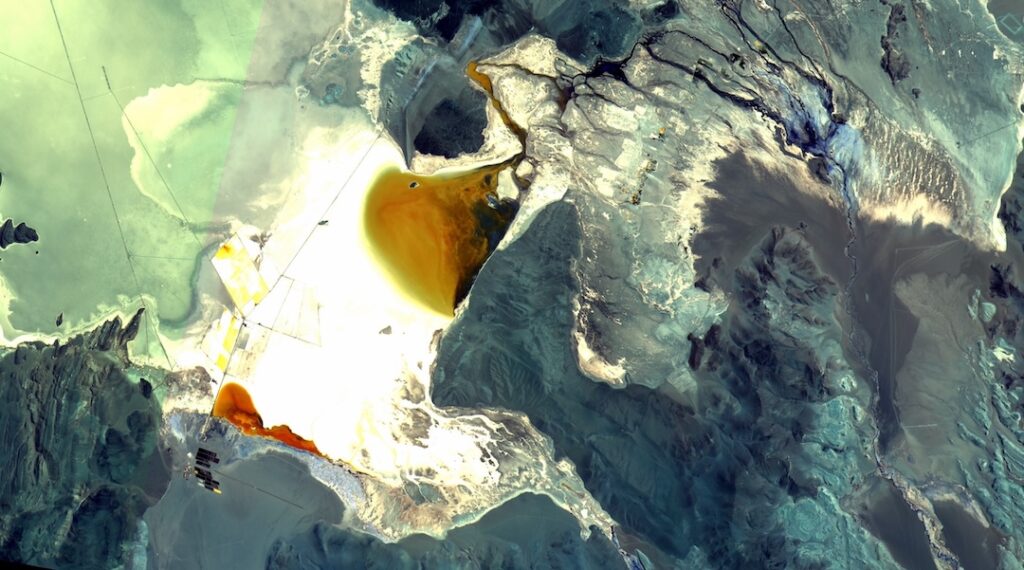
From electric vehicles to smartphones to grid-scale storage, the world runs on lithium batteries. The majority of known lithium reserves sit in the Lithium Triangle, spread across Argentina, Bolivia, and Chile. [1] Both the U.S. and China recognize this and are spending accordingly. Since 2020, Chinese firms have invested billions in mining in the Triangle. To counter, the United States has mobilized development finance and multilateral partnerships to secure critical mineral supply chains. [2] But the region’s lithium production remains far below its geological potential. Across the three countries, the provinces with the most lithium lack the necessary electrical grid infrastructure for extraction at the scale that global electrification demands, and project contracts are collapsing under community opposition. Plenty of capital is flowing into the Triangle, but that capital is flowing into a vacuum where the absence of formal governance is eating billions in investment.
While the conventional framing of U.S.-China competition in critical minerals treats it as a zero-sum game where more Chinese lithium means less American leverage, this framing misses the binding constraint. More important than the question of ownership is the fact that the current environment produces governance fragility, social conflict, and infrastructure gaps that reduce total production for everyone. The door is open for the United States to build a Critical Minerals Project Finance Standard that would stabilize supply chains with a binding, rules-based framework backed by existing U.S.-linked institutions and integrated as a condition for producer governments to access multilateral capital. Such a standard would secure long-term investment by enforcing symmetric market rules, resolving the infrastructure bottleneck, and institutionalizing local consent and transparent bidding.
Roughly 50 lithium-related firms operate across the three countries, and Chinese entities now hold ownership stakes in roughly two-thirds of those companies. Six of the 16 active lithium projects in Argentina are under Chinese ownership or partnership, and in 2023, while only 11 percent of Argentine lithium exports went to the United States, 43 percent went to China. The gap between Chinese and U.S.-aligned capital is significant. Between 2020 and 2023, Chinese investment in the Lithium Triangle exceeded $3 billion. [2] In the same period, U.S.-aligned lenders committed only half that amount. [3]
Early lithium production in the Triangle used the power of the sun, pumping lithium-rich brine into large ponds where evaporation removed water and precipitated other salts. While energetically efficient, pond evaporation takes multiple years to recover only 30 to 50 percent of lithium and uses hundreds of thousands of gallons of water to produce just one ton of lithium carbonate. [1] Most new projects now employ direct lithium extraction (DLE), using methods like adsorption, ion exchange, and membrane separation to capture roughly 80 percent of the lithium in just hours with substantially lower water use. This improved efficiency, however, comes at a cost; commercial-scale DLE facilities require a continuous supply of tens of megawatts, about the consumption of a medium town. [4] The grid in Jujuy or Socaire cannot support that scale of demand.
Operators have responded accordingly. A major Chinese lithium operator, Ganfeng, built a 120-megawatt photovoltaic system to support its Llullaillaco project in Salta, Argentina. [5] Genneia, an Argentine renewable energy company financed in part by Chinese capital, has invested $400 million in a dedicated high-voltage transmission line across the province, allowing for an estimated 150,000 metric tons per year of lithium carbonate production. [6][7] These are not just marginal adaptations. The energy demands of DLE and the lack of a reliable public grid have forced private actors to build their own infrastructure.
This energy deficit is largest in the same provinces where there is the greatest competition for lithium assets between U.S.-aligned and Chinese capital. When individual operators build captive solar arrays, they are only patching the problem, not building out an integrated, sustainable grid, and new 500 kV transmission lines financed by multilateral lenders only delay network saturation by a year or two. This infrastructure gap is a collective action problem exacerbated by geopolitical competition, and neither side has moved to solve it. Instead, they race to lock up assets in an environment where governance is thin and contract terms are opaque. The communities living above the lithium are increasingly the ones paying the price.
The starkest case, however, lies in Bolivia. Bolivia holds the world’s largest lithium reserves, an estimated 23 million metric tons, yet it accounted for only 0.04 percent of processed lithium as of 2023, despite nearly $1 billion in state investment at the Uyuni salt flats. In 2024, Bolivia’s state lithium company Yacimientos de Litio Bolivianos (YLB) signed a $1.03 billion contract with Hong Kong CBC, a consortium led by the Chinese battery company CATL, with plans to build two DLE plants at Salar de Uyuni. [8] Bolivia’s constitution requires state control of strategic resources, so YLB was to hold 51 percent of shares. The contract’s specific terms, however, were kept confidential. [9] YLB stated publicly that a confidentiality clause makes disclosure impossible and removed documents from its website in September 2024.
Additionally, legally required environmental impact assessments were not completed, and Indigenous communities affected by the project did not provide free, prior, and informed consent (FPIC). This came to a head in February 2025 when the Nor Lipez Lithium Advisory Council, a collection of Indigenous communities, formally demanded CBC’s expulsion, warning that the project threatened their freshwater basins. The council filed legal action that May, and a Bolivian court ordered the suspension of the CBC deal. The contract stalled in the legislature without ratification. [10] While the centrist government elected last November pledged to review the contract, it remains in an unbankable limbo. [11] The failure of this billion-dollar infrastructure deal lies in the lack of a governance framework to govern its terms.
Opaque deals produce problems domestically and internationally, but fear of them can also prevent mutually beneficial development. When Chile launched its National Lithium Strategy in 2023, it considered running an open competitive tender for new lithium development. Economic nationalists within the Boric administration and the leadership of state copper giant Codelco pushed back. An open tender risked being won by a Chinese state enterprise, which would have complicated Chile’s simultaneous courtship of U.S. private-sector partnerships through the 2024 Chilean Call. The government instead negotiated a direct partnership between state-owned Codelco and SQM. Codelco controls a majority of the resulting entity, NovaAndino Litio, through 2060, with the state capturing 85 percent of profit margins starting in 2031. [12] From Chile’s perspective, this choice was rational, but it was also forced by the absence of any multilateral framework that could neutralize geopolitical risk in the bidding process. Ultimately, by opting for a closed, state-negotiated partnership rather than a competitive market process, Chile locked out American and Chinese buyers while sacrificing competitive price discovery.
These failures are a predictable result of a governance vacuum. An investor like China, with massive deployable capital and low domestic accountability, inherently benefits from opacity. This lack of transparency subordinates community interests to deal velocity, while forcing producing governments into impossible trade-offs between geopolitical alignment and economic development. Chile, Argentina and Bolivia can choose between partners that offer financing speed and partners that offer market access. Both the U.S. and China claim to want stable, productive lithium supply chains in the Triangle, but neither has created the conditions that would produce them. Both sides have already demonstrated a willingness to deploy capital, but that’s not enough. For capital to work for both producers and consumers, it needs to sit within an overarching framework.
There is no binding, multilateral standard currently governing the commercial architecture of critical mineral project finance. Unlike oil and gas, critical mineral finance is not conditioned on offtake exclusivity, contract transparency, or community consent requirements. The Extractive Industries Transparency Initiative (EITI) covers revenue transparency, the Organization for Economic Cooperation and Development’s (OECD) due diligence governance covers human rights and conflict minerals, and the Inflation Reduction Act (IRA) creates market incentives for sourcing from free trade agreement countries, but none of them address the terms on which capital enters these projects. This is not an incidental gap. Both great powers have implicitly relied on this structure for advantageous bilateral deals, and closing it requires someone to move first.
The United States has the institutional leverage to make this work. Through the Inter-American Development Bank (IDB), the Minerals Security Partnership (MSP), and the Development Finance Corporation (DFC), the United States could back a multilateral Critical Minerals Project Finance Standard to require three things of any project seeking to access multilateral financing or IRA supply chain eligibility: 1) competitive tender processes open to all qualified bidders regardless of nationality; 2) EITI-style public disclosure of contract terms, including offtake provisions; and 3) verified completion of environmental and community consent requirements before financing disbursement. Rather than a bilateral demand directed at China, this framework would be adopted by producing-country governments as a condition of accessing multilateral capital and would apply symmetrically to all investors. Argentina is already an EITI member. Chile has signaled its intention to join the EITI as part of its national lithium strategy. This framework meets both countries where they already are, giving them institutional coverage for the governance reforms they already want but fear pursuing unilaterally.
The question here is why China would accept constraints on its most effective competitive advantages. Why would it allow a framework that seems to curtail its speed, opacity, and exclusivity? The answer lies in historical precedent. When the EU integrated OECD Due Diligence Guidance into binding regulation for mineral importers, Chinese firms with European market exposure, such as Tianqi Lithium, which holds a 22 percent stake in Chile’s SQM [13], adapted their supply-chain practices to meet those standards rather than forfeit market access. The OECD Guidance was adopted by more than 40 governments, including non-OECD members.
There is a historical model here for standards that transcend bloc membership. In general, Chinese firms are commercially rational actors operating across multiple regulatory environments, and if multilateral project finance standards become the condition for accessing IDB co-financing, IRA-eligible supply chains, or MSP-aligned project pipelines, Chinese firms have a relatively straightforward choice between adaptation and exclusion from the next generation of Triangle projects. The operational cost of exclusion is playing out in real time for the Bolivia CBC deal, which faces community expulsion demands and unresolved legal exposure over omitted FPIC.
A financing standard also creates conditions to address the infrastructure gap that heightens the entire competition. Private captive solar arrays and transmission lines are symptoms of a fragmented investment environment, with each operator building for its own project in isolation. A multilateral framework that conditions project approval on proportional contributions to shared grid infrastructure would turn the energy deficit from an individual operator problem into a fundable public good. This is the way development finance already works for roads or ports. The $400 million Genneia transmission line in Salta shows what grid investment could actually look like at scale. A financing standard would make that kind of project the norm rather than the exception.
I make no sentimental claims about U.S.-China cooperation here. The two countries don’t have to trust each other. This approach is the output of a straightforward calculation. Both countries need these supply chains to function, and both are currently investing in conditions that undermine their success. Neither can fix this governance vacuum alone. A multilateral standard merely demands a preference for legible, rules-based competition over an opaque system already costing them projects through community opposition, legal exposure, and infrastructure deficits that no single operator will finance on its own.
An obvious objection is that the timing is wrong. The Trump administration shows little appetite for multilateral institution building, and diplomatic bandwidth with China is mostly consumed by tariffs, Taiwan, technology controls, and requests for the PLA to help manage the Strait of Hormuz. This proposal does not depend on the United States reengaging in high-level diplomacy, nor does it require a bilateral summit, a new treaty, or Chinese buy-in. The IDB, the MSP, and the DFC are already operative institutions with existing mandates, and the DFC already conditions capital deployment on environmental and labor standards in principle. By embedding the standard into these existing lending architectures and IRA-eligibility channels, the U.S. would create commercial incentives for Chinese firms to meet transparency and consent standards. The architecture already exists; we don’t need presidential will when we have political will at the institutional level.
This problem, of course, is not limited to lithium. But the Lithium Triangle is a perfect test case. As AI infrastructure and global electrification drive demand across a full stack of critical minerals like cobalt, nickel, manganese, and graphite, this same governance vacuum will produce the same failure modes at a larger scale. Today it’s Bolivian lithium. Tomorrow it’s Congolese cobalt, and then it’s Indonesian nickel. Every bilateral deal that lacks governance standards is a community consultation omitted, a confidentiality clause invoked, and a captive infrastructure project that patches one operator’s problem while leaving the underlying deficit untouched. The cost compounds.
References
[1] Gallagher, J., et al. (2025). Battery-grade lithium materials: Virgin production and recycling, a techno-economic comparison. Advanced Energy Materials.
[2] Institute for Security and Development Policy. (2024, August). The lithium battle: Strategies of China and U.S. in Argentina.
[3] Licata, O. (2024, August). Securing critical minerals amid U.S.-China rivalry: Leveraging Latin American lithium. Center for Global Security Research, Lawrence Livermore National Laboratory.
[4] Vera, M. L., Torres, W. R., Galli, C. I., Chagnes, A., & Flexer, V. (2023). Environmental impact of direct lithium extraction from brines. Nature Reviews Earth & Environment, 4, 149–165.
[5] Panorama Minero. (2025, February 13). Ganfeng Lithium commences production at the Mariana project in Salta.
[6] Sladjana Djunisic. (2025, September 2). Argentina’s Genneia Secures CNY-358.8m Loan in Landmark Yuan Financing,” Renewables Now; Matías López Figueroa, Juan María Rosatto, and Teo Panich (2025, November 4). Yuan Loan from ICBC to Genneia S.A., Chambers and Partners.
[7] Panorama Minero. (2025, February 7). With a U.S. $400 million investment, Genneia advances a key project for mining electrification in Salta.
[8] S&P Global. (2024, November). Bolivia signs $1 billion lithium deal with China’s CBC Investments.
[9] Lloret Céspedes, R. (2025, October 6). Bolivia’s secret lithium agreements. La Región.
[10] MINING.COM. (2025, June 2). Bolivian court pauses Chinese, Russian lithium deals.
[11] Solomon, D. B. (2025, October 21). Bolivia’s new president rekindles cautious hope for long-stalled lithium dreams. Reuters.
[12] Gay, F. (2026, January 2). SQM’s Atacama lithium operation secured with Codelco partnership. Benchmark Mineral Intelligence.
[13] Agence France-Presse. (2025, December 28). Chilean firms partner to form giant company to exploit lithium. South China Morning Post.
Quinn Ennis graduated from Yale University in 2026 with a B.S. in Physics.
The views expressed in this article represent those of the author(s) and not those of The Carter Center.