
Introduction
With the rivalry between the United States and China deepening year by year, trade policy has become the sharpest edge of great-power competition. What began in 2018, during the first Trump administration, as a dispute over tariffs has since expanded into export controls on semiconductors, investment screening, sanctions list, and competing visions of how global supply chains should be organized. As the competition has intensified, economic policy has been progressively securitized: both governments now treat trade, investment, and technology policy as instruments of their respective security policy. Importantly, the networks built during the era of globalization have not disappeared; rather, they have become the very terrain on which this competition is fought.
Nowhere is this dynamic felt more acutely than in Southeast Asia. Over the past decade, the region absorbed much of the manufacturing that relocated from China under “China plus one” strategies, and Chinese capital followed the factories across the border: recent World Bank research finds that the countries replacing China as suppliers to the United States are precisely those most deeply integrated into Chinese supply chains.1 This success, however, has created a new kind of exposure. Countries that assemble Chinese-financed goods for the American market have increasingly come under scrutiny in Washington on two counts: the Chinese ownership of their factories and the suspicion that Chinese goods are merely transshipped through their territory. When sweeping “reciprocal” tariffs arrived in April 2025, the rates fell hardest on the economies least able to answer back. Although most governments negotiated their rates down over the following months, the harder questions of ownership, origin, and alignment remain unresolved. No country illustrates the resulting bind more clearly than Cambodia.
Chinese capital finances Cambodia’s manufacturing base, while the American market buys most of what those bases produces. Cambodia therefore sits at the intersection of two economic networks it does not control, each dominated by a rival of the other. Cambodia’s position creates a distinctive structural risk: asymmetric entrapment. To keep access to the American market, Cambodia must take on commitments aimed at Chinese firms; to keep the Chinese capital that built its factories, it must live with an ownership structure that Washington now treats as grounds for penalty.
It is worth stressing that this bind describes a tendency, not a settled outcome. Cambodia negotiated actively in 2025 and 2026, and at times did well. Yet the record of those two years shows the space for maneuver steadily shrinking: the tariff rate ran from 49 percent to 10, to 19, and back to 10. A binding trade agreement now contains export-control clauses aimed at third countries, and a new trade-remedy doctrine impacts Cambodian goods because of their Chinese ownership.
This paper examines Cambodia’s predicament in three aspects: (i) the dual structure of its exposure to Chinese investment capital and the American market; (ii) the mechanisms through which the 2025–2026 tariff sequence converted that exposure into constraint, together with the limits of Cambodian agency; and (iii) the policy directions available for widening the country’s room for maneuver. Cambodia’s entrapment remains a trajectory rather than a destiny, but that the window for correction is narrowing, though Washington and Beijing both have their own reasons to help keep it open.
From Weaponized Interdependence to Asymmetric Entrapment
In their influential account of weaponized interdependence, Henry Farrell and Abraham Newman explain how states that occupy central positions in global economic networks — financial messaging, dollar clearing, technology supply chains — can turn those positions into coercive power, monitoring adversaries through what the authors call “panopticon effects” and cutting them off through “chokepoint effects.”2 The framework was designed to explain the powerhouses that wield this leverage, far less attention has gone to the states on the receiving end, especially small states exposed to two rival hubs at the same time. Yet it is precisely there, below the level of great-power strategy, that the cumulative effects of weaponized interdependence are felt most sharply.
This concern predates the term. In 1945, Albert Hirschman showed that unequal trade dependence gives the larger partner political influence, whether anyone intends it or not.3 More recently, the Southeast Asian scholarship on hedging has described how small states avoid taking sides and seek benefits from both camps.4 Hedging rests on a commonly held premise in Southeast Asia: a small state’s ties with each power can be managed as parallel tracks, so that a concession made to one does not, by itself, carry costs in the relationship with the other.
Asymmetric entrapment describes the situation in which those tracks begin to converge. Three conditions produce it: a small state depends on two rival networks for vital economic functions; each hub can weaponize its chokepoint; and the concessions each hub demands touch the other hub’s network. When these conditions hold, hedging does not collapse all at once — its space erodes. Each individual deal may still be rational, and even successful. What matters is the cumulative pattern, in which the small state’s economy gradually becomes the arena where the rivals’ instruments operate.
Two caveats are in order. First, entrapment as used here describes a tendency, not a finished state. The question that matters is whether Cambodia’s room for maneuver is shrinking, not whether it has disappeared. Second, the concept does not require hostile intent on either side. In Cambodia’s case, some of the most constraining measures came from tariff formulas, statutory procedures, and court rulings in which Cambodia barely figured at all. Exposure, not hostility, did the work.
The Dual Exposure
Cambodia’s dual dependence is well documented on both sides. On the investment side, Chinese FDI inflows into Cambodia, including Hong Kong and Taiwan, reached US$3.4 billion in 2024, roughly 75 percent of total inflows according to the Council for the Development of Cambodia.5 National Bank of Cambodia data for 2025 show the same pattern: Chinese investors provided 73 percent of US$5.2 billion in total FDI.6 On the trade side, the United States is Cambodia’s largest export market, taking about 38-41 percent of total exports, mostly garments, footwear, and travel goods.7 U.S. imports from Cambodia reached US$15.3 billion in 2025. U.S. exports to Cambodia were just US$370.5 million.8 Figure 1 shows the two dependencies side by side.
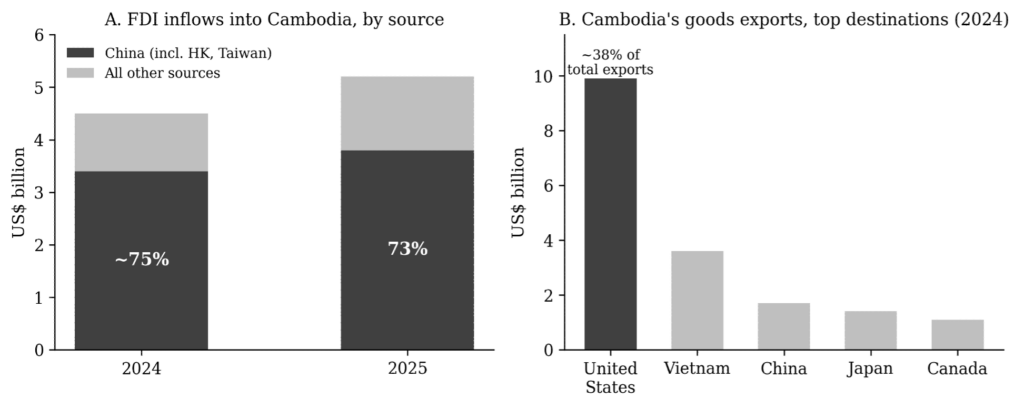
Figure 1. Cambodia’s dual exposure. Panel A: FDI inflows by source, US$ billion (2024: Council for the Development of Cambodia, via U.S. Department of State; 2025: National Bank of Cambodia). Panel B: goods exports by destination, 2024, US$ billion (General Department of Customs and Excise of Cambodia); U.S. share of total exports per U.S. Department of Commerce, International Trade Administration.
Of note, three features make this configuration more dangerous than the two headline numbers suggest. First, the import gap means Cambodia cannot retaliate against the United States in any meaningful way. There is nothing to retaliate with, and that is why accommodation was the only realistic option from the first day of the tariff crisis. Second, the two dependencies are connected. Chinese capital sits in the same export factories that supply the American market. Measures aimed at Chinese capital therefore hit Cambodian exports, and measures aimed at Cambodian exports hit Chinese capital. Each power’s leverage travels through the other’s network. Third, the exposure is concentrated in one industry. Garments, footwear, and travel goods run on thin margins, mobile buyers, and little pricing power, and they employ hundreds of thousands of workers whose livelihoods move with the tariff schedule.
The solar industry shows what this intersection looks like under stress. Cambodian solar exports to the United States were built almost entirely on Chinese-owned production. They reportedly fell from US$2.4 billion in 2023 to roughly US$6 million in the first nine months of 2025, a drop of more than 99 percent, first in anticipation and then under the weight of the U.S. trade-remedy decisions discussed below.9
What 2025–2026 Revealed: Mechanisms and Limits
This section draws on an event dataset the author compiled from executive orders, Federal Register notices, Congressional Research Service reports, and Cambodian government instruments. The dataset codes each measure by legal basis, effective date, status, and impact, separating announced measures from those actually implemented. The distinction matters. The 2025–2026 record is full of rates that were declared but never collected and deals that were announced but never signed. Three layers emerge from the data: a headline tariff negotiation, a set of quieter mechanisms that produced the entrapment dynamic, and a series of events outside Cambodia’s control that show the limits of its agency.
The tariff track. On April 2, 2025, Executive Order 14257 declared a national emergency over goods-trade deficits and set country-specific “reciprocal” tariff rates. Cambodia’s rate of 49 percent was the highest in Southeast Asia during the first announcement by President Trump in April 2025.10 The number came from a formula: the bilateral deficit divided by imports, then halved. The formula punished Cambodia for being a small economy that runs a large surplus with a country from which it imports comparatively little.. No one in Washington made a judgment about Cambodia to reach that number, and that is the point. This kind of exposure does not require being targeted.
Cambodia chose accommodation immediately. Within two days, Prime Minister Hun Manet wrote to President Trump proposing negotiations, and Cambodia cut its own tariffs on nineteen categories of U.S. goods from a maximum of 35 percent to 5 percent, before the 49 percent rate had even taken effect.11 The government chose accommodation over retaliation and over any ASEAN collective response, and it never changed course.12 The 49 percent rate was suspended the day it technically took effect. A presidential letter in July reset Cambodia at 36 percent with no published methodology, which moved the pressure from a formula to personal discretion. On July 31, Executive Order 14326 set Cambodia at 19 percent, effective August 7.13 That rate put Cambodia level with Thailand, Malaysia, Indonesia, and the Philippines. Months of intensive negotiation had bought parity, not advantage. On August 8, Cambodia delivered its full concession: zero tariffs on all U.S. imports across 11,414 tariff lines, formalized through sub-decree and ministerial instruments.14 Figure 2 traces the sequence and separates rates that were collected from rates that were only announced. The order of events matters here. Cambodia’s full concession came after the rate cut, not before it, so it ratified a decision Washington had already made rather than paying for one.
The Agreement on Reciprocal Trade (ART), signed by the two leaders in Kuala Lumpur on October 26, 2025, locked in the structure. Cambodia eliminates tariffs on all U.S. industrial and agricultural goods. The United States keeps its 19 percent rate, with a short list of exempted products.15
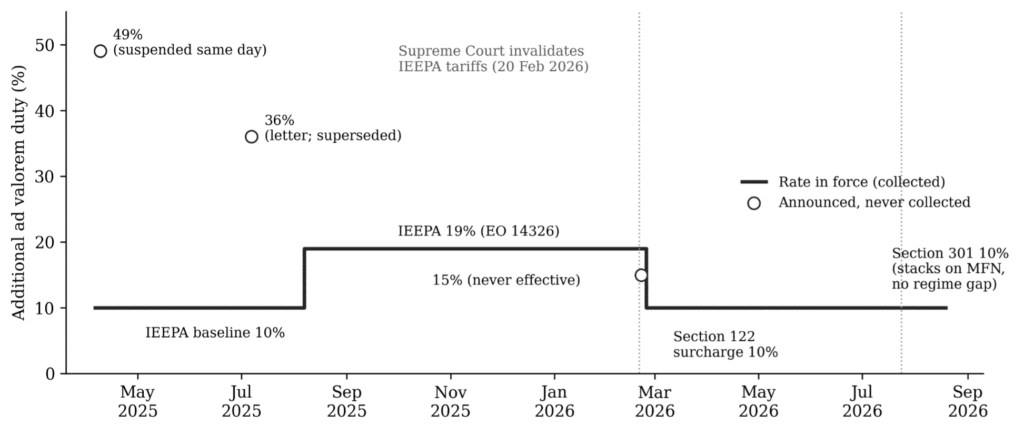
Figure 2. Additional U.S. tariffs on Cambodian goods, April 2025–August 2026. Solid line: rates in force and collected. Hollow markers: rates announced but never collected. The Section 301 duty (from July 24, 2026) stacks on normal MFN rates, unlike the preceding regimes. Compiled by the author from Executive Orders 14257, 14266, and 14326; Proclamation 11012 of February 20, 2026, under Section 122 of the Trade Act of 1974; and 91 Fed. Reg. 47318. The underlying dataset was compiled by the author in an Excel Sheet; the chart was prepared with AI assistance.
Three mechanisms of entrapment. The entrapment dynamic shows up in three quieter instruments rather than in the headline rates. First, the same July order that set the 19 percent rate created a 40 percent penalty for goods transshipped through a third country to evade duties. In practice, the rule turns Cambodia’s customs administration into the enforcement agent against Chinese rerouting, and the penalty falls on exports declared as Cambodian.16
Second, the ART’s export-control clauses commit Cambodia, case by case and upon request, to align with U.S. export controls, prevent backfilling, screen and share customs data, and restrict dealings with entities on the Commerce Entity List and the Treasury SDN List. Chinese firms figure prominently on both lists.17 The structure is simple to describe. The United States lifts restrictions on Cambodia, while Cambodia agrees to apply U.S. restrictions against third parties. The language is heavily qualified, and Cambodia’s administrative capacity is limited, so compliance in the near term will likely be selective. But the legal commitment now exists, and it points at Cambodia’s largest investor.
Third, and least noticed, is the trade-remedy track. The solar antidumping and countervailing-duty investigation began under the Biden administration on a petition from private industry, so it belongs to a legal process that runs on its own track rather than to any administration’s Cambodia policy. It ended in April 2025 with countervailing rates for most Cambodian respondents of 3,403.96 percent.18 Procedure, not economics, produced that number. The respondent firms told the Commerce Department they could not afford to keep litigating, and the “adverse facts available” rule then assigned them the margins the petitioners had alleged. Because firms from a least-developed country could not sustain an expensive U.S. legal process, they received duty rates about a hundred times higher than their neighbors’. The doctrine behind the case matters more than the rates. the US authorities found that Chinese state subsidies flowing to Chinese-owned factories in Cambodia could be countervailed against Cambodian exports. This was among the first affirmative findings of transnational subsidies.19 Unlike the transshipment rule, the doctrine needs no proof of routing. It reaches Cambodian-made goods because of who owns the factory, and that ownership model underpins much of Cambodia’s special-economic-zone development. If the doctrine spreads beyond solar, the garment, footwear, and electronics sectors are all exposed.
The sequence also crossed into the security domain. In late July 2025, while Cambodian–Thai border fighting was underway, Washington publicly made a ceasefire a condition for tariff negotiations. The Congressional Research Service confirms the linkage, and the peace accord and the trade agreement were signed at the same Kuala Lumpur venue on the same day in October.20 A month later, the United States lifted the export restrictions and arms embargo it had imposed in 2021 over, among other concerns, Chinese military access at Ream. Cambodia received this security concession while it was performing on trade. The main material penalty attached to the Ream file was removed without any publicly observed change at Ream itself.21
The limits. Cambodia was among the first twenty countries given access to negotiations. It kept its commitments, including a Boeing order signed in February 2026 at roughly twice the volume the agreement specified. Its ART undertakings also earned it a Cambodia-only list of tariff exemptions when the Section 301 forced-labor action arrived in July 2026, a payoff that nobody had planned.22 Most importantly, the limits of Cambodian leverage are just as clear. The largest single cut in Cambodia’s rate, from 19 to 10 percent in February 2026, came from U.S. domestic litigation in which Cambodia played no part, when the Supreme Court ruled that the International Emergency Economic Powers Act does not authorize tariffs.23 The replacement regimes arrived just as unilaterally. A Section 122 surcharge was invoked within hours of the ruling and later held unlawful by the Court of International Trade.24 A Section 301 forced-labor tariff followed, and it stacks without a cap on top of normal MFN rates. A Cambodian garment line facing roughly 16.5 percent MFN now pays roughly 26.5 percent, while developed partners that negotiated caps pay 16.5.25 A parallel Section 301 investigation into “structural excess capacity” remains open. It rests on the same bilateral-surplus logic that U.S. courts have now rejected twice under other statutes, and it could restore country-specific rates under a third legal label.26Cambodia has faced four statutory tariff regimes in eighteen months. For a small state, the deeper cost is not any single rate. It is learning that no concession buys stability.
Widening the Corridor: Three Policy Directions
If Cambodia’s entrapment remains a tendency rather than a settled fact, the task for policy is to preserve, and where possible widen, the country’s room for maneuver before it narrows further. The mechanisms identified above suggest three directions.
First, diversify the sources of FDI. This does not mean decoupling from Chinese capital, which would be neither feasible nor desirable for an economy at Cambodia’s stage of development. It means gradually changing the mix of new inflows, because concentration itself now carries a price under U.S. trade-remedy doctrine. After the transnational subsidies finding, the ownership of a factory can determine the tariff its exports face. Practical steps include making fuller use of the free-trade agreements with Korea, the Gulf countries, and the United Arab Emirates and of Regional Comprehensive Economic Partnership (RCEP); directing investment promotion toward Japanese, Korean, European, and Gulf capitals in the sectors where the doctrine bites hardest; and, the harder part, fixing the investment-climate problems that have kept non-Chinese capital away, including transparency, dispute resolution, and regulatory predictability. Diversification, seen this way, is not a geopolitical slogan. It is risk management against a documented legal doctrine.
Second, build permanent negotiating and legal capacity. The solar case is the lesson. Cambodian producers received duty rates about a hundred times higher than their neighbors’ not because their subsidies were larger, but because they could not afford to litigate. A standing trade-remedy defense would include a permanent professional negotiating team instead of senior officials seconded case by case, retained U.S. trade counsel, systematic monitoring of Federal Register dockets and comment deadlines, and cost-sharing with ASEAN peers facing the same instruments. Together these would cost a fraction of one year’s tariff losses. In the current environment, a Section 301 docket can matter more than a summit. The 2026 proceedings showed that written submissions and hearing participation now shape outcomes for small economies as much as leader-level diplomacy does.
Third, invest in rules-of-origin and compliance systems. The transshipment penalty, the forced-labor regime, and the pending cotton-linked tariff-rate quotas all land on Cambodian administrative capacity: customs data, origin verification, labor-standards enforcement. This is usually described as a burden imposed from outside. It is better understood as an asset built at home. Demonstrated compliance is what earned Cambodia its exemption list in July 2026, and it will decide whether the tariff-rate quotas, once established, bring real relief to the garment sector or stay on paper.27 The same systems protect Cambodia on both fronts. Strong origin verification shields exports from U.S. penalties and gives Phnom Penh a rules-based answer to any Chinese pressure over enforcement.
These three directions share one feature. They are investments in what could be called sovereignty infrastructure. None of them picks a side. Each one raises the cost, for either power, of using Cambodia’s economy as an instrument, and each one preserves the options that any future hedging will need.
Redefining Peace: Diversification as a Shared Interest
What, then, should peace mean in a geo-economic era? It cannot mean the end of U.S.–China competition over chokepoints — no small state can produce that outcome, and no realistic forecast predicts it. The proposal advanced here is narrower and more practical: Washington and Beijing should treat small-state economic diversification as a shared interest rather than a contested asset.
For Washington, the record above carries a warning about its own tools. A partner that signed one of the first binding agreements of the reciprocal-tariff era still faces an uncapped tariff stack on its main export and an open excess-capacity investigation. Other small states will draw the obvious lesson: an agreement buys neither preference nor stability. Washington could change that lesson. It could cap stacked rates for least-developed partners that comply, fund the compliance capacity its own instruments demand instead of merely requiring it, and deliver the promised quotas on schedule. Those steps would turn a coercive architecture into something closer to order, and they would make the next negotiation with the next small state easier rather than harder.
For Beijing, concentration has begun to defeat itself. The transnational subsidies doctrine destroyed a Cambodian solar sector that was overwhelmingly Chinese-owned. The capital that concentration placed in Cambodia was the capital the countermeasure burned. A Cambodia with more diverse investors and stronger origin systems would be a more stable and less targeted host for the Chinese capital that stays.
For both, the point is the same. A small state with real options is a less contested intersection, and less contested intersections are what peace in this era is made of. Cambodia’s asymmetric entrapment is a trajectory, not a destiny. Trajectories are corrected early or not at all. The record of 2025 and 2026 suggests the window for correction is still open but actively closing.
Chhay Lim is Designated Deputy Director & Researcher at Center for Southeast Asian Studies of Institute for International Studies and Public Policy.
This essay is published as part of The Carter Center’s Emerging Voices for U.S.-China Cooperation, a conference for early career U.S.-China experts.
References
- Caroline Freund, Aaditya Mattoo, Alen Mulabdic, and Michele Ruta, “Is US Trade Policy Reshaping Global Supply Chains?,” Journal of International Economics 152 (2024). The study finds that the reorientation of U.S. imports since 2017 is consistent with a “China plus one” strategy, and that the countries replacing China as suppliers to the U.S. market are those most deeply integrated into Chinese supply chains. https://www.sciencedirect.com/science/article/abs/pii/S0022199624001387
- Henry Farrell and Abraham L. Newman, “Weaponized Interdependence: How Global Economic Networks Shape State Coercion,” International Security 44, no. 1 (2019): 42–79.
- Albert O. Hirschman, National Power and the Structure of Foreign Trade(Berkeley: University of California Press, 1945).
- Kuik Cheng-Chwee, “The Essence of Hedging: Malaysia and Singapore’s Response to a Rising China,” Contemporary Southeast Asia 30, no. 2 (2008): 159–185.
- U.S. Department of State, 2025 Investment Climate Statements: Cambodia(Washington, DC, 2025), citing Council for the Development of Cambodia data, https://www.state.gov/reports/2025-investment-climate-statements/cambodia.
- National Bank of Cambodia data, reported in “Cambodia Attracts $5.2 Billion in FDI in 2025, China Accounts for Over 70% of Inflows,” Cambodia Investment Review, February 2, 2026, https://cambodiainvestmentreview.com/2026/02/02/cambodia-attracts-5-2-billion-in-fdi-in-2025-china-accounts-for-over-70-of-inflows/.
- U.S. Department of Commerce, International Trade Administration, “Cambodia — Market Overview,” Country Commercial Guide, 2025, https://www.trade.gov/country-commercial-guides/cambodia-market-overview.
- Office of the United States Trade Representative, “Cambodia,” country page, https://ustr.gov/countries-regions/southeast-asia-pacific/Cambodia-.
- See U.S. Department of Commerce, “U.S. Department of Commerce Announces Final Determinations in Antidumping and Countervailing Duty Investigations of Solar Cells from Cambodia, Malaysia, Thailand, and Vietnam,” press release, April 2025, https://www.trade.gov/press-release/us-department-commerce-announces-final-determinations-antidumping-and-countervailing; and “US Sets Antidumping Duties for Southeast Asian Solar Cells,” PV Tech, https://www.pv-tech.org/us-sets-antidumping-duties-for-southeast-asian-solar-cells/ Export figures compiled from U.S. trade data as reported in coverage of the determinations.
- Executive Order 14257, “Regulating Imports with a Reciprocal Tariff to Rectify Trade Practices that Contribute to Large and Persistent Annual United States Goods Trade Deficits,” April 2, 2025.
- “Cambodia Seeks Negotiations after U.S. Imposes 49 Pct Tariff on Products,” Xinhua, April 4, 2025, https://english.news.cn/asiapacific/20250404/3a4cdc8d3d954dc38355d337ddc1a666/c.html.
- On the accommodation strategy, see “Cambodia Prioritizing Diplomacy in Trade Negotiations with the U.S. in Response to Tariffs,” US-ASEAN Business Council, https://www.usasean.org/article/cambodia-prioritizing-diplomacy-trade-negotiations-us-response-tariffs.
- Executive Order 14326, “Further Modifying the Reciprocal Tariff Rates,” July 31, 2025.
- U.S. Department of Agriculture, Foreign Agricultural Service, “US and Cambodia Reciprocal Trade Agreement,” GAIN Report No. CB2026-0001, February 11, 2026 (documenting Sub-decree No. 139, Prakas No. 632, and Instruction No. 3724/25, and reporting implementation).
- “Agreement Between the United States of America and the Kingdom of Cambodia on Reciprocal Trade,” The White House, October 26, 2025, https://www.whitehouse.gov/briefings-statements/2025/10/agreement-between-the-united-states-of-america-and-the-kingdom-of-cambodia-on-reciprocal-trade/.
- Executive Order 14326 (see note 13).
- Agreement on Reciprocal Trade (see note 15), provisions on export controls and economic security.
- U.S. Department of Commerce, final determinations press release (see note 9).
- “Crystalline Silicon Photovoltaic Cells, Whether or Not Assembled Into Modules, From Malaysia and Thailand: Amended Final Countervailing Duty Determinations; Crystalline Silicon Photovoltaic Cells, Whether or Not Assembled Into Modules, From Cambodia, Malaysia, Thailand, and the Socialist Republic of Vietnam: Countervailing Duty Orders,” 90 Fed. Reg. (June 24, 2025), FR Doc. 2025-11589, https://www.federalregister.gov/documents/2025/06/24/2025-11589/crystalline-silicon-photovoltaic-cells-whether-or-not-assembled-into-modules-from-malaysia-and.
- Congressional Research Service, “Cambodia,” In Focus IF10238, https://www.congress.gov/crs-product/IF10238.
- Congressional Research Service, “Cambodia” (see note 20).
- Office of the United States Trade Representative, “Notice of Actions in Section 301 Investigations of Acts, Policies, and Practices of Various Economies Related to the Failure to Impose and Effectively Enforce a Prohibition on the Importation of Goods Produced with Forced Labor,” 91 Fed. Reg. 47318, July 28, 2026, https://www.federalregister.gov/documents/2026/07/28/2026-15181/notice-of-actions-in-section-301-investigations-of-acts-policies-and-practices-of-various-economies.
- Learning Resources, Inc. v. Trump, decided together with Trump v. V.O.S. Selections, Inc., 607 U.S. ___ (2026).
- State of Oregon v. United States and Burlap and Barrel, Inc. v. United States(U.S. Court of International Trade, May 7, 2026) (invalidating Proclamation 11012 of February 20, 2026).
- 91 Fed. Reg. 47318 (see note 22), Annex II, including the tariff caps negotiated by certain developed partners.
- Office of the United States Trade Representative, “Initiation of Section 301 Investigations: Acts, Policies, and Practices of Certain Economies Relating to Structural Excess Capacity and Production in Manufacturing Sectors,” 91 Fed. Reg. (March 17, 2026), Dockets USTR-2026-0067 and USTR-2026-0068 (investigations initiated March 11, 2026), https://www.federalregister.gov/documents/2026/03/17/2026-05214/initiation-of-section-301-investigations-acts-policies-and-practices-of-certain-economies-relating.
- 91 Fed. Reg. 47318 (see note 22), including the direction to establish tariff-rate quotas for Bangladesh, Cambodia, Indonesia, and Malaysia.