
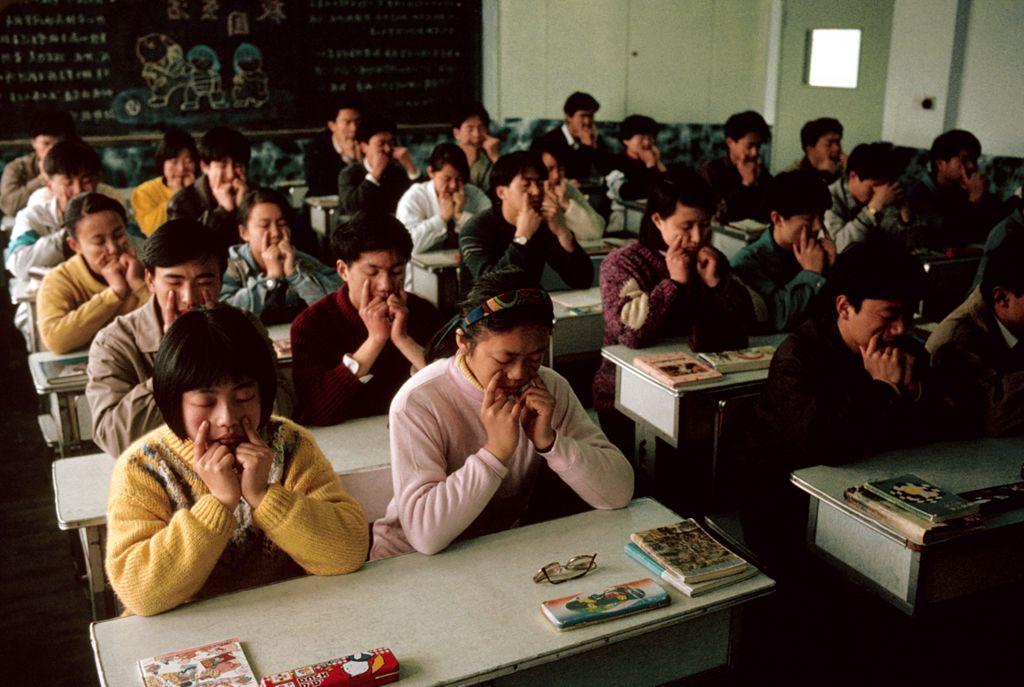
How has the mass expansion of higher education in China over the past three decades reshaped the college experience, employment prospects, and society at large? Why are age anxiety and the “good-student mentality” so pervasive among Chinese youth? The “Schoolification” of society, according to Xiang Biao, distorts intimate relationships, diminishes the richness of life experience, and leads to social isolation.
The director of the Max Planck Institute for Social Anthropology in Germany, Biao Xiang’s research interests span migration, labor, education, state–individual relations, public consciousness, and economic transformation. Xiang studied sociology at Beijing University, China, and received his PhD in social anthropology from the University of Oxford, UK. He was a professor of social anthropology at Oxford before he joined MPI in 2021. Through public-facing articles and interviews, Xiang’s ideas regularly generate wide discussions in China and beyond.
AL: How should we understand the expansion of Chinese higher education since the 1990s? You noted that “the core crisis facing universities today is the shrinking of public life. Universities focus only on academic output and the utilitarian goal of talent cultivation, gradually losing sight of their essential mission as communities of thought, life, and emotion.” Spell it out for our readers.
XB: There’s this interesting comment on social media: Chinese universities have now become like high schools. College students I’ve interviewed said that it’s just like high school all over again, as they are kept constantly busy by packed schedules and have so little free time. University teachers complained to me that they had to teach more because, from the university administrators’ point of view, “If you don’t make the students busy, they will make you busy.” Universities think that teachers have to occupy students’ attention and monitor them, so they won’t have free time to do something else. Even more so since COVID, there’s very little friendship, debate, or free exploration in college. Universities increasingly become a training institution rather than a community of ideas.
In the classroom, there is very little engagement and eye contact, which teachers really complain about. A professor at one of China’s elite universities told me that she now teaches a class of 200 students. After teaching for 45 minutes, she announces a 15-minute break. Apart from a few students who go to the restroom, she is the only one who gets up, goes downstairs, and takes a short walk. Everyone else remains seated in the classroom, eyes glued to their phones, laptops, and tablets. They have become conditioned to see the break as an opportunity to get a spreadsheet done or to keep looking at their tablets.
I know for a fact that a painful common experience for many young people is that when a family member dies, normally a grandparent, while they are in secondary school, they may not even know about it because their parents conceal it from them. And this is not limited to death; there are all kinds of other family matters that parents conceal from their children. Normal life experiences are treated as a disruption to learning and have to be suppressed.
There are many other examples. A friend once told me that, when he was in secondary school, his father told him that the friends he was making at school weren’t really worth spending so much time on. These were not particularly meaningful friendships, his father said, because in a couple of years everyone would go their separate ways, and those friendships would simply dissipate. What mattered now was focusing on one’s studies, getting into university, and a good one, for that matter. Only there, he was told, would he find truly “high-quality” friends. Under this kind of reasoning, one’s relationships with family, friendship, and those around them all begin to become distorted.
AL: Beyond exam-oriented education, another feature distinctive to Chinese society is sensitivity to age. Why has age become such an important source of anxiety in Chinese society?
XB: Yes, anxiety about age. Young people feel that if they haven’t achieved certain goals by the age of 35, they are basically finished. This applies whether you are trying to establish yourself in an academic department or advance within the government bureaucracy or technology companies. In China, you’ll see job advertisements that very clearly specify that a position is open only to people below a certain age. Postdoctoral applications openly reject applicants over the age of 35.
If you ask young Chinese people what’s causing their anxiety, many will tell you that they feel that one misstep would lead to a series of missteps. Many people have developed this kind of catastrophic thinking. Life is step-locked; one must do the right thing at the right age. They have to be extremely careful at every step, constantly planning ahead and making sure that they make the right decisions. Hence an extreme sensitivity to the biological clock.
It has to do with how education and career trajectories are structured in China. Public institutions and government organizations structure career trajectories in a rigid, linear way. In the case of high school teachers, being rejected for promotion once will lead to serious ramifications in terms of prestige, pay, and future opportunities. If you boil it down to one point, it’s really the formalization of life trajectories in the past few decades.
AL: Before, you talked about how universities today have become high-school-like. But you also observed that “Chinese society as a whole has become ‘school-like.’ Companies are also called campuses, and colleagues address one another as ‘classmates.’” Fascinating. Tell us more.
XB: This is not entirely unique to China. High-tech companies in Silicon Valley also present themselves as campuses. But China really intensified this tendency. In companies, public institutions, and even government offices, colleagues address each other as “classmates” (tongxue).
Why is that? It’s first related to what I just mentioned, the formalization of life trajectories due to the massification of higher education and the growing economic importance of large companies and institutions. The high-tech industries are playing a more important role not only in offering employment but also in structuring social life in general. Workplace management itself often reproduces the structures of school administration. Under their paternalistic management, employees naturally feel as if they’re still in school.
There is also an underlying desire on the youngsters’ part that society be as easy to navigate as school. Because the majority of their early life is spent studying, and they befriend mostly only schoolmates, school life becomes all the life they know. Many young people today are really reluctant to leave school and enter society, never feeling themselves quite prepared for it, really. And another important part of it is that, being a very well-protected generation, young people become less receptive to taking on all kinds of challenges. This is something very different from my time. When I finished college, we were all fairly excited and enthusiastic about starting work, earning salaries, and beginning a new chapter.
AL: Well, that’s interesting. I had interpreted the “classmate” lingo as irony. The running joke on RedNote is that you no longer get fired from a company these days, but only “graduate” from it, per the euphemistic language used by employers when it comes to layoffs.
XB: Yes! The question is why the company would choose this specific term, “graduation,” to describe a dismissal. And I think it reflects a popular desire, hoping that social and professional life is like school, guided by clear, single-rule principles, and where nobody will fire you.
Many of my interlocutors told me that they really carry the so-called haoxuesheng mentality, the good-student mentality. It’s about always worrying about criticism from figures of authority, whether your boss, supervisor, or superior, and wanting to outperform expectations to be recognized and praised. My research finds a strong tendency among young employees to delight their supervisors with their outstanding performance. This creates a huge burden on themselves, even if the bosses are impressed.
AL: In recent years, one popular social trend of thought has been “social determinism.” Some of its most extreme arguments even hold that everything is predetermined in the mother’s womb. In sum, a fatalistic narrative that distrusts individual agency, most commonly associated with the notion of xiaozhen zuotijia. How do you understand this line of thinking? Does it reflect reality?
XB: Well, it does reflect the fact that society is becoming increasingly unequal. The gap between the rich and the poor is widening as the channels for upward mobility are narrowing. But, of course, that kind of fatalistic ideology can be dangerous, as it denies one’s own agency altogether and renders one passive. It leaves one longing for messianic salvation as they feel that they’re condemned to subordination.
The concept of xiaozhen zuotijia, or “small-town exam achievers,” is illuminating. The concept was coined in the 2010s and became a widespread form of self-consciousness. Small-town exam achievers have grown up through a process of self-negation. Their task has been to leave themselves behind, to leave their hometowns, and to disown the circumstances into which they were born.
On the one hand, small-town exam achievers recognize that they are objectively successful. They excel academically and achieve upward social mobility. This is a fairly typical pathway to “changing one’s destiny”. But these people’s biggest annoyance is that they feel out of place in their newly acquired positions. They do not feel at home there, often lost, lonely, and confused in their work and everyday lives, not relaxed for a bit.
Small-town exam achievers often attribute this sense of estrangement to their upbringing. Coming from rural areas, they feel that they have not been adequately exposed to the wider world and lack the social capital that their urban peers have. But I think the cause of their difficulty lies somewhere else. It is not because of the social backgrounds that make small-town exam achievers feel out of place, but it is precisely their constant effort to deny their backgrounds that makes them feel estranged. They have devoted so much of their energy to changing their destinies. But the problem is that the meaning of life has never simply concerned changing one’s destiny. The meaning of life is to allow one’s destiny to unfold and then to experience, feel, and enjoy it.
AL: Over the past decade or so, online discussions about “toxic parents,” unhappy childhoods, and emotional abuse have really picked up steam. Increasingly, young Chinese people are recognizing that home, instead of the supposed source of warmth and security, is often a root cause of pain and suffering. How do you understand the dynamics of parent-child relationships in contemporary Chinese society?
XB: I have distinguished two forms of interpersonal recognition: “Recognition-as-approval” (renke) and “Recognition-as-understanding” (rende). I introduce the distinction between validation and understanding to discuss how people experience a sense of their own worth and existence. You can gain recognition in two ways. One comes through validation by an authority; the other comes through being understood by peers, especially friends.
If we break this down further, there are two important differences between understanding and validation.
First, understanding is a process that takes place between two individuals, whereas validation is between a system and an individual. For example, when my supervisor validates me, the supervisor is not simply a person but a representative of the system. Secondly, understanding implies equality. When I understand you, I place you and myself on an equal footing. When a supervisor tells a subordinate, “I understand how you feel,” what they are doing is lowering themselves to assert equality with the interlocutor. Validation works in the opposite direction and implies some kind of hierarchy, and it involves an affirmation of one’s worth.
Second, validation is one-directional; it is a judgment about an individual, and individuals who pursue validation cannot influence the system itself. Understanding, by contrast, is reciprocal and can only be achieved through two-way communication. If you want others to understand you, you will need to make an effort to understand others. Genuine understanding is achieved through resonance, empathy, and mutual opening up.
Obviously, we need both forms of recognition. The problem in Chinese society now is that “recognition-as-approval” has become a precondition for “recognition-as-understanding”. You need to have renke first before having rende. Naturally, children want to be understood by parents, but they sense that if they want to be understood, they must first receive validation by, for example, getting good grades. This is ubiquitous in Chinese families. “If you get a perfect score, Mom will take you out to the park.” Love is turned into a conditional transaction. It seems that many parents cannot imagine understanding their children apart from through validation. The resulting blow to young children’s sense of existence is enormous. This is what causes so much pain within Chinese families.
Chinese families teem with the notion that “love is conditional,” that is, one has to prove that one deserves love and attention. This is the core reason why so many young people have felt that life is burdensome since childhood. Most would agree that they receive love; it’s just that the sense of conditionality baked into love by families, schools, and society turns the supposed source of nourishment into a burden. The reason so many adults sacrifice so much time and energy in pursuit of success and validation is precisely that they see it as the prerequisite for being loved.
Here’s a typical example. I know a PhD candidate who’s frequently pressured to get married but who has no interest in marriage at all. Exasperated, her mother told her, “If you manage to bring home a Nobel Prize, I will ask you to get married.” What is the logic behind this exchange? If marriage is the gateway to happiness, what does it have to do with a Nobel Prize? What her mother meant was that her willingness and effort to understand her daughter are conditioned on external validation: “If society highly validates you, then I will treat you more fully as a human being and make a greater effort to empathize with your feelings.”
AL: I suppose you’re trying to make the case that validation, based on objective criteria, eliminates genuine affection for one’s family members.
XB: That’s right. Comparing a family member to somebody else, for instance, comparing my son to my neighbor’s son in exam scores or incomes or whatever, is a typical example of how validation distorts affection. Comparisons like this feel very odd for those who are being compared, but it’s seen in all kinds of intimate relationships in China. Your parents comparing you with other people when you’re already in your twenties or thirties can be deeply hurtful. Your parents might point out that their colleague’s son earns more than you, or that your high school classmate is already married. It may very well be true, but it registers rather painfully for the listeners, as though their parents are telling them that their existence has no value. They’d think, “My parents are the very people who love me with their lives and have sacrificed so much for me. And yet they are telling me that they cannot see my worth.”
In China, people often speak about family members, especially spouses, as though they were replaceable or interchangeable. People compare their partners with others and make hypothetical statements: “If I had married someone else,” or “If you (my spouse) were more like Xiao Wang next door, I would be better off.” They entertain the possibility that their children or spouses could be different people, someone else with a better job, a more attractive personality, in sum, someone who is more presentable to outsiders. It’s all about the instrumentality of their family member, in lieu of the person himself. This approach to family leaves people with deep psychological scars, oftentimes hurtful for a lifetime.
I’d also like to talk a bit about parents from rural backgrounds. Many of them settle in cities, buy a home, and obtain urban residency, allowing their children to attend public schools in their residential district. Others stake everything on getting their children into the very best schools. People who come from rural society sometimes have a kind of retaliatory desire to turn their lives around, to finally “make it.” The very act of sending a child to a private school carries enormous symbolic significance, and it is also a declaration to the child: “Look how much I care about you.” Today, there are all kinds of what might be called irrational investments in children. In urban settings, this investment takes the form of tutoring, summer camps, and winter camps. This declaration of devotion to their children is a way for a generation of Chinese people to compensate for the meaning they feel their own lives have lacked.
The meaning of these rural-background parents’ entire lives was oriented toward an imagined future for their kids, which takes the form of infinite investment. Their investments are not necessarily about anticipating a particular future for their children, but rather about redeeming their own past. Because their past was marked by enormous incompleteness, they feel the need to fill the blanks of their past and account for what they went through by compulsively investing in their children’s education.
AL: What’s the most needed change in Chinese society today?
XB: I think the most important change is a redefinition of the meaning of life. It is remarkable that many people still believe that the shortage of resources is a major problem. Education became so suffocatingly competitive in China exactly at the same time as a tremendous expansion in educational resources. Between 1999 and 2020, the total enrollment in Chinese higher education institutions increased sixfold. Why do people feel the resource is so scarce? Because everyone believes that only Peking University and Tsinghua University are the most desirable universities, and all the rest are inferior. Then the vast majority of the people feel inadequate and deprived. So the problem is the narrowness of our evaluation and meaning system. I feel that there’s a kind of suicidal simplification of our own lives.
But does everyone really want to befriend the supposedly most outstanding people? I doubt it. We’re normally attracted to those who are a little lazy or laid-back, but interesting. Children become close friends often simply because they live near each other and regularly walk to and from school together. Children don’t consciously choose but gradually come to appreciate the distinctive and complementary aspects of each other’s personalities.
We need richer ways of appreciating one another. We really need to make school life richer and more lively. We need to make the school more like society and make society less like a school.
For more of Xiang’s academic writings on relevant topics, see
(1) 66th Edward H. Hume Memorial Lecture, Hierarchical Egalitarianism, Xiang Biao: watch
(2) Ambition: Migration, Desire and Fatigue in China by Professor Biao Xiang: watch
(3) Two Modes of Recognition: Rende (Recognition-as-understanding) and Renke (Recognition-as-approval): https://www.researchgate.net/publication/395392066_Two_Modes_of_Recognition_Rende_Recognition-as-understanding_and_Renke_Recognition-as-approval