
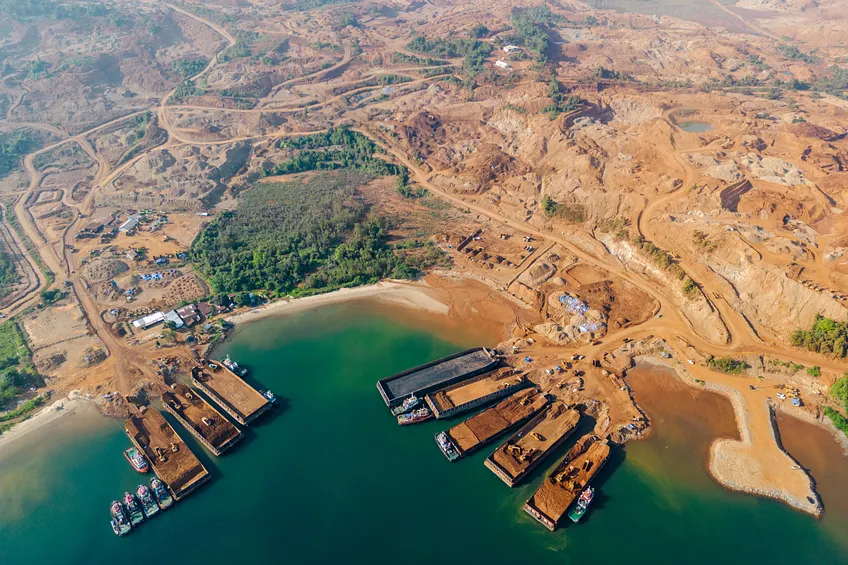
When U.S.-China rivalry reaches Indonesia, it rarely arrives as an explicit demand to choose Washington or Beijing. More often it is translated into questions of access: who may mine, process, invest, export, supply technology, or enter a strategic market. In 2026, that politics became unusually visible at Weda Bay Nickel in North Maluku, often described as the world’s largest nickel mine. The mine is a joint venture of China’s Tsingshan Holding Group, France’s Eramet, and Indonesia’s state-owned Antam. Jakarta sharply reduced the production quota for 2026 to 12 million wet metric tons, from 42 million the year before. The cut formed part of a national tightening of nickel quotas that the energy ministry framed as a defense against oversupply and falling prices, and benchmark nickel prices rose 2.2 percent when the cut became public.
A dispute over a mining quota does not initially sound like a story about global order. Yet the same administrative instrument that disciplines a China-linked mining complex also sits inside Indonesia’s bargaining with the United States over critical minerals and supply chains. Jakarta can therefore remain connected to rival economic systems while retaining authority over some of the gateways between them. I call this brokered recoupling: rival economic systems reconnect through a third country that retains enough regulatory control to bargain over the terms of reconnection.
My own fieldwork on Indonesia’s nickel downstreaming and its place in U.S.-China competition backs this up. That fieldwork consists of 47 elite interviews with policymakers, investors, and strategic-policy specialists, read alongside official documents and news reporting. In those interviews, the same set of tools kept coming back: licensing, production quotas, ownership arrangements, access to state institutions. These are what determine how foreign capital gets accommodated, and how it gets disciplined. Indonesia’s room to maneuver is not just a function of its resource wealth or its formal non-alignment; it gets built, deliberately, through regulatory decisions.
That makes the domestic question central: who does the brokering? Indonesia’s democracy has been eroding for about a decade. V-Dem’s liberal democracy index for the country fell from roughly 0.5 in 2016 to 0.3 in 2025, and in March 2025 parliament amended the armed forces law to let active-duty officers hold posts in 14 state institutions, up from 10.
Great-power rivalry did not create Indonesia’s democratic backsliding. But in a political system where checks and balances have weakened considerably, external competition raises the strategic value of regulatory powers that are already concentrated in the executive. I describe this as a geopolitical executive premium where rivalry rewards institutions able to bargain quickly and selectively, while representative scrutiny often follows later. The argument is therefore not that U.S.-China rivalry causes authoritarianism, but that an already centralizing state may find executive discretion increasingly useful as economic interdependence becomes strategic.
Non-Alignment Meets Its Economic Limits
Indonesia’s position is often described as hedging or polyalignment: maintaining relations with competing powers rather than choosing one. But polyalignment is not always the product of a coherent grand strategy. Decades of globalization have embedded firms, ministries, and supply chains in overlapping networks that governments would struggle to unwind even if leaders wanted a clean geopolitical choice. Connector status can therefore be partly a de facto condition. Bargaining power still must be made.
Indonesia is not an indispensable global chokepoint. Nothing forces Washington or Beijing to route supply chains through Jakarta. Its leverage is narrower and partly constructed through policy: the ore-export ban, annual production quotas, domestic-ownership rules, state-company participation, and negotiated market access. These instruments matter internationally because Indonesia controls valuable resources and a large market. They matter domestically because most can be adjusted through ministries, regulators, and state enterprises without first passing through a full legislative process.
The important question is therefore not simply whether Indonesia can bargain with both powers, but who controls the instruments through which that bargaining occurs. Nickel, the U.S. trade agreement, and Nusantara show three versions of this problem: control over a strategic commodity, negotiation over market access, and choices between technological ecosystems.
Nickel: Control over the Gateway
Indonesia’s nickel downstreaming policy is usually read as resource nationalism, as publicly hailed by the government. It banned raw-ore exports to force processing onshore and attracted tens of billions of dollars into new industrial parks. Yet this success also deepened dependence on Chinese finance, technology, and firms. A C4ADS investigation found Chinese firms controlling roughly three-quarters of Indonesia’s nickel-refining capacity. Some scholarship therefore reads Indonesia’s position less as sophisticated balancing than as dependence shaped by domestic elite interests.
Dependence and bargaining power can nevertheless coexist. Jakarta may rely heavily on Chinese capital while retaining control over ore, licenses, quotas, and ownership requirements. The important test is whether those gateways can be used to extract gains without eroding the investment base on which downstreaming depends, and who inside the state actually makes that judgment.
At Pomalaa, a plant in Southeast Sulawesi designed to process nickel ore into battery materials, the ownership structure captures brokered recoupling in miniature: China’s Huayou Cobalt holds 73.2 percent, Vale Indonesia 18.3 percent, and Ford 8.5 percent. An American carmaker thus enters a supply chain built around Chinese technology and Indonesian ore. U.S. industrial policy may seek to reduce exposure to certain Chinese entities, but the commercial connection is reassembled inside an Indonesian licensing regime that ministries and state enterprises continue to administer.
A related pattern emerged in 2024-25. U.S. rules limited clean-vehicle subsidies for supply chains tied to certain Chinese entities, creating incentives to restructure ownership. Around the same time, Indonesian state-owned mining company Antam bought 30 percent of a nickel producer linked to Chinese-owned Tsingshan Holding Group. The consequential ownership and licensing adjustments are handled primarily through boards, ministries, and regulators. External pressure is translated into domestic industrial arrangements through executive-controlled gateways.
Weda Bay shows both the reach and the limits of this leverage. Its initial 2026 production quota was 12 million wet tons, down from 42 million the year before, a reduction of roughly 70 percent. By early June the operation had exhausted that quota and idled part of its mining activity. As of August this year, Indonesian officials said the company had applied for more, but no increase had yet been approved. In May, the China Chamber of Commerce in Indonesia complained of excessive regulation, corruption, and extortion, citing quota cuts exceeding 70 percent at some mines.
Jakarta, meanwhile, wants more control over price formation. In August, President Prabowo announced plans for a domestic commodity exchange and argued that Indonesia should become a price-setter rather than a price-taker. Energy ministry officials had already said the annual production ceiling was being cut from roughly 379 million tons to 250-260 million, while some Chinese investors began scouting alternatives in Africa and New Caledonia.
My fieldwork suggests that this assertiveness generates considerable ambivalence among Indonesian elites. Some interlocutors worried that repeated intervention in quotas and investment conditions could unsettle investors, encourage relocation, and ultimately weaken the industrial base that downstreaming was meant to build. Yet some of the same elites understood these interventions through a different political register: as resource nationalism increasingly folded into Prabowo’s populist political style. Restricting production, demanding a larger Indonesian share of commodity rents, and promising to turn the country from a price-taker into a price-setter can be presented not simply as technocratic industrial policy, but as evidence of a strong executive reclaiming national wealth from foreign interests. Strategic and populist logics can therefore overlap.
With this in mind, Indonesia can impose costs and renegotiate terms, but only within a narrowing window. Brokered recoupling should not be mistaken for settled strategic strength. It is an ongoing contest over how far Jakarta can use administrative discretion to discipline foreign capital, capture a larger share of value, and sustain a domestic narrative of economic sovereignty without undermining the investment base on which that leverage depends. The contest is also institutionally uneven. Ministries and executive agencies can alter quotas, licenses, and ownership conditions before parliament or other representative institutions meaningfully scrutinize the trade-offs involved. Indonesia’s room for maneuver abroad may therefore come with an executive premium at home.
The U.S. Trade Deal: Access without Equality
The February 2026 U.S.-Indonesia Agreement on Reciprocal Trade reveals the other side of this bargaining. Indonesia reduced a threatened 32 percent U.S. tariff to 19 percent and obtained zero-tariff treatment for 1,819 categories of Indonesian exports. The agreement was signed in Washington on February 19, 2026, alongside US$38.4 billion in commercial packages. This was a real market-access gain for a middle power negotiating with a much larger economy.
Interviews with Indonesian policymakers, however, produced mixed assessments of how far this outcome reflected Indonesia’s bargaining strength. Several top officials regarded Prabowo’s personal closeness to the Trump administration as potentially useful because it created direct political access and room for transactional negotiation at the highest level. Others were more cautious, warning that a personalized relationship could be mistaken for durable structural leverage. Even among those who viewed Prabowo’s rapport with Trump positively, there was recognition that Indonesia’s capacity to convert access into lasting concessions remained limited by the asymmetry of the relationship. Washington could impose tariffs, set market-access conditions, and reshape supply-chain rules on a scale Jakarta could not reciprocate. Personal diplomacy could widen room for maneuver, but only at the margins.
The agreement also extends well beyond tariffs. Its economic-security provisions reach into investment screening, export controls, and measures concerning third-country restrictions. The trade-off is therefore not simply success or submission. Indonesia won immediate concessions while accepting commitments that may narrow parts of its future policy space. Prabowo’s access to the Trump administration was a form of brokerage, but it did not erase the underlying hierarchy. Jakarta could negotiate the terms of adjustment more successfully than a passive rule-taker, yet it could not determine the structure within which the negotiation occurred.
That trade-off also remained legally unsettled. Indonesia had not formally ratified the agreement by late July, and official guidance insisted that the raw critical-mineral export ban remained intact. The government consulted business associations and technical actors during the negotiations, but parliamentary scrutiny became more visible after signature. In July, the relevant parliament commission held a hearing with civil-society groups and acknowledged that it had not yet discussed the agreement in a dedicated meeting with the Trade Ministry. The trade agreement, therefore, shows the executive premium in procedural form: concentrated authority may help Jakarta bargain quickly, while representative scrutiny is left to catch up afterwards.
Nusantara: Where Technology May Force a Choice
Nusantara, the new seat of government that Indonesia is building in East Kalimantan, offers a looser and more prospective version of the same problem. The new capital is designed as a sensor-heavy smart city organized around an integrated command center. Its authority is presidentially appointed and the territory has no elected regional legislature of its own; earlier fieldwork also found weak local participation and limited public oversight in its institutional design. Nusantara is therefore useful not as evidence that geopolitical rivalry caused centralization, but as a case in which strategically important technology choices are being made inside an already executive-centered governance structure.
The technology landscape is mixed rather than cleanly aligned. A U.S.-backed command-center proof of concept brought together Amazon Web Services, Cisco, IBM, and other American firms. Indonesia also conducted a multi-vendor 5G Standalone Open RAN trial at Nusantara, while Telkomsel and Ericsson demonstrated 5G Standalone network slicing. Huawei, meanwhile, remains tied to Indonesia’s wider policy ecosystem through a digital-transformation partnership with Bappenas and cooperation with the labor ministry.
These overlapping ties can emerge through different agencies and firms operating on different timelines. Digital infrastructure may be where that arrangement becomes hardest to sustain because standards, security requirements, and installed equipment create durable dependencies. Open RAN has been promoted as a way to reduce switching costs and dependence on a single supplier, but geopolitical pressure is becoming more explicit. In August 2026, Washington prepared to tell Pax Silica partners that participation in a rival China-led AI framework could be incompatible with future U.S. cooperation. Earlier, the EU warned Vietnam that Chinese participation in its 5G network could deter investment.
For Nusantara, the future test is therefore institutional as well as technological: what happens when access to one ecosystem increasingly requires excluding the other? In an appointed governance structure, external pressure to choose vendors or standards can become a consequential governance decision before representative scrutiny has much opportunity to shape it. Nusantara is weaker evidence of bargaining than nickel, but a useful probe of what happens if technological fragmentation begins to narrow Indonesia’s ability to keep both doors open.
The Domestic Politics of Geopolitical Adaptation
The Indonesian evidence points to a wider comparative proposition. IMF research identifies non-aligned “connector countries” that gain importance as trade and investment are rerouted across geopolitical blocs. Indonesia suggests a more politically specific pattern within that category: a connector state in which regulatory leverage over competing systems coexists with weakening checks on executive authority. Brokered recoupling describes the external relationship; the geopolitical executive premium describes its domestic institutional effect.
Recurrent external shocks increase the relative value of institutions able to act quickly and selectively: executive ministries, regulators, state enterprises, and sovereign funds. Parliaments, courts, and civil society typically operate on slower timetables. A comparable transfer of practical authority towards the executive has been documented in the United States as foreign commerce becomes securitized. The democratic risk is greater where constraints are already weakening because temporary urgency can make discretion more useful and, over time, harder to constrain.
The sovereign fund Danantara illustrates the institutional toolkit. Launched in 2025 to manage roughly US$900 billion in state assets across around 1,000 companies, it quickly became a favored vehicle for new economic tasks. In May 2026, Prabowo proposed giving a Danantara unit a central role in exports of strategic commodities. The fund was not created because of U.S.-China rivalry, and officials later clarified that existing exporters would continue while implementation was phased. But it reveals that when the government wants to respond to external economic pressure, it increasingly reaches for executive-controlled organizations with broad mandates.
In this sense, Indonesia is not unique. Türkiye’s democratic backsliding and presidential centralization developed alongside a turn towards strategic autonomy, while autonomy-seeking also became a source of domestic political legitimation. India offers a more cautious parallel: it has intensified balancing against China while remaining economically interdependent, but the relationship between that strategy and domestic centralization is less clearly established. These comparisons suggest that geopolitical pressure is filtered through domestic institutions, and that states with expanding executive authority may be especially capable of turning external flexibility into concentrated domestic discretion.
These bargains also distribute costs and benefits unevenly. Gains from the U.S. trade agreement, state equity, and commodity-price intervention accrue to different actors, while environmental and labor costs around processing parks fall heavily on local communities. Bargaining power abroad is therefore inseparable from distributional politics at home. Whatever Indonesia wins in concessions, the democratic questions stay the same: who decides, who benefits, who bears the costs, and when the people affected get a chance to challenge the bargain.
What Peace Requires Beyond Washington and Beijing
For third countries, peace cannot be reduced to stabilizing relations between Washington and Beijing. Trade and investment are being redirected through non-aligned connector economies, and IMF research suggests that these connectors can cushion direct U.S.-China decoupling while becoming more vulnerable as fragmentation deepens. Peace therefore also means preserving room for middle powers to maintain non-sensitive ties to both systems rather than making every commercial relationship a loyalty test.
Washington and Beijing should define security restrictions narrowly and transparently, with a clearer line between genuinely sensitive sectors and ordinary commerce. ASEAN can reinforce that space through common rules on origin, mineral traceability, data governance, and consultation over new trade or security restrictions. Such arrangements would not eliminate rivalry, but they could reduce the risk that individual states are negotiated with one at a time into incompatible regulatory systems.
External restraint, nevertheless, addresses only half of the problem. In a backsliding democracy, geopolitical pressure raises the value of exactly the executive institutions best placed to react quickly to tariffs, investment restrictions, supply-chain disruptions, and technological competition. This means peaceful non-alignment has a domestic side too. Major geo-economic agreements and strategic-industrial decisions need earlier legislative scrutiny; distributional costs need to be disclosed; and courts, regional governments, and civil society need a real chance to contest decisions before they harden into commitments.
Middle powers require real bargaining capacity because the international system is asymmetric. The narrower democratic task is to prevent that capacity from becoming a standing reason for insulating strategic economic decisions from scrutiny. Indonesia’s gains are real: tariff concessions, state equity, and regulatory leverage are not accidents. But bargaining strength abroad is not the same as accountable strength at home. If geo-economic rivalry keeps rewarding institutions that can act faster than those meant to hold them accountable, Indonesia’s challenge is not only how to preserve room for maneuver between Washington and Beijing. It is how to do so without turning external autonomy into another source of internal concentration. What kind of Indonesian state is being built in the effort not to choose between the two?
Rendy Pahrun Wadipalapa is a Researcher at the National Research and Innovation Agency (BRIN) in Jakarta, Indonesia.