
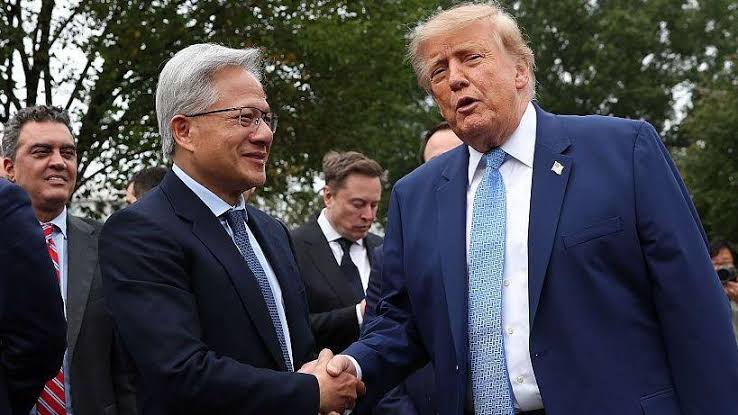
Just eleven days after stepping down as Nvidia’s chief executive, Jensen Huang returned to lead the world’s most consequential AI chipmaker. Nvidia’s shares surged by more than 30 percent on the first trading day after Huang’s return, lifting the broader U.S. stock market. President Donald Trump openly took credit for Huang’s reinstatement, celebrating him as a national asset. Meanwhile, lawmakers from both parties expressed concerns, and congressional investigations loom.
The extraordinary reversal reveals how personal interests, electoral calculations, racial dynamics, and China-U.S. technological competition have become increasingly intertwined in American politics.
Trump’s Three Layers of Motivation
Trump’s motivations for bringing Huang back can be understood at three levels: personal, ideological, and political.
At the personal level, Trump has considerable financial interests in Nvidia. According to his financial disclosure, as reported by the Associated Press, his Nvidia holdings were valued at between $12.5 million and $58 million at the end of 2025. Huang’s reinstatement could therefore have directly benefited the president financially, depending on his current holdings. Trump’s personal rapport with Huang may also have played a role. Moreover, given Trump’s own history of personal controversies and his relatively dismissive remarks about Huang’s extramarital affairs, he apparently does not regard the moral dimension of the scandal as particularly disqualifying.
At the ideological level, Trump sees AI development as a race that the United States cannot afford to lose. While others are increasingly concerned about cybersecurity, regulatory oversight, and the unintended consequences of artificial intelligence, Trump wants to accelerate its development. Both Trump and Vice President JD Vance reportedly regard Huang as particularly important to maintaining American competitiveness in open-weight AI models, an area where Chinese companies have made considerable progress.
At the political level, the stock market’s reaction to Huang’s departure raised the stakes considerably. Trump has repeatedly presented Wall Street’s performance as evidence of his successful presidency. Having suffered a major setback in the midterm elections, he can hardly afford a financial meltdown during his remaining two years in office. A collapse of the AI boom could undermine not only the American economy but also his political legacy. Bringing Huang back thus became an attractive solution in which Trump’s personal financial interests, technological ambitions, and political calculations converged.
The Democrats’ Dilemma
With Democrats set to control both chambers of Congress in January, Huang’s reinstatement provides them with an opportunity to investigate Trump, Huang, and other Nvidia executives. Senate Democratic leader Chuck Schumer has already signaled his intention to pursue such investigations. Connecting the scandal to China-U.S. technological competition could also help Democrats secure bipartisan support for congressional inquiries.
Yet Democrats face a dilemma of their own. Their sweeping victories in the midterm elections were more a rejection of Republican governance than an endorsement of the Democratic Party. Exit polls suggest that economic dissatisfaction, particularly persistent inflation and declining purchasing power, was central to the Republican defeat.
Voters elected Democrats primarily to improve their economic circumstances. If Democrats devote excessive political energy to investigating Trump and Nvidia, they may find themselves entering the 2028 presidential election with few tangible economic accomplishments. Moreover, investigations that destabilize the AI industry could adversely affect millions of Americans whose retirement savings are tied to stock market performance.
The Democrats’ congressional majority, therefore, should not be mistaken for an enduring electoral realignment. Their ability to retain voters in 2028 will depend considerably more on whether Americans feel economically better off than on how many scandals they uncover.
Why Jensen Huang?
Another uncomfortable question deserves attention: Why did Huang’s personal misconduct initially prove so politically consequential?
Several prominent American technology entrepreneurs, including Bill Gates, Jeff Bezos, and Elon Musk, have faced public controversies surrounding their private lives without comparable immediate demands for their departure from the companies they led or founded.
Some Asian Americans see the differential treatment of Huang as reflecting a deeper racial inequality in corporate America. Breaking through the “bamboo ceiling” remains difficult for Americans of Asian descent. Even those who reach the pinnacle of corporate leadership may find their positions more precarious and their mistakes less readily forgiven than those of their white counterparts.
Huang survived this episode partly because he retains extraordinary control over Nvidia’s strategic resources, corporate decision-making, and business relationships. Few executives possess comparable leverage. Had Huang been more replaceable, the outcome might have been quite different.
There is, however, a fundamental distinction between Huang’s case and the personal controversies surrounding other technology billionaires. Huang’s relationship with Alice Huang, a former executive of Singapore-based Megaspeed, potentially intersects with China-U.S. technological competition. Allegations concerning her connections to Chinese intelligence and the possible diversion of advanced chips warrant examination, although the espionage allegations have yet to be substantiated publicly.
Ultimately, the relevant national security question is not how many extramarital affairs Huang had, but whether his relationships compromised sensitive technologies, facilitated violations of export controls, or otherwise undermined legitimate American security interests. These questions must be answered through evidence rather than ethnic profiling.
Regardless of the outcome, the controversy could make the professional environment more challenging for Americans of Chinese descent. Women of Chinese and broader Asian descent may face additional pressures as gendered stereotypes become intertwined with national security suspicions. For individuals who have already overcome substantial barriers to professional advancement, their ethnicity could increasingly become a liability.
When Great-Power Competition Becomes Personal
The Huang episode illustrates the increasingly pervasive nature of China-U.S. competition. What began primarily as competition over trade, technology, and geopolitical influence has penetrated corporate governance, domestic electoral politics, personal relationships, and questions of ethnic identity.
Ironically, the United States’ determination to maintain its technological advantage over China could undermine one of the very foundations of that advantage: its ability to attract, retain, and empower talent from around the world, including talent of Chinese origin.
Huang’s reinstatement may have temporarily restored confidence on Wall Street, but it has resolved neither Washington’s political divisions nor the underlying tensions between economic interdependence and national security.
The greater danger is that, as China-U.S. competition intensifies, the distinction between Chinese ancestry and allegiance to China becomes increasingly blurred. When a great-power rivalry begins to determine how individuals are judged, trusted, and treated, its costs are no longer confined to governments or corporations. They become embedded in society itself.