What does Shenzhen Summit Tell about the Cross-Strait Relations in the Future?
For Chiang Kai-shek, Taiwan was never meant to be the final destination. After retreating to the island in 1949, he continued to dream of returning to the mainland and restoring the Republic of China’s rule over all of China. But Washington had other ideas. Although the United States supported Taiwan’s defense, it was unwilling to sponsor a full-scale military campaign to retake the mainland. By the early 1960s, American officials had concluded that such an operation was unrealistic and risked dragging the United States into another major war. As the balance of power increasingly shifted toward Beijing, Chiang’s ambitions became harder to sustain. The military reconquest of the mainland eventually disappeared from Taiwan’s strategic agenda, and the KMT gradually learned to live with the reality of separate rule, even while retaining the long-term goal of national unification.
Taiwan’s subsequent democratization brought another political transformation. The Democratic Progressive Party (DPP), once committed to establishing a new state for the island, increasingly argued that Taiwan was already “an independent” political entity and therefore did not need to declare a new state. Chen Shui-bian's “Four Noes” pledge in 2000 and later administrations’ commitment to maintaining the status quo helped preserve this practical arrangement. Democracy also became an important source of international legitimacy, allowing Taipei to seek support for its self-governing system without formally declaring independent.
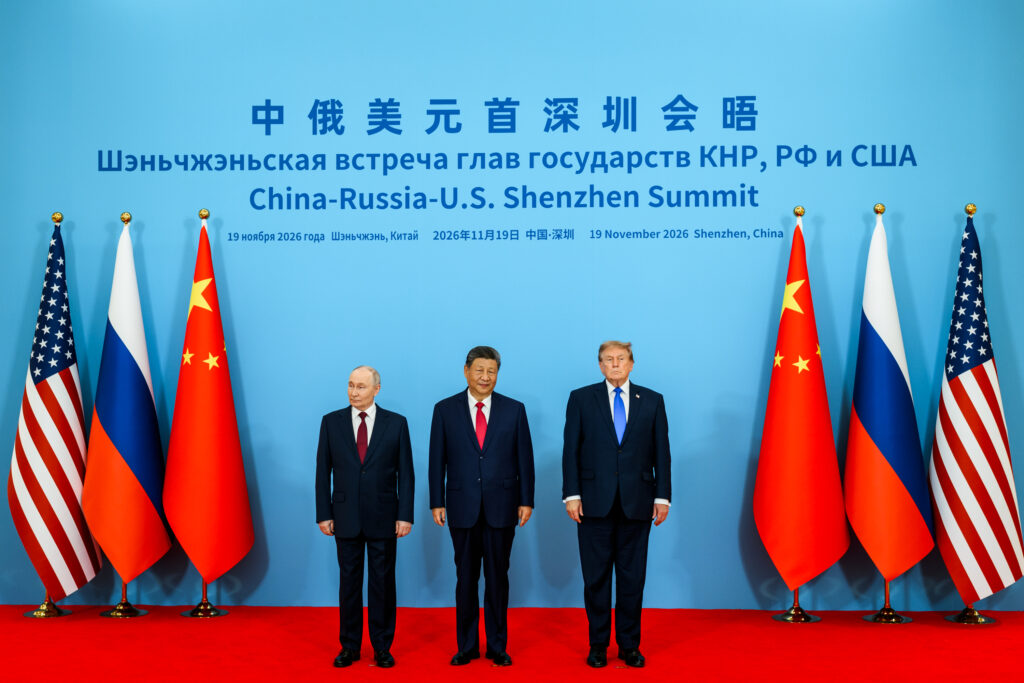
For decades, this arrangement appeared sustainable. But the return of great-power politics is making Taiwan’s insulated autonomy increasingly fragile. The unusual November 19 meeting in Shenzhen among Donald Trump, Xi Jinping, and Vladimir Putin offered a reminder that the world’s major powers are once again seeking to manage international affairs through direct diplomacy. Taiwan was not mentioned in their joint declaration, but Xi raised the issue separately with Trump.
In this context, for Taipei, the question is no longer simply how to defend its democratic identity. It is how much control it can retain over its future when the strategic environment is increasingly shaped by decisions made elsewhere. Here is an agency paradox for the island: the more Taipei seeks to protect its autonomy through international support, the more its strategic choices may become dependent on outside powers.
Democracy is not a Guarantee
For much of the past decade, democracy has been one of Taipei’s most effective arguments in its limited international arena. While Taipei has few formal diplomatic allies, it has built strong unofficial relationships with the United States, Japan, and several European countries. Its democratic institutions have helped turn Taiwan from a difficult question of Chinese sovereignty into a broader issue of defending “democratic values”. Frankly speaking, this strategy has brought real benefits. Taiwan has gained greater international attention, stronger political support from Western legislatures, and wider cooperation in areas ranging from technology to security. By presenting Taiwan as “a frontline democracy”, Taipei has also made it politically harder for democratic governments to ignore pressure from Beijing.
But there is a difference between international sympathy and strategic commitment, especially illustrated in the relations with the United States. Washington maintains close unofficial relations with Taiwan and provides defense assistance, but the Taiwan Relations Act does not require the United States to intervene militarily if war breaks out across the Strait. American policy deliberately leaves the question of intervention uncertain. In other words, Washington’s support for Taiwan’s democratic system has never amounted to an unconditional security guarantee.
This distinction has become especially important under Trump. Despite the fact that his administration has continued to recognize Taiwan’s strategic importance, it has also shown a willingness to consider Taiwan-related decisions within its broader negotiations with Beijing. A proposed $14 billion arms package for Taiwan has been held back, with Trump himself describing arms sales as a useful negotiating chip. Meanwhile, members of Congress have continued to press the administration to strengthen Taiwan’s defenses.
It shows that American support for Taiwan comes from different institutions and serves different purposes. Congress may emphasize democratic solidarity and long-term security commitments, while the White House must also consider trade, military resources, and relations with China. For Taipei, the lesson is difficult but vital. “Democracy” can help Taiwan win international support to some extent, but it cannot give Taiwan control over Washington’s decisions.
The Hidden Cost of External Protection
Taiwan’s dilemma goes deeper than uncertainty about American support. Its efforts to strengthen its political identity and security may themselves create new limits on its strategic autonomy.
Since the DPP returned to power in 2016, Taiwan’s top leaders have increasingly emphasized the island’s distinct political identity, democratic institutions, and international partnerships. Under President Lai Ching-te, the defense of democracy remains closely connected to “national security” and resistance to pressure from Beijing. This approach may reflect political preferences within Taiwan. An October 2026 survey released by Taiwan’s Mainland Affairs Council found that 92 percent of respondents agreed that Taiwan’s future should be decided by its 23 million people, while 86.5 percent supported maintaining peace and stability across the Strait. Another 80.6 percent supported increasing defense spending. These figures suggest that the desire for political autonomy remains strong, even as security concerns grow.
Yet protecting that autonomy increasingly requires military capabilities and external support that Taipei cannot provide entirely on its own. The more serious the perceived threat from Beijing becomes, the stronger Taipei’s incentive to seek assistance from Washington. But, unfortunately, this creates a structural problem, that is, greater external protection can also make Taipei more sensitive to changes in American policy. Decisions about weapons deliveries, diplomatic negotiations, or military deployments may depend on U.S. priorities rather than Taipei’s immediate preferences.
There is also a political cost. The more Taiwan places its security within a broader “democratic alliance,” the more Beijing may interpret its actions as an attempt to make separation permanent. Beijing’s response can then increase the very insecurity that led Taipei to seek external protection in the first place. Beijing has its own political objectives and strategic calculations, including its longstanding commitment to unification. Pressure on Taiwan would not necessarily disappear if Taipei adopted a more cautious policy.
In a word, the paradox is that Taiwan’s search for greater security may still deepen a cycle in which its room for independent political choice becomes narrower.
Implications of the Return of Great-Power Politics
The Shenzhen summit offers a reminder that Taiwan’s future will not be shaped by cross-Strait relations alone.
Certainly, the three-way meeting did not produce a settlement over Taiwan or establish a new division of spheres of influence. Its immediate results were limited. But the willingness of Washington, Beijing, and Moscow to meet directly over major security questions suggests that great-power bargaining remains an important way of managing international disputes.
For Taipei, the more consequential development may be the renewed emphasis on managing U.S.-China relations as a whole. During their November 19 bilateral meeting, Xi and Trump discussed building a constructive relationship of strategic stability. According to China’s official account, Xi also stressed the importance of handling the Taiwan question carefully. The contrast between the trilateral declaration, which did not mention Taiwan, and the separate bilateral discussion is revealing. Taiwan remains a core concern for Beijing, but it is also one issue within a much wider relationship involving trade, technology, and international security.
For Beijing, Taiwan remains closely tied to sovereignty and national unification. For Washington, Taiwan is an important security partner and a major factor in the Western Pacific balance of power. But American interests also extend to economic competition, nuclear stability, and cooperation on global problems. When these interests compete, Taiwan cannot assume that its preferred political narrative will always determine American choices.
The Shenzhen summit does not necessarily herald a return to a Yalta-style world, as someone suggested, in which great powers simply divide smaller territories among themselves. Nor is there any evidence that Washington and Beijing have reached an agreement to decide Taiwan’s political future. What is changing, however, is the strategic framework in thinking Taiwan’s future. The language of democracy may continue to shape public debate around the world, but decisions about military risks will be increasingly, and more clearly, guided by calculations national interest. In this sense, at least for the foreseeable future, the extent of international support for Taiwan will be shaped more by geopolitics than by “democratic solidarity”.
Autonomy Is More than Identity
It is too early to say that Taiwan is merely an object of competition between China and the United States. Its economic importance, especially in advanced semiconductors, also gives it influence beyond its size. But it does not mean the island can sustain its political autonomy. Taipei can exercise considerable control over its internal political identity while possessing much less control over its external security environment. It can de jure decide what kind of political system it wishes to maintain, but it cannot independently determine how Beijing will respond or how far Washington will go to defend it.
This suggests that Taipei may need to think about autonomy more as the practical ability to preserve room for political choice. Maintaining good relations with Washington and other partners is important, but these efforts need not exclude communication with Beijing or the careful management of political signals that could increase the risk of confrontation.
International democratic solidarity does not automatically guarantee American intervention especially in the era of great-power politics. Taiwan’s future will be influenced by decisions made far beyond the island, even when those decisions are not explicitly about Taiwan. Democracy may define what Taiwan wants to preserve, but geopolitics eventually determines what it can afford to do.