China Pulse is a twice-annual survey research project measuring Chinese public opinion on international relations conducted by The Carter Center and Emory University. This brief contains data from a preliminary survey conducted between July 7 and August 17, 2025 (1,428 respondents) and a full wave conducted between October 27, 2025, and January 1, 2026 (2,506 respondents).
This survey shows Taiwan is China’s most favored neighbor, ahead of Russia and Singapore. Aside from Singapore, the Chinese public views all neighbors asked about in this survey unfavorably, including most of Northeast and mainland Southeast Asia, the Philippines, and India. A plurality of the Chinese public believe that China will benefit from a Russian victory in the war with Ukraine, and most support their government strengthening economic cooperation with Moscow but oppose deploying the People’s Liberation Army to support Russia militarily. Conversely, regarding North Korea, a majority supports continued economic cooperation while a plurality also supports continued military cooperation. This survey suggests that the Chinese public could support territorial bargaining with the Philippines in the South China Sea in exchange for Manila reducing military ties with the United States, a potential path to easing tensions. These findings also suggest that most Chinese support Beijing increasing military spending in response to further militarization in Japan and South Korea. In both cases, diplomatic protest also ranked at or near the top of preferred responses. This implies a public open to both hard and soft responses to growing geopolitical tensions in Asia.
Key Findings
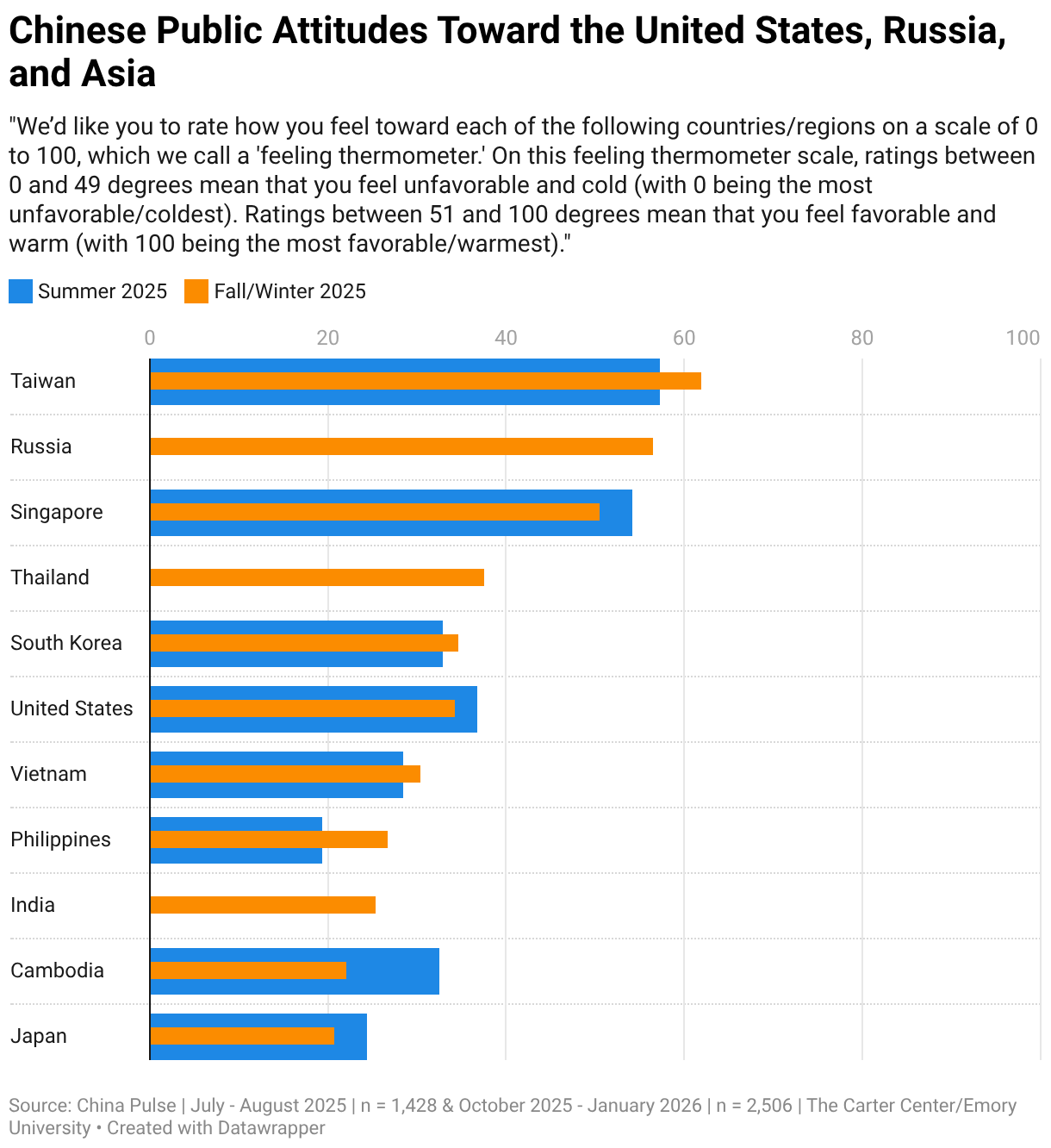
- The Chinese public holds favorable views of Taiwan, Russia, and Singapore, rating them 62, 56, and 50, respectively, on a scale of 0 to 100.
- The Chinese public holds unfavorable views of 7 out of 10 of China’s neighboring countries, including Thailand (38/100), South Korea (35/100), Vietnam (30/100), Philippines (27/100), India (25/100), Cambodia (22/100), and Japan (21/100).
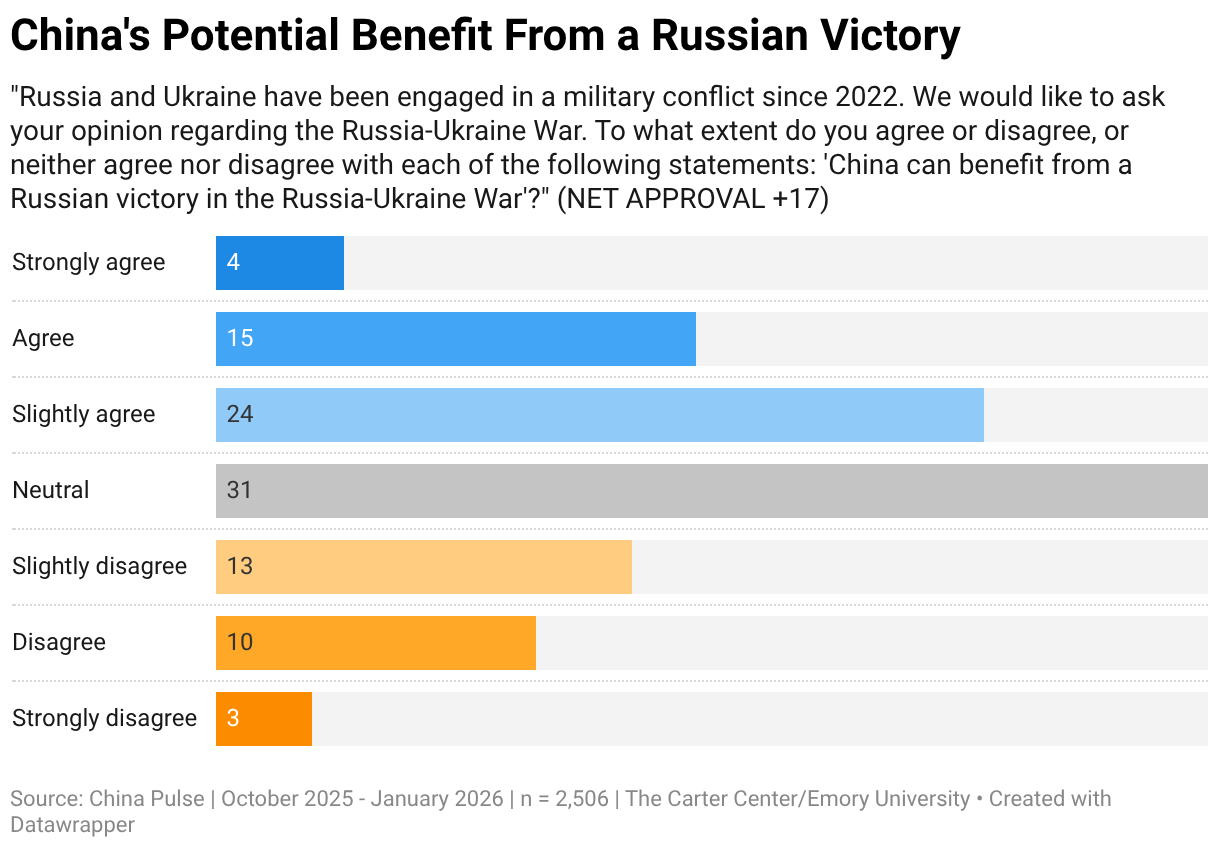
- A plurality of the Chinese public believe that China will benefit from a Russian victory in the Russia-Ukraine war (43%). About one quarter disagree.
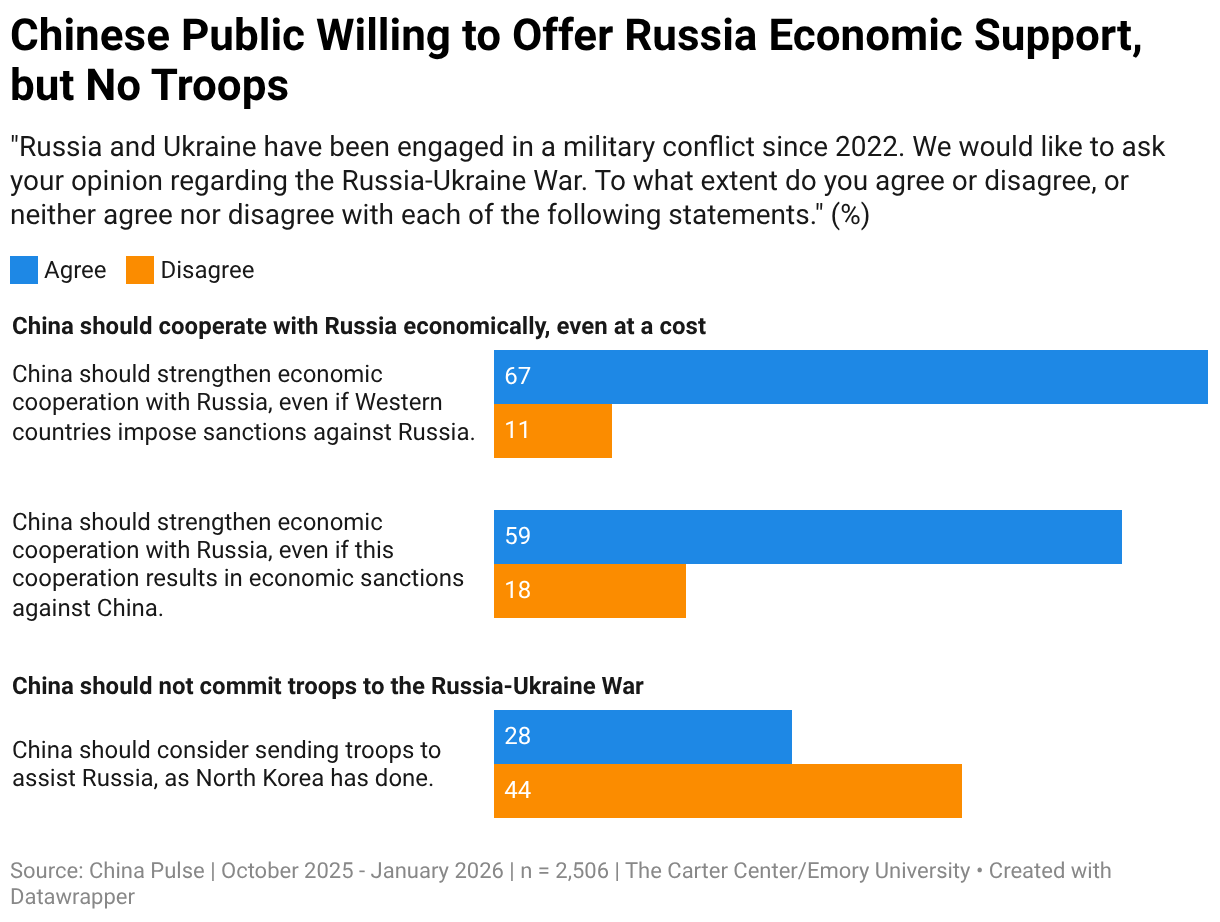
- Most Chinese people believe their government should strengthen economic cooperation with Russia whether sanctions are levied against Russia (67%) or China-Russia cooperation results in sanctions against China (59%).
- A plurality of the Chinese public believe China should not send troops to Russia to support its war with Ukraine (44%). Only 28 percent support committing troops.
- Like views on Russia, most Chinese support their government providing economic support to North Korea despite sanctions against that country (56%). However, unlike views on Russia, a plurality of the Chinese public also supports their government continuing to provide military support to North Korea (42%).
- The Chinese public is willing to bargain and make concessions on Beijing’s territorial claims. When asked to consider hypothetical proposals from the Philippines that would result in China backing down on claims in the South China Sea, a plurality of the Chinese public supported negotiation if Manila reduced military cooperation with the United States (43%) or terminated its U.S. mutual defense treaty (43%).
- In response to scenarios in which Japan changed its constitution to allow offensive military actions and South Korea developed nuclear weapons, the Chinese public most approved of Beijing responding by increasing military spending (66% and 63%, respectively). In the South Korea scenario, increasing military spending was tied with diplomatic protest (63%).
The Chinese Public and Their Neighbors
Since 2020, public favorability toward China among neighboring countries has shifted significantly. According to the Asia Society’s Global Public Opinion on China, public opinion toward China in Vietnam improved from a net favorability of -44 in 2020 to +20 in 2024, with similar increases in Russia and Cambodia. Although China’s overall favorability in India was negative in 2024, it nevertheless rose markedly from its nadir during the COVID-19 period. China’s favorability rating in Thailand has remained consistently positive, while persistently high unfavorability has remained a feature of public opinion in South Korea, Japan, and, to a lesser extent, the Philippines. Apart from Russia, the Chinese public views all these countries unfavorably.
The Chinese public rates Taiwan (62/100), Russia (56/100), and Singapore (50/100) positively, but views most neighboring countries unfavorably, including Thailand (38), South Korea (35), Vietnam (30), the Philippines (27), India (25), Cambodia (22), and Japan (21). This reflects China’s broader geopolitical alignments: Russia, as China’s closest strategic partner, and Taiwan, viewed as a rogue province, are the only major regional actors regarded warmly. By contrast, countries with close U.S. defense ties, particularly Japan, the Philippines, and South Korea, rank at the bottom of Chinese public opinion, suggesting that alignment with Washington is a significant driver of unfavorable sentiment among the Chinese public. The overall trend in these findings is consistent with polling conducted by The Chicago Council on Global Affairs and The Carter Center in 2024.
Russia and North Korea: Allies
Russia is China’s closest partner among major powers. Following President Xi Jinping and President Vladimir Putin’s 2022 signing of a “no-limits partnership,” China became Russia’s largest trading partner, with bilateral trade reaching record levels in 2023 and 2024, exceeding $240 billion in 2023 alone. The two countries conduct regular joint military exercises, and Russia and North Korea, though weaker partners overall, appear much more willing to contribute serious resources to one another in support of China’s strategic posture. China remains North Korea’s most important economic lifeline and diplomatic protector.
Polling from the Chicago Council on Global Affairs and The Carter Center found that Russia and North Korea were ranked as the countries most friendly toward China among a list of ten major powers and neighboring countries. The same poll showed that the Chinese public believes common security interests are at the core of China-Russia and China-North Korea relations. According to polling from Tsinghua University’s Center for International Security and Strategy, in 2024 only 6 percent of Chinese people believed Russia was primarily to blame for the Russia-Ukraine war, while 42 percent believed “other third parties” (neither Russia nor Ukraine) were responsible for starting the conflict. This survey finds that 43 percent of the Chinese public believes China will benefit from a Russian victory in the war in Ukraine (see Appendix for more detail).
However, the Chinese public’s views on the Russia-Ukraine war do not reflect Beijing and Moscow’s “no-limits partnership.” This survey finds broad support for economic cooperation with Russia with little interest for entering the war militarily. A larger majority of Chinese support economic cooperation with Moscow despite any Western sanctions against Russia (67% agree vs. 11% disagree). A majority also supports strengthening China-Russia economic cooperation even at the cost of economic sanctions against China (59% agree vs. 18% disagree). However, trade despite sanctions appears to be the limit of Chinese popular support. Nearly twice as many Chinese oppose sending troops to support Russia (44%) as support sending them (28%).
This pattern does not hold for relations with North Korea. North Korea’s defense agreement with Russia strained its relations with China, and many Western analysts believe North Korea’s nuclear program has made maintaining regional stability difficult for Beijing. Nonetheless, China-North Korea relations date back to the former’s support of the latter against U.S. forces in the 1950s. This longer relationship is reflected in the Chinese public’s expanded support for North Korea compared to Russia. While 56 percent of the Chinese public approves of economically supporting Pyongyang, even if the United Nations Security Council imposes sanctions against North Korea, a plurality also support militarily supporting the country.

U.S. Ties Outweigh Support for Unification with Taiwan in the South China Sea
Scarborough Shoal (known as Huangyan Island in China) sits approximately 120 miles from the Philippines’ largest island and has been one of the most contested features in the South China Sea. China has maintained a near-constant naval, coast guard, and maritime militia presence within and around the shoal since a standoff between the two countries in 2012. In 2016, The Hague ruled in favor of the Philippines’ claim to the territory, disputing China’s legal basis for including it within the “Nine-Dash Line.” China declared the ruling invalid and has refused to recognize it.
Over a decade later, Chinese coast guard vessels repeatedly patrol the water around the shoal and use water cannons against Philippine ships conducting routine patrols. In September 2025, China announced plans to designate Scarborough Shoal as a national nature reserve, a move the Philippines warned could further entrench China’s military foothold in the area. Chinese analysts have accused Manila of pursuing a strategy of internationalized legal and military pressure, deepening defense ties with the United States, Japan, and Australia to sideline Beijing diplomatically.
To gauge the relative importance of Beijing’s territorial claims in the South China Sea to its claims over Taiwan, this survey asked if the Chinese public would support their government backing down from claims to Scarborough Shoal (Huangyan Island) in exchange for Manila supporting Beijing’s position on Taiwan, even if unification included the use of military force. A plurality of respondents disagreed with this proposal (45%) while a still sizeable minority agreed (38%). More attractive to the Chinese public were scenarios in which Manila traded defense ties with the United States in exchange for Beijing giving up territorial claims. If Manila reduced U.S. military cooperation and removed missiles capable of targeting Beijing, 43 percent agreed to backing down from territorial claims (39% disagreed). If Manila ended its mutual defense treaty with the United States in favor of non-alignment, then another 43 agreed to backing down on territorial claims (37% disagreed). The results show that the Chinese public would accept an agreement in which their government ceded territory, but the terms of the agreement are high. For many in the Philippines, it would require giving up relations they believe protect them from Chinese military coercion.

Military and Diplomatic Responses to Militarization in Northeast Asia Receive Roughly Equal Support
China-Japan relations in 2025 began on a cautiously optimistic note. Since Prime Minister Ishiba took office in late 2024, ties had warmed through high-level exchanges and economic cooperation, partly driven by shared concerns over U.S. uncertainty. Exchanges culminated in a sixth High-Level Economic Dialogue in Tokyo in March 2025. That momentum, however, collapsed in the second half of the year. Japan’s relationship with China entered a deep freeze following Prime Minister Takaichi’s November remarks that Tokyo could intervene militarily in a Taiwan crisis, prompting China to suspend Japanese aquatic imports, cancel Japanese concerts and films, and see Chinese tourists (roughly a quarter of all visitors to Japan) cancel travel en masse. Security tensions escalated in parallel. Chinese coast guard vessels sailed near the Senkaku/Diaoyu Islands, and Japan announced missile deployments on Yonaguni island, just 110 km from Taiwan. The deterioration of China-Japan relations is unlikely to be resolved quickly because it is rooted in the core interests of both sides – Japan’s security ambitions vs. China’s position on Taiwan.
This survey asked the Chinese public their preferred policy responses to Japanese militarization. Specifically, how should Beijing respond to increased Japanese military spending and pressure from some Japanese politicians to amend their constitution to allow offensive military action. The most popular response was to increase China’s military spending (66%), followed by imposing economic sanction on Japan (62%) and issuing diplomatic protests (62%). Bans on Japanese cultural imports received very little support (34%), as did launching a preventative military attack on Japan (31%).

The South Korean and Chinese public express relatively similar low favorability toward one another. As with attitudes toward many of China’s neighbors in this survey, relations between South Korea and the United States appear to be a major factor determining favorability. In 2016, China-South Korea relations took a negative turn when Seoul agreed to host THAAD, a U.S. missile defense system. In the 2026 U.S. National Defense Strategy, the vision outlined for South Korea expanded from defense against Pyongyang to serving as a regional defensive partner against China. Despite this, China remains South Korea’s largest export market just ahead of the United States (according to 2024 data). China-South Korea relations appear to be improving along trade lines in 2026 with dozens of new memorandums of understanding signed between the two countries and the hosting of the first South Korean trade expo in Beijing in nine years. The South Korean government has also taken a softer position on Taiwan compared to Prime Minister Takaichi’s government in Japan. South Korea’s electronic arrival cards list Taiwan as “China (Taiwan),” a practice recently reaffirmed by the government. Nonetheless, rallies protesting China’s influence in the region are common in South Korea, particularly from young people, and trade agreements with Beijing must be balanced against Seoul’s recent nuclear submarine deal with the United States.
This survey asked the Chinese public how their government should respond to South Korea’s growing military cooperation with the United States and its allies, popular anti-China sentiment, and increasing public support for nuclear weapons development. As with Japan, the most preferred responses were to increase China’s military spending (63%), issue diplomatic protests (63%), and impose economic sanctions (58%).

Conclusion
Chinese public opinion toward China’s neighboring countries closely mirrors geopolitics in the region. Chinese people view Taiwan and Russia favorably, reflecting nationalist, irredentist discourse on the one hand and Beijing and Moscow’s no-limits partnership on the other. Thailand, South Korea, the Philippines, India, and Japan are all viewed unfavorably and all have close relations with the United States. In India’s case, recent and historical territorial disputes are also likely a major factor impacting favorability. Likewise, explanations of attitudes toward Japan must always consider the violence Japan committed against China in the first half of the 20th century. Favorability toward Cambodia is the outlier to the geopolitical trend. The “ironclad friendship” between Phnom Penh and Beijing has recently been tainted in the Chinese public’s eye due to scam syndicates operated out of Cambodia targeting primarily Chinese citizens.
This survey shows that the Chinese public is willing to participate in further regional militarization in response to militarization in Japan and South Korea, but it is not willing to militarily intervene in active conflicts. Economic cooperation with Russia has broad support, sending troops to support Russia’s efforts in Ukraine does not. As China navigates an increasingly volatile geopolitical world, the Chinese public’s opposition to militarily supporting Russia is significant. It indicates that the Chinese government does not have the public’s support in engaging in foreign conflicts. However, this survey’s findings regarding disputes with the Philippines demonstrate the Chinese public may be willing to compromise if the result is a weakened U.S. position in Asia.
Methodology
This study employs a repeated cross-sectional design, conducted in collaboration with a China-based survey company maintaining a large respondent panel. We initiated the research with a pilot wave (N=1,428) in July and August 2025 to refine question wording and validate internal logic. The results were treated as preliminary validation for the main study.
The core findings derive from the first official wave, which surveyed 2,506 Chinese adults between October 27, 2025, and January 1, 2026. Utilizing quota sampling, the demographic profile matches China’s population on key variables, including age, gender, and geographic distribution across the North, East, Southwest, Northeast, South Central, and Northwest regions. The 50-question survey yielded a median completion time of 16.75 minutes.
About the Authors
Nick Zeller is a senior program associate for The Carter Center’s China Focus and editor of the English-language U.S.-China Perception Monitor website. Prior to joining the Carter Center, Nick was a Visiting Assistant Professor of World History in Kennesaw State University’s Department of History and Philosophy, Visiting Assistant Professor of Asian History in the University of South Carolina’s Department of History, and an NSEP Boren Fellow at Tsinghua University in Beijing. He received his Ph.D. in modern Chinese history from the University of Wisconsin-Madison.
Renard Sexton is a political scientist who studies conflict and development, particularly in Asia and Latin America. His research combines quantitative methods, fieldwork, and experiments, and has been published in top academic journals, policy forums and public outlets. From 2022 to 2023 he served as a senior advisor in the China/Taiwan unit at US Indo-Pacific Command through a Council on Foreign Relations (CFR) fellowship. He is currently Associate Professor of Political Science at Emory University, and the director of the Security and Conflict Lab.
Yawei Liu is the Senior Advisor on China at The Carter Center and an adjunct professor of political science at Emory University. An expert on U.S.-China relations and Chinese grassroots democracy, he is a member of the Council on Foreign Relations and the associate director of the China Research Center in Atlanta. He is regularly invited to speak about Chinese public opinion, and his previous engagements include the Center for Strategic and International Studies, the Brookings Institution, the Ukrainian National Academy of Sciences, and the Institute for China-America Studies.
About The Carter Center
Waging Peace. Fighting Disease. Building Hope.
A not-for-profit, nongovernmental organization, The Carter Center has helped to improve life for people in over 80 countries by resolving conflicts; advancing democracy, human rights, and economic opportunity; preventing diseases; and improving mental health care. The Carter Center was founded in 1982 by former U.S. President Jimmy Carter and former First Lady Rosalynn Carter, in partnership with Emory University, to advance peace and health worldwide.
About The Carter Center’s China Focus
The Carter Center is an independent, nonpartisan organization. Through its China Focus initiative, the Center seeks to improve the U.S.-China relationship through a thoughtful assessment of the international records of both countries. We convene leading Chinese and American policy professionals and academics, conduct pioneering research in Chinese public opinion, support next generation foreign policy experts, and publish research-backed opinion. Our goal is to contribute to lasting international peace between the world’s two largest powers, which is the foundation for solving the biggest problems facing humanity today.
About Emory University’s Department of Political Science
The intellectual mission of the Department of Political Science is twofold. First, we seek to engage in knowledge-building through rigorous theoretical and empirical research that enables us to address urgent contemporary political challenges related to democratic institutions and governance, identity and difference, inequality, and political violence. Second, we aim to train students who will become the next generation of scholars and practitioners through the skills we impart to them both in and outside of our classrooms. The rise of political polarization and populism in the United States and other countries make clear that democratic governance cannot be taken for granted. Global crises such as the COVID pandemic and climate change also demonstrate the need for solutions that are not only scientifically correct, but also politically feasible. More than ever, a greater understanding of the incentives and behavior shaping political life is necessary.
Appendix A: China’s Potential Benefit from a Russian Victory in Ukraine (All Demographics)

Appendix B: Chinese Public Attitudes Toward Russia, the Philippines, Japan, and South Korea (All Demographics)