
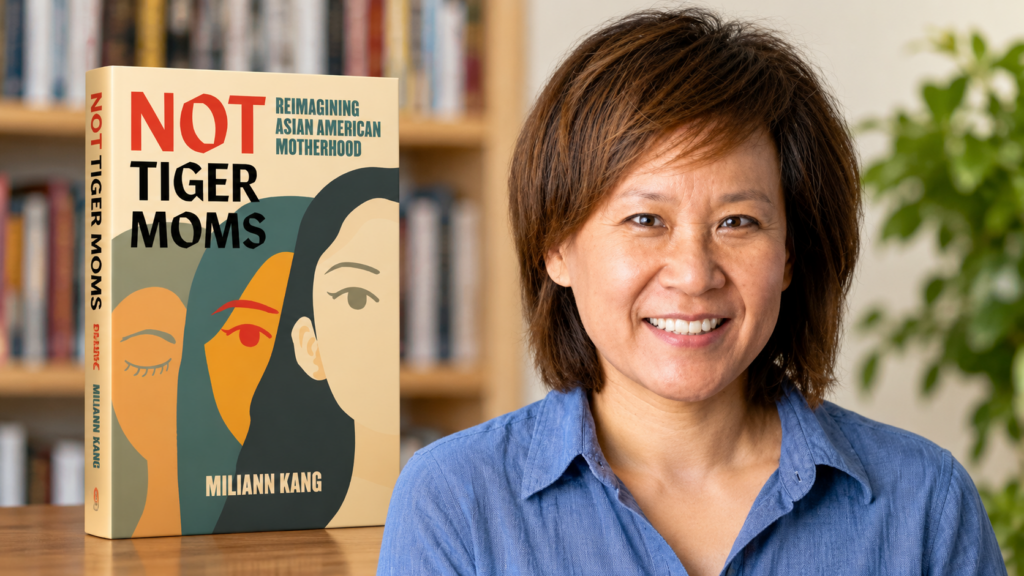
Since Chinese American scholar Amy Chua published Battle Hymn of the Tiger Mother, the term “Tiger Mom” has gradually become a cultural label used in American society to describe Asian American mothers.
In her new book, Not Tiger Moms: Rethinking Asian American Motherhood, Miliann Kang, a scholar at the University of Massachusetts Amherst (UMass Amherst), examines the experiences of Asian American mothers against the historical backdrop of racial exclusion, immigration restrictions, and reproductive politics in the United States. She explores how race and gender intersect to shape societal expectations of motherhood.
Drawing on interviews with more than 100 Asian American mothers, Kang argues that these women must navigate not only intertwined stereotypes such as the “model minority” and the “Tiger Mom,” but also the ongoing process of redefining motherhood, cultural belonging, and their sense of American identity.
Juan Zhang (JZ): Ever since Amy Chua published Battle Hymn of the Tiger Mother, the “Tiger Mom” archetype has become a kind of cultural shorthand for Asian American parenting. What inspired you to write Not Tiger Moms, and what core message do you hope the title conveys?
Miliann Kang(MK): I did not set out to write about the tiger mother, but similar to the ways that Black mothers constantly have to fend off the welfare queen or mammy tropes, I realized that the tiger mother trope has become a specter that looms over Asian American mothers and that they must constantly negotiate. I explore the tiger mother as just one example of a broader phenomenon that I refer to as “mother/othering,” in which motherhood and reproduction are used to enforce boundaries of belonging.
I had actually started a small research project on gender, work and family issues for Asian American women before Battle Hymn of the Tiger Mother was published. But after Chua’s book came out, whenever I would mention my research on Asian American mothers, people would say something like, “Oh, like the tiger mother.” To which I respond, “No, like the anti-tiger mother.” But in truth, it was a lot more complicated than that. The core message that I hope to convey is not about adjudicating whether or not certain Asian American mothers practice some aspects of hard-driving, achievement-oriented “tiger” parenting and what are the impacts on their children, as these concerns have already been widely debated. Instead, I am asking how Asian American have so easily and universally been pegged as tiger mothers, ignoring their vastly diverse approaches and identities, and what this tells us about how the intersections of race and motherhood drive a wide range of public issues, from education to immigration.
JZ: Your book places Asian American motherhood in the much longer history of racial exclusion in the United States, including the Page Act, anti-Chinese laws, and anti-miscegenation laws. How does this history help us understand the experiences of Asian American mothers today?
MK: The tiger mother trope did not come out of nowhere; it is part of a long history of anti-Asian racism, xenophobia, and exclusionary laws encoded to keep Asians from immigrating and to limit the reproduction of those already here. I refer to this complex history and its legacies as one of “reproductive exclusion” in which control of reproduction has been central to defining boundaries of citizenship and belonging that continue to the present day. By highlighting key legal cases, I try to show the throughline between the various forms of exclusion that have been directed at Asian Americans and the ongoing challenges that Asian American mothers continue to negotiate in the current day, ranging from perceptions of them as “forever foreigners” to fears that they are overtaking neighborhoods, schools and jobs.
JZ: Your book explores how Asian American mothers have been shaped by racialized and gendered expectations. How do stereotypes such as the “model minority” and the “Tiger Mom” shape the way Asian American mothers are perceived and the expectations placed on them?
MK: Here I draw on scholarship in Asian American Studies, particularly people like Kandice Chuh, erin Khuê Ninh, Lisa Sun-hee Park, Pawan Dhingra, C.N. Le, Jennifer Lee, Min Zhou and many others who have shown that the model minority stereotype is not just about high achievement but about positioning Asian Americans on a racial hierarchy between Whites and Blacks. This hierarchy is then used to justify all kinds of punitive policies against “non-model” minorities, ranging from policing and deportations, to cutting of funding for schools and social services.
These issues may seem a long way removed from motherhood, let alone the tiger mom, but I try to build on the strong connections that scholars in Black. Latinx and Native and Indigenous Studies have drawn between race and reproductive politics. In short, I argue that motherhood reflects much broader racial constructions of who is seen as worthy of belonging and who is positioned as undeserving, threatening and “other.”
JZ: Could you share a specific story or example from your book that vividly illustrates how an Asian American mother is redefining what motherhood means in her own life?
MK: The last part of the book explores a range of stories about what it means to “imagine motherwise,” or how to reenvision Asian American motherhood, and motherhood broadly. One story that really stands out is about a mother who challenged her child’s school not only about the limited curriculum and activities offered for the students, but also about the unequal pay and working conditions for the teachers.
Other stories range from how Asian American mothers make choices about their children’s names, activities, food, language, holiday celebrations and relationships to much larger social issues that span local communities and transnational contexts. Examples range from taking their children for visits to their ancestral homelands, to raising them bilingually, to advocating for policies related to immigration, education and social justice.
JZ: Looking at the stories of the U.S.-raised mothers you interviewed, how much of their experience is shared by mothers across America, and how much is uniquely shaped by Asian American identity?
MK: Many of the experiences and concerns discussed in the book are shared by mothers, and parents broadly, throughout the U.S. but also across the world, such as lack of affordable childcare, unsupportive workplaces, unequal division of labor in the household and generally unrealistic standards for mothers to be unconditionally loving, nurturing and self-sacrificing.
But I focus on the additional and specific challenges that Asian American mothers confront, such as the perception of them as simultaneously “model minority” reproducers who are expected to be hard working and high-achieving, and to produce children who meet the same standards. At the same time, they have to be careful not to overachieve at the risk of being regarded as “yellow peril” threats. These kinds of challenges are not distinct to Asian American mothers but they tap into particular racial constructions that are based on long-standing stereotypes, of which the tiger mother is just a recent manifestation.
JZ: How do the mothers you interviewed navigate the balance between raising their children to feel fully American while also fostering a strong, grounded sense of their Asian American heritage?
MK: Based on the over 100 interviews that I conducted, I argue that Asian American mothers are less concerned with passing on or preserving Asian cultural traditions from their homelands, and more focused on creating new forms of Asian American cultures.
These often involve adapting and synthesizing various cultural practices and giving them their own meanings, often tied to specific people, places and memories of their own childhoods. It also involves challenging the idea that assimilation to the mainstream culture is a requirement of claiming “Americanness” and instead, actively shaping and asserting broader claims to cultural citizenship.
As mentioned before, these include speaking different languages, worshipping in different faiths, listening to different forms of music, dressing in different clothes, and claiming these differences as essential parts of being American, rather than disqualifications.
JZ: If you could share one piece of advice with Asian American mothers who may feel weighed down by expectations about what a “good mother” should be, what would it be?
MK: I was recently asked this exact question by a student in my Asian American Feminisms course that I teach at UMass Amherst. My response, which I will repeat here, is that the goal of the book is to open up space for mothers to assert their own identities, commitments and definitions of motherhood, rather than to substitute the current expectations with yet another set of impossible standards. To sum up, I’ll end here with a quote from the epilogue:
I want this book to speak not only about but to and with mothers, especially but not only those who identify as Asian American mothers, and those who wish to understand and support them. By naming and exploring the contours of mother/othering, my hope is that mothers will be less susceptible to it, whether as its targets or its agents. It is a tall order and not one that any individual, or mother, can fill alone. But together, we might get somewhere better. My dream is that by collectively imagining motherwise, we can not only remake motherhood but repair the world.