
China Pulse is a twice-annual survey research project measuring Chinese public opinion on international relations conducted by The Carter Center and Emory University. This brief contains data from a preliminary survey conducted between July 7 and August 15, 2025 (1,428 respondents) and a full wave conducted between October 27, 2025, and January 1, 2026 (2,506 respondents). References to the July-August 2025 survey only occur where there has been no change in the wording of questions asked again in the full October 2025-January 2026 wave.
Results show that the Chinese public’s feeling toward Taiwan warmed slightly in the latter half of 2025 but opposition to the use of military force as a tool for unification decreased during the same period. In the October-January survey, 38% of respondents agreed that unification with Taiwan should not be by force under any circumstances while 47% disagreed. The Chinese public demonstrates strong support for culturally focused, peaceful paths to improve cross-strait relations. Their preferences reflect the shared history and culture between mainland China and Taiwan emphasized in mainland Chinese nationalist discourse. If military force is necessary to prevent explicit Taiwanese independence, the Chinese public support limited attacks on offshore islands (81%) over full-scale military attack (32%). This is likely because when asked whether the use of force will make the Taiwan issue worse twice as many respondents agreed (50%) than disagreed (24%).
Key Findings
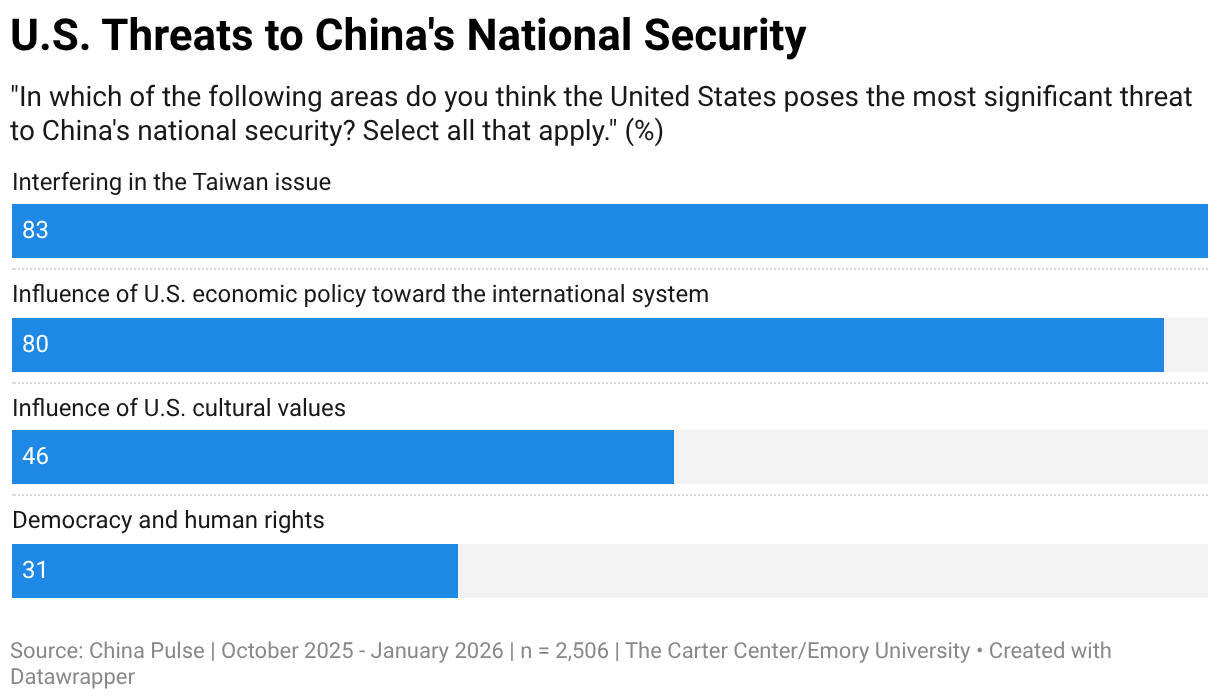
- Most Chinese (83%) who believe the United States is a national security threat rank the Taiwan issue as the largest danger.
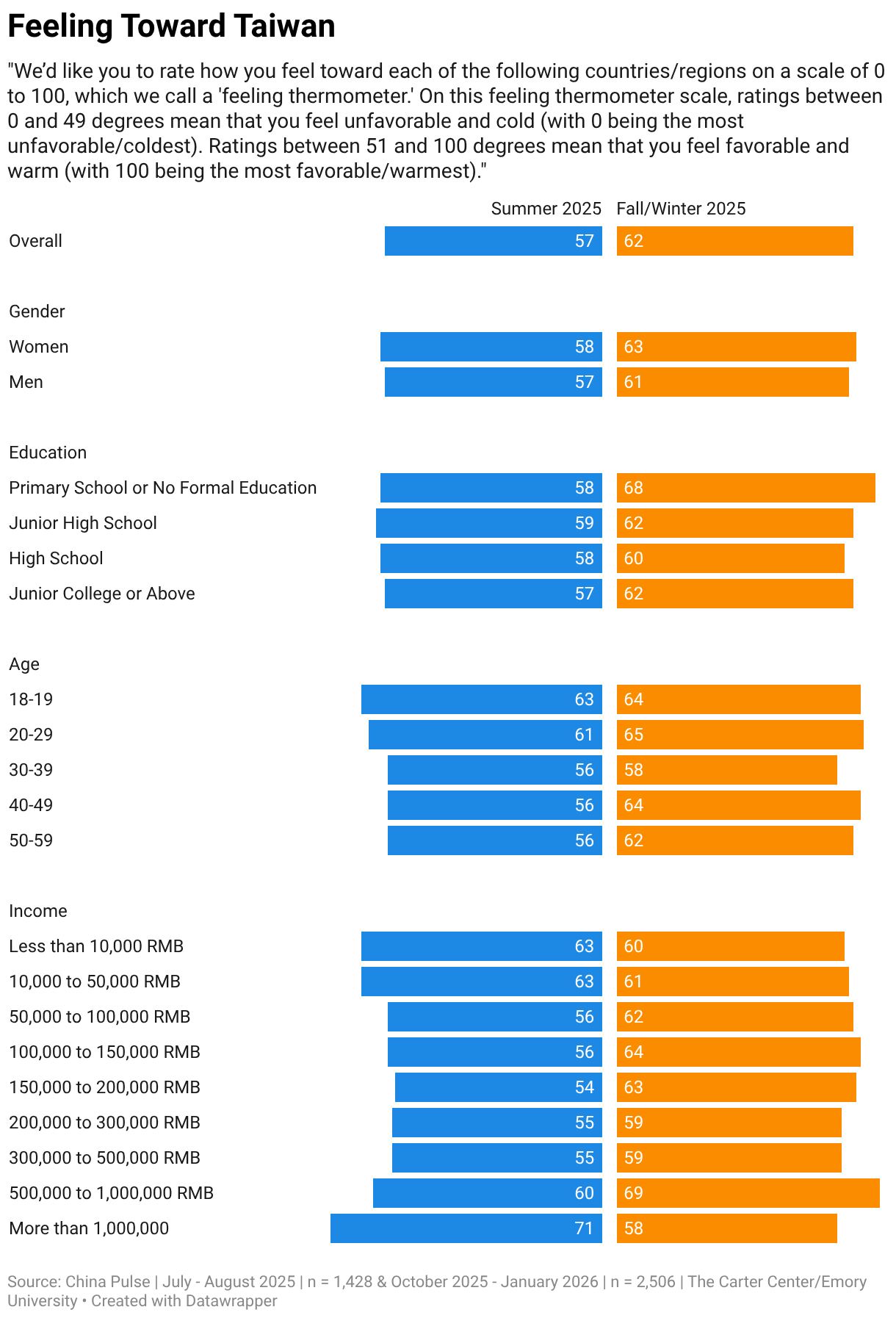
- The Chinese public expresses generally warm sentiments toward Taiwan, ranking it 57 out of 100 on a feeling thermometer in the summer of 2025 and 62 out of 100 in the fall and winter of the same year.
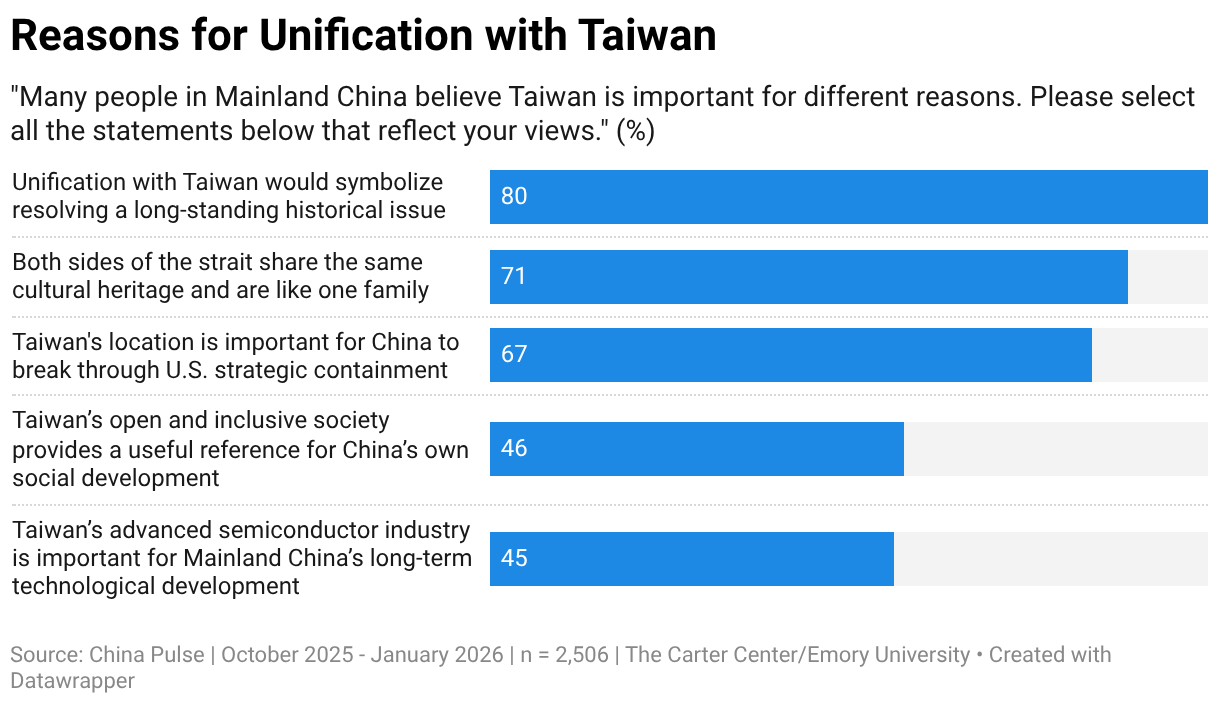
- Geopolitical strategy and technological competition are not the top reasons the Chinese public views Taiwan as important. Instead, Chinese value Taiwan for historical and cultural reasons common to nationalist discourse, indicating that unification would resolve a long-standing historical issue (80%), both mainland China and Taiwan share a common cultural heritage (71%), and Taiwan is part of the United States’ geostrategic containment of China (67%).
- Despite the centrality of high-tech competition to discussions of U.S.-China rivalry in the West, only a minority (45%) of the Chinese public view Taiwanese semiconductor manufacturing as an important factor in the island’s value to the mainland.
- There is no clear commitment to pacifism or militarism toward Taiwan. In the July-August 2025 wave of this survey, a small majority (51%) of the Chinese public agreed Taiwan should not be unified by military force under any circumstances (29% disagreed). In the October-January wave, there was no majority opinion (38% agree vs. 45% disagree).
- The Chinese public most prefer non-military paths to improving cross-strait relations, including promoting cultural (86%) and economic (81%) ties with Taiwan as well as policies to encourage Taiwanese businesspeople and students to live and work in mainland China (68%).
- Should Taiwan declare de jure independence from the mainland, the Chinese public supports limited military operations on offshore islands (81%) and economic sanctions (62%) as a response over a full-scale military attack (32%).
- Twice as many Chinese people agree the use of military force will only make the Taiwan issue worse (50%) than disagree (24%).
The Precariousness of Cross-Strait Relations
Taiwan is a major point of contention in U.S.-China relations. For most of the last 50 years, the United States has relied on strategic ambiguity when discussing Taiwan, a refusal to publicly commit to any specific response should the People’s Republic of China take action against the island. The United States’ commitment to ambiguity was questioned during the Biden administration when President Biden stated openly that the United States would come to Taiwan’s defense if it was attacked by mainland China. Under the Trump administration, U.S.-Taiwan relations have appeared close, with commitments from Taiwan to invest $250 billion in America’s high-tech industry and the announcement of an arms sale package worth $11.5 billion from Washington to Taipei in December 2025. However, at time of writing, Trump’s State Department has delayed acting on the agreement ahead of a planned Trump-Xi meeting. Meanwhile, mainland China’s regular military exercises and success in stripping away many of Taiwan’s diplomatic partners speak to Beijing’s commitment to preventing de jure Taiwanese independence. In February and March 2026, debates emerged in Chinese foreign affairs publications over whether the current geopolitical moment is the “best window” for military unification.
This survey finds that, among Chinese who believe the United States is a national security threat to China, Taiwan is the highest-ranking issue (83%), above the influence of U.S. economic policy toward the international system (80%), the influence of U.S. cultural values (46%), and democracy and human rights (31%).
Despite the perceived threat of conflict, however, this survey also finds that the Chinese public hold comparatively warm feelings toward Taiwan, with an average rating of 62 out of 100 in the most recent wave. These figures are similar to American feelings toward Taiwan reported by the Chicago Council on Global Affairs. While there is variation in feeling toward Taiwan within demographics like gender, age, and income, there is no demographic that expressed negative feelings (below 50) in either wave of this survey.
Reasons for Unification
With the rise of U.S.-China rivalry in high-tech industries like electric vehicles and large language models, China’s access to the most advanced semiconductors is a regular talking point on all sides. In the United States, this has meant speculation that China desires unification with Taiwan as a means to improve its access to the most cutting edge semiconductor technology. This could not be further from the Chinese public’s understanding of Taiwan’s importance according to this survey.
This survey indicates that geopolitics and high-tech rivalry rank below nationalistic historical and cultural concerns in the Chinese public’s account of Taiwan’s importance. Above all else, the Chinese public (80%) believes that unification with Taiwan will resolve a long-standing historical issue, bringing an end to the century of humiliation (a period of successive national defeats for China between the First Opium War [1839-1842] and the founding of the People’s Republic of China [1949]). Beyond this history, the Chinese public (71%) believe they share a deep cultural heritage with Taiwan that binds both places together. The concerns rank above Taiwan’s geopolitical significance in the ‘first island chain’ and well above concerns that Taiwanese society represents an attractive model for China or that it semiconductor manufacturing is important for China’s economic development.
No Preference for a Military Invasion of Taiwan
Both the United States and China have moved to significantly militarize the Taiwan question in the last decade. Last year, China conducted its largest war games to date around Taiwan while many in Washington became convinced that 2027 was President Xi’s deadline for a full-scale invasion. The Biden administration sold a total of $8.4 billion dollars in arms to Taiwan, which, if it is finalized, will be surpassed by the Trump administration’s congressionally approved $11 billion package.
This survey finds no clear mandate from the Chinese public for a military invasion of Taiwan. Neither is there clear evidence for a majority pacifist position. In the summer of 2025, a small majority of the Chinese public (51%) agree that Taiwan should not be unified by force under any circumstances (29% disagreed). In the fall and winter of 2025, only 38 percent agree with this pacifist position while 45 percent disagreed.

There is a slightly larger preference against military force among women (40% agree) than men (36% agree). Commitment to dovishness generally decreases as educational attainment increases, with those who only graduated from junior high school most likely to agree (46%, well above the average 38%) and those who graduated from junior college or above the least likely to agree (34%).
The clearest factor impacting agreement with a dovish position on unification appears to be income. Most of the lowest earning survey respondents (54%) agreed with the dovish position while only a quarter of the highest earning survey respondents agreed (none in the latter category indicated “strongly agree”). It should be noted that both income extremes represent a small subset of the total survey respondents. Nonetheless, the trend appears to hold across more populated income brackets.

High Interest in Strengthening Cultural and Economic Ties
While the Chinese public does not rule out the use of military force, when presented with a range of non-coercive paths to improving cross-strait relations, there is a clear preference for emphasizing the cultural ties they believe make Taiwan important in the first place (86%). Most of the Chinese public also support better economic ties between Taiwan and the mainland (81%), easier paths for Taiwanese businesspeople and students to live in mainland China (68%), and a negotiated peace agreement (54%). Only a quarter of Chinese support unprovoked economic sanctions.

Support for Limited Military Operations to Prevent Independence
While the Chinese public is ambivalent on the use of force to achieve unification and strongly supports an array of non-coercive paths to improve cross-strait relations, this survey indicates that the military operations the Chinese public is willing to support should Taiwan declare de jure independence are limited in scope, focusing on offshore islands like Kinmen and Matsu (81%). There is also majority support for the implementation of economic sanctions to prevent Taiwanese de jure independence (62%). Only a minority would support a full-scale military invasion of Taiwan (32%).
These findings illustrate that although the Chinese public are strongly committed to unification in principle, there are important limits to the risks they are willing to take to achieve it using military force. These results suggest the Chinese public may be more dovish on the Taiwan issue than recent academic literature has found. Based on surveys conducted in 2020 and 2021, Liu and Li found 58 percent of Chinese found full-scale military invasion an acceptable policy toward Taiwan.

Military Force Makes Things Worse
The above reticence to declare a commitment to full-scale war is potentially explained in this survey by the finding that twice as many Chinese agree (50%) that “the use of military force only makes the Taiwan issue worse” than disagree (24%).
As with agreement above that Taiwan should never be unified by military force, women (53%) are more likely than men (47%) to agree with the dovish position. Likewise, the least educated in this survey tended to agree (57%) that military force will make the Taiwan issue worse compared to the best educated (49%). Following income, the lowest earning respondents expressed the most agreement (61%). However, unlike above, half of the highest earning respondents also agreed military force offered no clear solution to the Taiwan issue.

Conclusion
Given the marked tensions in U.S.-China relations over the past decade, it is not surprising that the possibility of a conflict with the United States over Taiwan is on top of mind for much of the Chinese public. This survey does not find, however, overwhelming support for such a conflict. Instead, these results show an ambivalence toward the use of military force to settle the Taiwan issue and clear interest in improving cross-strait relations through non-coercive means. Should a conflict occur, the Chinese public prefers that it remain limited and away from the main island of Taiwan, because, as many have indicated, the use of military force can only complicate an already fraught issue.
Methodology
This study employs a repeated cross-sectional design, conducted in collaboration with a China-based survey company maintaining a large respondent panel. We initiated the research with a pilot wave (N=1,428) in July and August 2025 to refine question wording and validate internal logic. The results were treated as preliminary validation for the main study.
The core findings derive from the first official wave, which surveyed 2,506 Chinese adults between October 27, 2025, and January 1, 2026. Utilizing quota sampling, the demographic profile matches China’s population on key variables, including age, gender, and geographic distribution across the North, East, Southwest, Northeast, South Central, and Northwest regions. The 50-question survey yielded a median completion time of 16.75 minutes.
About the Authors
Nick Zeller is a senior program associate for The Carter Center’s China Focus and editor of the English-language U.S.-China Perception Monitor website. Prior to joining the Carter Center, Nick was a Visiting Assistant Professor of World History in Kennesaw State University’s Department of History and Philosophy, Visiting Assistant Professor of Asian History in the University of South Carolina’s Department of History, and an NSEP Boren Fellow at Tsinghua University in Beijing. He received his Ph.D. in modern Chinese history from the University of Wisconsin-Madison.
Renard Sexton is a political scientist who studies conflict and development, particularly in Asia and Latin America. His research combines quantitative methods, fieldwork, and experiments, and has been published in top academic journals, policy forums and public outlets. From 2022 to 2023 he served as a senior advisor in the China/Taiwan unit at US Indo-Pacific Command through a Council on Foreign Relations (CFR) fellowship. He is currently Associate Professor of Political Science at Emory University, and the director of the Security and Conflict Lab.
Yawei Liu is the Senior Advisor on China at The Carter Center and an adjunct professor of political science at Emory University. An expert on U.S.-China relations and Chinese grassroots democracy, he is a member of the Council on Foreign Relations and the associate director of the China Research Center in Atlanta. He is regularly invited to speak about Chinese public opinion, and his previous engagements include the Center for Strategic and International Studies, the Brookings Institution, the Ukrainian National Academy of Sciences, and the Institute for China-America Studies.
About The Carter Center
Waging Peace. Fighting Disease. Building Hope.
A not-for-profit, nongovernmental organization, The Carter Center has helped to improve life for people in over 80 countries by resolving conflicts; advancing democracy, human rights, and economic opportunity; preventing diseases; and improving mental health care. The Carter Center was founded in 1982 by former U.S. President Jimmy Carter and former First Lady Rosalynn Carter, in partnership with Emory University, to advance peace and health worldwide.
About The Carter Center’s China Focus
The Carter Center is an independent, nonpartisan organization. Through its China Focus initiative, the Center seeks to improve the U.S.-China relationship through a thoughtful assessment of the international records of both countries. We convene leading Chinese and American policy professionals and academics, conduct pioneering research in Chinese public opinion, support next generation foreign policy experts, and publish research-backed opinion. Our goal is to contribute to lasting international peace between the world’s two largest powers, which is the foundation for solving the biggest problems facing humanity today.
About Emory University’s Department of Political Science
The intellectual mission of the Department of Political Science is twofold. First, we seek to engage in knowledge-building through rigorous theoretical and empirical research that enables us to address urgent contemporary political challenges related to democratic institutions and governance, identity and difference, inequality, and political violence. Second, we aim to train students who will become the next generation of scholars and practitioners through the skills we impart to them both in and outside of our classrooms. The rise of political polarization and populism in the United States and other countries make clear that democratic governance cannot be taken for granted. Global crises such as the COVID pandemic and climate change also demonstrate the need for solutions that are not only scientifically correct, but also politically feasible. More than ever, a greater understanding of the incentives and behavior shaping political life is necessary.