
China Pulse is a twice-annual survey research project measuring Chinese public opinion on international relations conducted by The Carter Center and Emory University. This brief contains data from a preliminary survey conducted between July 7 and August 15, 2025 (1,428 respondents) and a full wave conducted between October 27, 2025, and January 1, 2026 (2,506 respondents).
Results from this survey show that the Chinese public hold negative opinions of the United States and view the United States as a threat to China’s national security. Of the majority who view the United States as a threat (73%), Taiwan and international trade are the primary concern. Despite this, however, the Chinese public believe the areas of greatest perceived threat are also the areas of greatest mutual interest: economy and trade, global security, and technological innovation. Areas that are normally viewed as comparatively safe arenas for cooperation, like cultural exchange and education, rank lower. On the one hand, these results demonstrate public support for Beijing to engage directly with Washington on issues causing the most stress in the relationship. On the other hand, traditional methods of bilateral cultural exchange appear less important to the Chinese public. This is demonstrated by survey findings in the plurality of Chinese who are willing to restrict Americans in China in response to American restrictions on Chinese in the United States.
Key Findings
- Chinese public sentiment toward the United States remained relatively low throughout the latter half of 2025, ranking 37 (July – August 2025) and 34 (October 2025 – January 2026) out of 100.
- Although public sentiment toward the United States fell across all demographics, respondents in higher income brackets tended to rank the United States higher on a feeling thermometer.
- Most of the Chinese public views the United States as a national security threat, and this attitude increased over the last half of 2025 (61% in July – August 2025 vs. 73% in October 2025 – January 2026).
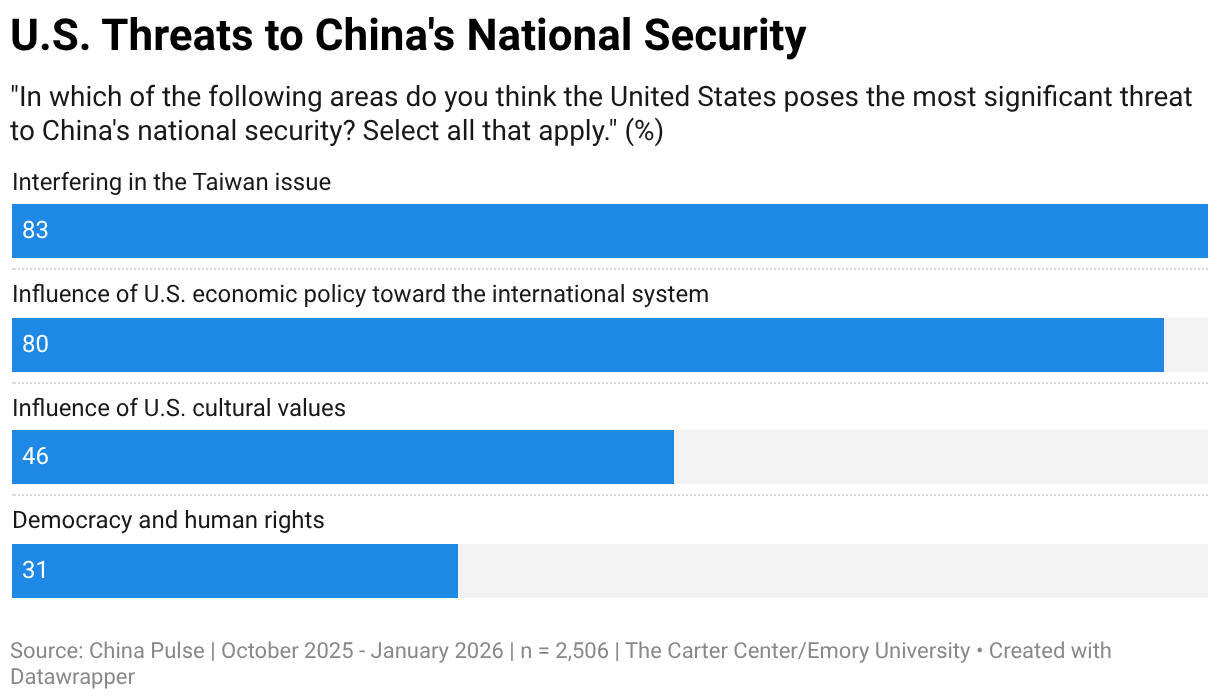
- The most important threats the United States poses to China’s national security in the eyes of the Chinese public are related to Taiwan (83%) and international economics and trade (80%). Only minorities indicated a threat from American cultural (45%) and political (31%) values.
- Despite negative sentiment toward the United States, most Chinese believe the United States and China have common interests in international economics and trade (75%), global security (71%), technological innovation (68%), and public health (53%).
- In a break with the past, where people-to-people exchanges received broad support, only 29 percent of the Chinese public believes the United States and China have common interests in education.
- Concerning recent changes and threats to visas for Chinese studying and working in America, a plurality (40%) of the Chinese public believes their government should match the U.S. approach and begin restricting Americans living in China.
A Decade of Degradation
U.S.-China relations began to degrade in the 2010s with the Obama administration’s Trans-Pacific Partnership, seen by its critics as an attempt to halt China’s economic rise and maintain U.S. power in the Pacific. Relations continued to sour under the first Trump administration, first through trade disputes and then in response to COVID-19. This was the era of “wolf warrior diplomacy” when Chinese diplomats adopted assertive postures both online and in meetings with foreign counterparts. The Biden administration attempted to balance competition and diplomacy. However, the Biden administration maintained his predecessor’s tariffs, increasing them on certain products and issuing export controls on advanced chips. The second Trump administration reignited the trade war from the late 2010s within weeks of taking office. Although there were several trade meetings in 2025, relations have remained difficult in ways that have extended beyond trade to university student enrollment and safety, the AI race, and escalating threat of conflict over Taiwan.
This survey finds Chinese feeling toward the United States fell in the latter half of 2025 from 37 to 34 out of 100. This is consistent with results from a Chicago Council on Global Affairs-The Carter Center poll published in September 2025, which found 83 percent of Chinese said the United States was not friendly. Tsinghua University’s Center for International Security and Strategy reported in 2025 that Chinese favorability toward the United States was at a recent high of 2.38 out of 5, still less than 50 percent. In a 2024 poll by The Carter Center and Emory University, Chinese favorability toward the United States was 23.5 percent. Research by the Eurasia Group found Chinese favorability toward the United States at 39 percent in 2020. This survey shows that current Chinese public feeling toward the United States is unfavorable across all demographics.
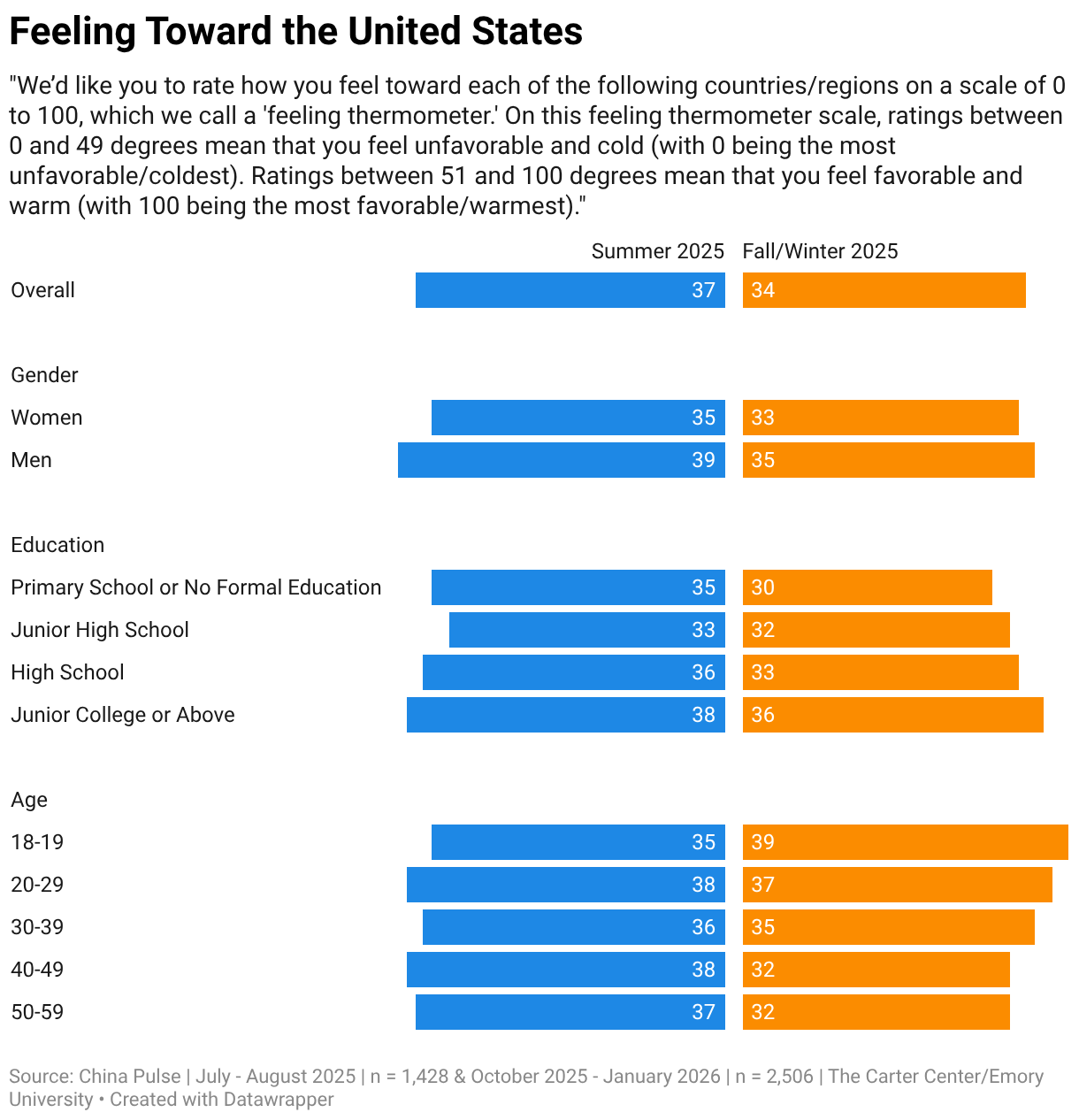
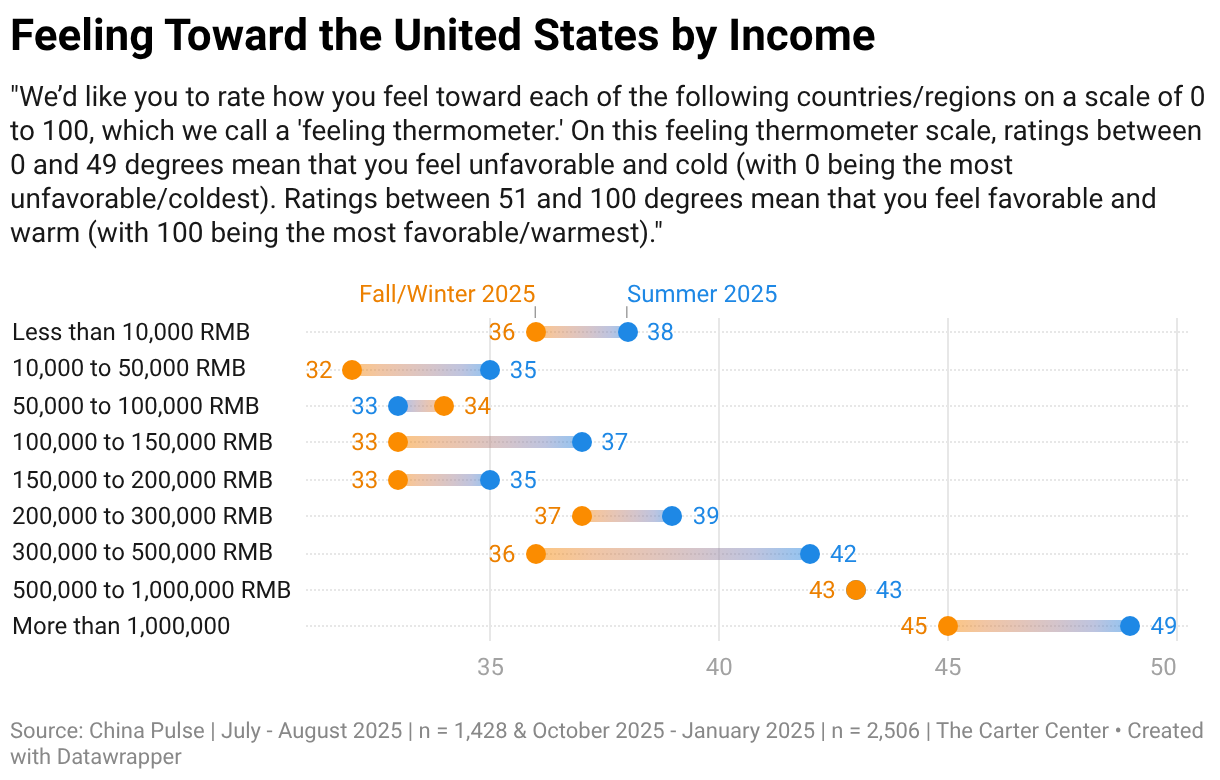
In the most recent data, feeling toward the United States appears to increase with educational attainment and decrease with age. Perhaps the most striking pattern, however, is income. The average feeling for Chinese earning an annual income of 200,000 RMB and above in the summer of 2025 was 43 out of 100, well above the average of 37. In the most recent data, this figure fell to 40, still higher than the overall average of 37 and higher than the average of those earning less than 200,000 RMB annually (34).
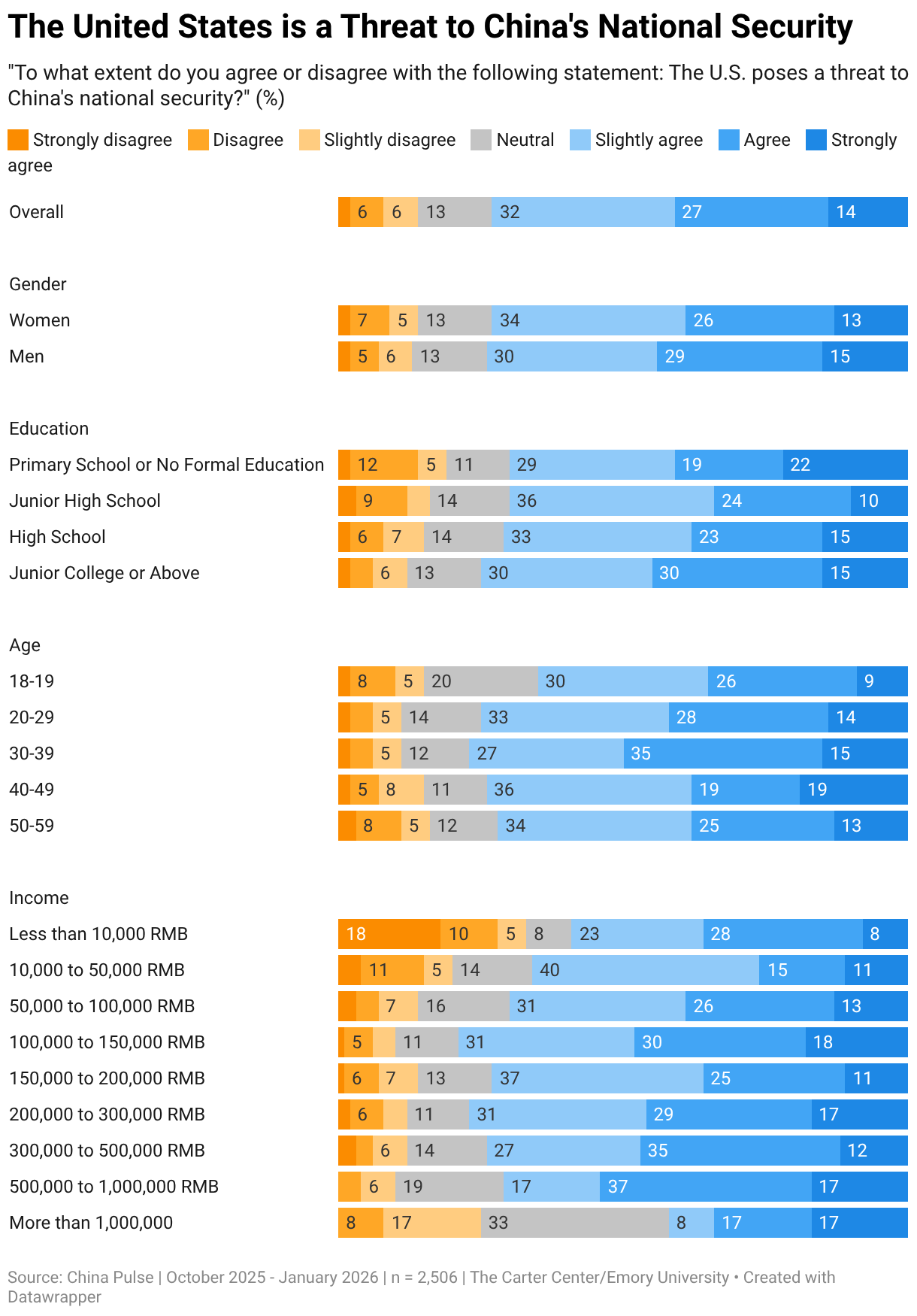
As favorability toward the United States has fallen, the perception that the United States is a threat has risen. In the summer of 2025, 61 percent of Chinese agreed that the United States is a threat to China’s national security (20% disagreed). In the fall and winter of 2025, 73 percent agreed that the United States was a national security threat (14% disagreed).
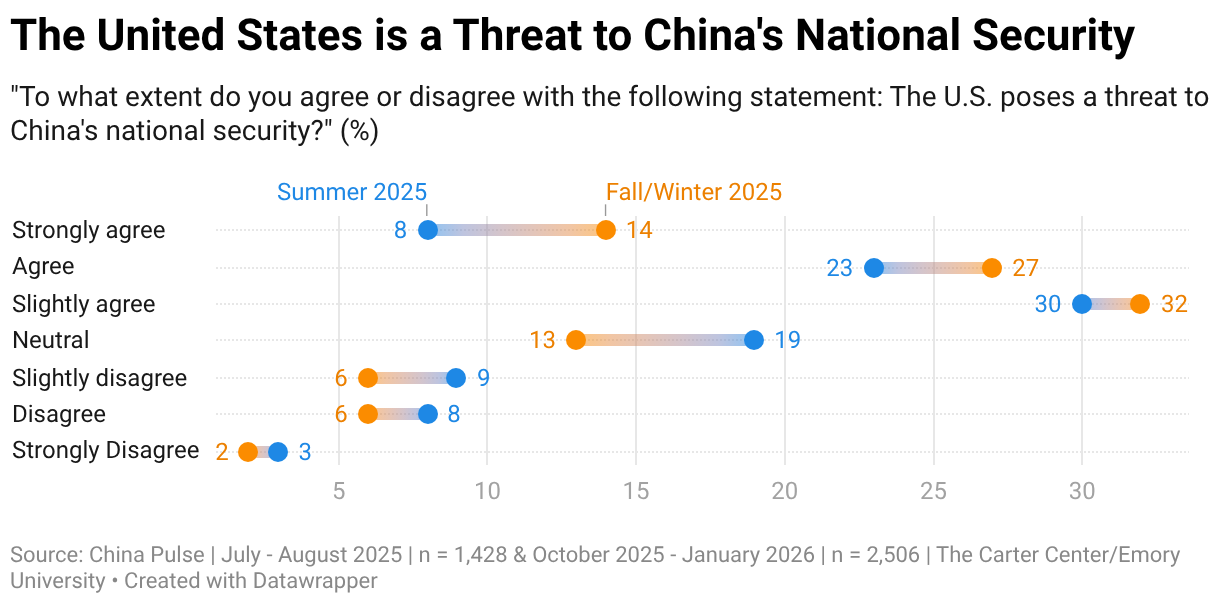
This finding holds true across all demographics. Women and men agree the United States is a threat at near equal rates (73% vs. 74%, respectively) while this perception appears to increase slightly with educational attainment (75% agreement among the best educated). Only among the wealthiest, a small subset of the total survey, does a minority (42%) regard the United States as a threat.
Most See the United States as a Geopolitical and Economic Threat
The dominant perceived threats are unsurprising given debates in U.S.-China relations on both sides. Although the Chinese public is ambivalent on the use of force against Taiwan, both Beijing and Washington have recently participated in escalation toward a potential military conflict through military exercises and arms sales, respectively Most believe the United States is a threat regarding its position on Taiwan (83%) (see our full report on Chinese public opinion on Taiwan here). A major feature of the current U.S.-China rivalry is control over supply chains and geoeconomic borders for advanced chip technology. Most Chinese believe the international economic influence of the United States is a threat (80%). Few among the Chinese public are concerned about U.S. cultural influence (46%), and even fewer are concerned about the influence of political values like democracy and human rights (31%). These figures only include respondents who agreed the United States poses a national security threat (see Appendix for more detail).
The Chinese Public Still Sees Potential for Cooperation
Despite broad agreement that the United States is a threat to China, this survey finds that the Chinese public still sees many areas of mutual interest between the two countries. The interests with the highest agreement are also the most central to U.S.-China rivalry, including trade (75%), global security (71%), and technological innovation (68%). A small majority also identified public health as a mutual interest (53%). Given the recent history of COVID-19 and the rapid aging of both the United States and China, these respondents may well be correct. Thearea least identified as a mutual interest was education (29%). American students have been slow to return to China after COVID-19, and Chinese students and faculty in America have had their visas and jobs threatened in recent years. These results are consistent with the current authors’ finding in 2024 that 70 percent of the Chinese public believe peaceful and friendly U.S.-China relations were necessary for China’s continued prosperity regardless of low U.S. favorability (see Appendix for more detail).

Support for Visa Retaliation
Chinese students studying in American universities make up roughly 25% of all overseas students. This was the largest single national population of students studying in America until the Chinese population was surpassed by students from India (29%) in 2024. Since the normalization of U.S.-China relations in 1979, Chinese students studying at American universities has been an important pillar of people-to-people exchange. Threats from Washington regarding the visa status of Chinese students are, therefore, a major concern for many in China and for the long-term stability of U.S.-China relations. A plurality of the Chinese public prefers for Beijing to match Washington’s visa policies and restrict U.S. workers and students living in China (40%). A smaller minority (32%) prefer for their government to maintain current immigration policies for Americans, while 28 percent prefer China to change policies to encourage more Americans to work and study in China.

Conclusion
The Chinese public views the United States as a threat with which they nonetheless share mutual interests. Rather than identifying mutual interests that seem from the outset to be more achievable, albeit piecemeal, they identify core axes of U.S.-China rivalry as potential sites of U.S.-China cooperation. This survey finds that while Chinese attitudes toward the United States worsened in the latter half of 2025, the potential to walk back from what some scholars have called the “edge of ruin” remains, at least in terms of what the Chinese public would like to see from its own government. These results also suggest, however, that for the Chinese public to change its opinion on the United States, there are no shortcuts. Issues like Taiwan and trade must be addressed directly by the leaders of both countries and new terms for stability must be established.
Methodology
This study employs a repeated cross-sectional design, conducted in collaboration with a China-based survey company maintaining a large respondent panel. We initiated the research with a pilot wave (N=1,428) in July and August 2025 to refine question wording and validate internal logic. The results were treated as preliminary validation for the main study.
The core findings derive from the first official wave, which surveyed 2,506 Chinese adults between October 27, 2025, and January 1, 2026. Utilizing quota sampling, the demographic profile matches China’s population on key variables, including age, gender, and geographic distribution across the North, East, Southwest, Northeast, South Central, and Northwest regions. The 50-question survey yielded a median completion time of 16.75 minutes.
About the Authors
Nick Zeller is a senior program associate for The Carter Center’s China Focus and editor of the English-language U.S.-China Perception Monitor website. Prior to joining the Carter Center, Nick was a Visiting Assistant Professor of World History in Kennesaw State University’s Department of History and Philosophy, Visiting Assistant Professor of Asian History in the University of South Carolina’s Department of History, and an NSEP Boren Fellow at Tsinghua University in Beijing. He received his Ph.D. in modern Chinese history from the University of Wisconsin-Madison.
Renard Sexton is a political scientist who studies conflict and development, particularly in Asia and Latin America. His research combines quantitative methods, fieldwork, and experiments, and has been published in top academic journals, policy forums and public outlets. From 2022 to 2023 he served as a senior advisor in the China/Taiwan unit at US Indo-Pacific Command through a Council on Foreign Relations (CFR) fellowship. He is currently Associate Professor of Political Science at Emory University, and the director of the Security and Conflict Lab.
Yawei Liu is the Senior Advisor on China at The Carter Center and an adjunct professor of political science at Emory University. An expert on U.S.-China relations and Chinese grassroots democracy, he is a member of the Council on Foreign Relations and the associate director of the China Research Center in Atlanta. He is regularly invited to speak about Chinese public opinion, and his previous engagements include the Center for Strategic and International Studies, the Brookings Institution, the Ukrainian National Academy of Sciences, and the Institute for China-America Studies.
About The Carter Center
Waging Peace. Fighting Disease. Building Hope.
A not-for-profit, nongovernmental organization, The Carter Center has helped to improve life for people in over 80 countries by resolving conflicts; advancing democracy, human rights, and economic opportunity; preventing diseases; and improving mental health care. The Carter Center was founded in 1982 by former U.S. President Jimmy Carter and former First Lady Rosalynn Carter, in partnership with Emory University, to advance peace and health worldwide.
About The Carter Center’s China Focus
The Carter Center is an independent, nonpartisan organization. Through its China Focus initiative, the Center seeks to improve the U.S.-China relationship through a thoughtful assessment of the international records of both countries. We convene leading Chinese and American policy professionals and academics, conduct pioneering research in Chinese public opinion, support next generation foreign policy experts, and publish research-backed opinion. Our goal is to contribute to lasting international peace between the world’s two largest powers, which is the foundation for solving the biggest problems facing humanity today.
About Emory University’s Department of Political Science
The intellectual mission of the Department of Political Science is twofold. First, we seek to engage in knowledge-building through rigorous theoretical and empirical research that enables us to address urgent contemporary political challenges related to democratic institutions and governance, identity and difference, inequality, and political violence. Second, we aim to train students who will become the next generation of scholars and practitioners through the skills we impart to them both in and outside of our classrooms. The rise of political polarization and populism in the United States and other countries make clear that democratic governance cannot be taken for granted. Global crises such as the COVID pandemic and climate change also demonstrate the need for solutions that are not only scientifically correct, but also politically feasible. More than ever, a greater understanding of the incentives and behavior shaping political life is necessary.
Appendix A: The United States is a National Security Threat to China (All Demographics)

Appendix B: Strongest U.S.-China Mutual Interests (All Demographics)

Appendix C: Weakest U.S.-China Mutual Interests (All Demographics)